
Why Corpshore is becoming the BPO partner of choice for enterprise CX


At a glance
- Enterprise CX is one of the most demanding operational challenges a global business faces.
- Most BPO providers can handle volume. Fewer can handle multilingual, omnichannel CX at enterprise scale without quality deteriorating.
- Corpshore Solutions is built specifically for enterprise CX delivery, with multilingual capability as a core differentiator.
- Companies choosing Corpshore are doing so for consistency, language coverage, and measurable CX outcomes.
Enterprise CX sits at the intersection of brand reputation and operational complexity. Customers interact across more channels, in more languages, with higher expectations than they had five years ago.
A BPO provider that works well for a mid-size domestic business often starts to show its limits when an enterprise scales. Language coverage falls away, quality becomes inconsistent across markets, and account management is handled by whoever is available rather than someone who knows the business.
Companies that are leaders of CX achieved more than double the revenue growth of ‘CX laggards’ between 2016 and 2021. The consequences of getting enterprise CX delivery wrong are not just operational. They are commercial.
Corpshore Solutions is built for the enterprise end of that spectrum, and this article covers what enterprise CX actually requires and why Corpshore is gaining ground as a preferred partner.
What enterprise CX actually demands from a BPO partner
Enterprise CX is not simply a larger version of SMB customer service. The requirements are qualitatively different.
A global enterprise needs coverage across languages, not just the primary one.
It needs consistent quality standards across every channel and every market. It needs account management that matches the complexity of the relationship.
And it needs a partner that can absorb growth, enter new markets, and adapt to shifting requirements without the client having to start over with a new provider every few years.
Most BPO providers are not built for this. Many are built for volume. Volume and enterprise CX are not the same thing.
Where most BPO providers fall short on enterprise CX
Here is where other providers fail:
Limited language capability
A provider that genuinely supports three or four languages is a liability for a brand operating across ten markets. When language coverage gaps emerge, customer experience degrades in those markets.
Response times lengthen, customers get transferred more often, and satisfaction scores drop in ways that are difficult to attribute but very real in their commercial impact.
Quality inconsistency as headcount scales
Quality control in BPO is harder to maintain at enterprise headcount.
High agent turnover, inconsistent training across locations, and outdated QA frameworks undermine service consistency. Consequently, the quality delivered to the client varies significantly depending on which agent handles the interaction.
At enterprise scale, that variability compounds.
Inflexible delivery models
Enterprise requirements change. A new market launch, a product line addition, or a regulatory shift can require rapid changes to how support is structured.
Providers with rigid delivery models create friction in exactly those moments, leaving the client to manage around the limitations rather than working with a partner capable of adapting.
What separates a strong enterprise CX BPO from the rest
So what makes a better enterprise CX BPO?
1. True multilingual capability
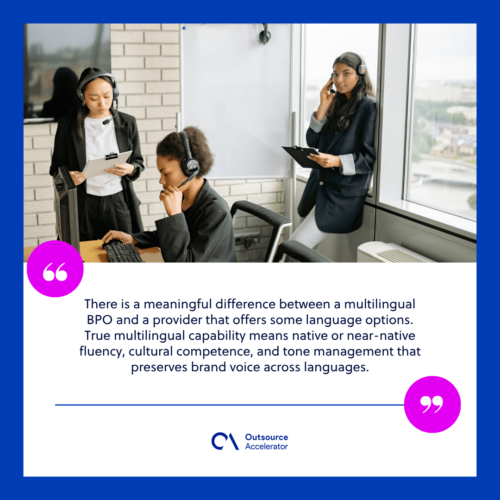
There is a meaningful difference between a multilingual BPO and a provider that offers some language options. True multilingual capability means native or near-native fluency, cultural competence, and tone management that preserves brand voice across languages.
Translated scripts and bilingual agents handling multiple languages at reduced quality are not the same thing, and the gap shows in customer satisfaction data.
2. Consistent quality across channels and markets
Forrester’s 2024 US Customer Experience Index recorded a third consecutive year of declining CX quality across US brands. This is a sign of how difficult it is to maintain standards at scale.
The quality framework should apply equally whether a customer contacts via phone, email, chat, or social, and it should apply in every market. Inconsistency here is where brand damage accumulates, quietly and over time, before it becomes visible in churn figures.
3. Structured QA and performance governance
Interaction monitoring, regular CSAT measurement, coaching cycles, and transparent reporting to the client are what separate a managed service from a vendor relationship.
Enterprise clients should expect regular business reviews with detailed performance data, not monthly volume summaries.
4. Scalable delivery without quality trade-offs
The ability to add headcount, enter new markets, or absorb volume increases without compromising customer experience. This requires operational infrastructure, not just a willingness to hire faster.
5. Dedicated account management
An account manager who understands the client’s business, not just their SLAs. Someone who brings recommendations, flags emerging issues, and participates in the client’s operational planning cycle.
| Capability | Standard BPO | Enterprise CX BPO |
|---|---|---|
| Language coverage | 1 to 3 languages | 10+ languages, native fluency |
| QA framework | Basic monitoring | Structured, client-reported QA |
| Scalability | Slow, manual headcount ramp | Flexible, planned capacity model |
| Account management | Generic support desk | Dedicated account team |
| Channel coverage | Phone and email | Omnichannel |
| Reporting | Monthly volume summaries | Real-time dashboards, business reviews |
Why Corpshore Solutions is becoming the enterprise CX partner of choice
Corpshore Solutions has built its offering around the CX complexity that global enterprises actually face: multiple languages, multiple channels, and quality standards that need to hold at scale.
Their multilingual capability is a core part of their delivery model, not an add-on service covering secondary markets at reduced quality.
For enterprises evaluating BPO partners, Corpshore provides the combination of language depth, operational structure, and account management that the standard BPO market does not reliably offer. Their focus on enterprise CX means the infrastructure and governance frameworks are designed for the scale and complexity their clients operate at.
Find out more at corpshore.solutions.
FAQs
What is enterprise CX outsourcing?
Enterprise CX outsourcing involves contracting a BPO provider to manage customer interactions across channels and markets on behalf of a large organisation. This typically covers multiple contact channels, multiple languages, and multiple regions under a single managed service agreement with defined SLAs and governance frameworks.
How many languages does a BPO provider need to support for global enterprise CX?
That depends on the markets the enterprise serves. The relevant question is not how many languages the provider lists, but whether they can deliver genuine quality in the specific languages you need.
Two well-supported languages are worth more than ten languages managed at a lower standard.
How do you measure CX quality when working with a BPO provider?
CSAT scores, first-contact resolution rates, average handling time, and escalation rates are the standard metrics.
The more important question is whether those metrics are reported transparently, reviewed regularly, and tied to meaningful consequences when they fall below agreed thresholds.
What is the typical contract structure for an enterprise BPO engagement?
Enterprise BPO contracts typically run for 2 to 3 years with SLAs defined for each channel and performance metric. Pricing models vary: per-agent, per-interaction, or outcome-based depending on the scope.
Governance structures, including review cadence and escalation procedures, should be defined in the contract rather than left to informal arrangement.
Key takeaways
- Enterprise CX requires more than volume capacity. Multilingual capability and QA rigour at scale are the real differentiators.
- Most standard BPO providers fall short when language coverage and omnichannel consistency are needed across multiple markets.
- Corpshore Solutions is built for enterprise CX delivery, with multilingual capability at its core.
- The right BPO partner improves customer outcomes across markets, not just operational cost efficiency.






 Independent





