
Data mining: definition, advantages, and applications

What does data mining mean for your business?
Data mining is the process of digging through large sets of data to find patterns, trends, and insights that help a business make smarter decisions.
- It turns raw data into clear answers you can act on.
- It supports sales, marketing, risk control, and fraud detection.
- It works best when your data is clean, well organized, and secure.
The idea behind data mining is old. For centuries, people used data to make sense of the world. You can see early examples in regression analysis and in manual formulas for statistics.
Today, tools do the heavy lifting. Businesses now collect huge amounts of data every day. As a result, they use data mining to improve almost every part of their work. It helps them understand the past and present. More importantly, it gives clear clues about what is likely to happen next.
What is data mining?
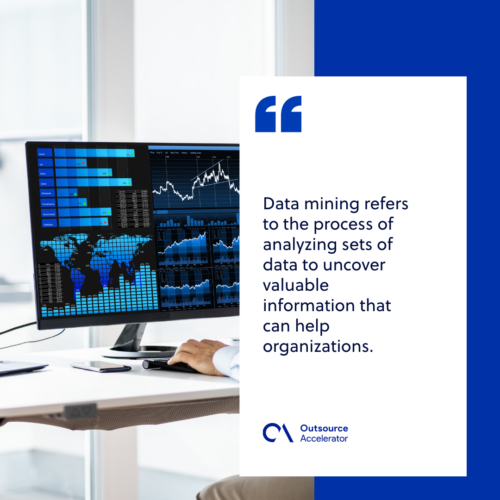
Data mining refers to the process of studying sets of data to find useful information. In turn, that information helps organizations do the following:
- Lower their risks
- Solve problems
- Find new opportunities
Data mining lets teams spot patterns and trends across very large data sets. It also powers tasks like fraud detection, database marketing, and credit risk management. Because of this, many firms pair it with machine learning to find deeper links in the numbers.
The data mining process has five simple steps:
- First, the company gathers sets of data and places them in a data warehouse.
- Next, it stores that data on in-house servers or in cloud storage.
- Then IT specialists, managers, and business analysts review the data and decide how to sort it.
- After that, software organizes the data based on the results the user wants.
- Finally, the end user shows the results in an easy format, such as a graph or a table.
Good results start with good inputs. So a clear data collection strategy matters just as much as the mining itself.
Advantages of data mining
Data mining brings many benefits to a business. Here are three of the clearest ones.
Increased revenue
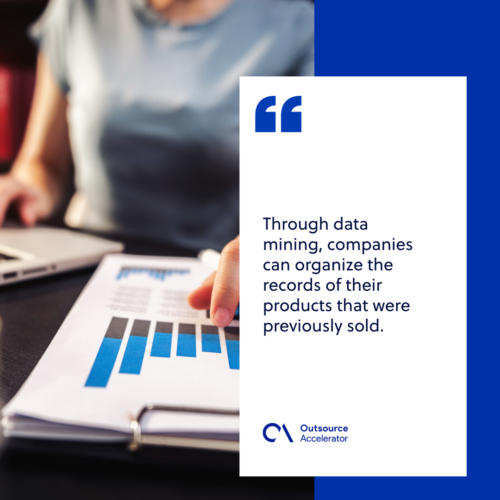
With data mining, companies can review records of past sales. Based on those results, they can build the products people actually want. At the same time, they cut costs they no longer need. As a result, revenue tends to rise.
Customer identification
Customers are not all alike. They differ in habits and behavior. So data mining helps a business see who its real customers are. In turn, the company can shape its offers to attract them.
Marketing strategies
Firms can build data models using different data mining methods. Through these models, they learn which customers want their goods. Because of this, they also spot which products will sell best and bring profit.
These are just a few benefits. Data mining also supports cross-selling and upselling, brand building, and winning new customers. Many teams fold it into their wider data processing services so the work stays consistent. To add more value, they also use data enrichment to fill gaps in each customer record.
Data mining applications
Data mining applies to every sector. In each one, it helps a business stay competitive. Below are three clear examples.
Banking
Banks use data mining to check creditworthiness and catch fraud. It helps them study a customer’s financial data, including card and purchase history. As a result, they understand customer habits better. Because of this, they can plan sharper marketing campaigns.
Retail
Retail stores use data mining to spot buying patterns. So they learn which items to stock and where to place them. They can also see which campaigns earn the most interest. In turn, they spend their budget where it works.
Healthcare
Data mining gives doctors a clear view of patient records. This includes medical history, treatment patterns, and test results. As a result, they can reach a more accurate diagnosis. Still, teams must keep that data safe at every step.
Who runs data mining projects?
Data mining is a team effort. Analysts, engineers, and IT staff all take part. It also helps to know the difference between a data scientist and a data analyst before you hire. Because the data is often sensitive, strong data security in outsourcing should sit at the center of every project.
Fulfill your data mining requirements with 123Employee
With 123Employee, you can hire data mining pros who know computing, analysis, and big data. These experts also handle many types of data mining software. So you get skilled help without building a team from scratch.
Learn more about 123Employee here!
Frequently asked questions about data mining
What is data mining in simple terms?
Data mining is the way a business searches large data sets for useful patterns. It turns raw numbers into clear insights. Then teams use those insights to make better choices about products, customers, and risk.
What is the difference between data mining and data analysis?
Data analysis reviews data to answer a known question. Data mining goes further and hunts for patterns you did not expect. In short, analysis confirms, while mining discovers. Many teams use both together.
Which industries use data mining the most?
Banking, retail, and healthcare are among the heaviest users. Still, almost every sector gains from it. Any business that collects customer or sales data can put data mining to work.
Is data mining the same as machine learning?
No, but they are close cousins. Data mining finds patterns in existing data. Machine learning uses those patterns to make predictions and improve over time. As a result, the two often run side by side.
How do I keep data safe during data mining?
Start with clear access rules so only the right people see sensitive data. Next, encrypt stored records and track who uses them. Finally, work with partners who follow strong data protection standards.






 Independent






