
20 best data masking tools to use in 2026


What are the best data masking tools?
The best data masking tools hide sensitive data with fake but realistic values, so teams can test, share, and analyze data safely while staying compliant.
- Top options include Informatica, Oracle, Delphix, Microsoft Azure, and Salesforce.
- Good tools support many masking methods, such as encryption, tokenization, and anonymization.
- The right pick depends on your data types, scale, and compliance needs.
List of data masking tools
- Informatica Cloud Data Masking
- Oracle Data Masking and Subsetting
- Delphix Data Masking
- Broadcom Test Data Manager
- Microsoft Azure SQL Database
- K2View Data Masking Tools
- Immuta Dynamic Data Masking
- IRI FieldShield
- DATPROF Privacy
- Hush-Hush Data Masking
- Imperva Data Security
- Protegrity Data Security Platform
- Solix Data Masking
- VGS Platform
- BizDataX
- IBM Infosphere Optim Data Privacy
- Data Secure
- Redgate Data Masker
- Mage Data
- Salesforce Data Mask
Data breaches and privacy worries loom large today. So the need for strong data security is easy to see. As a result, data masking has become a key defense to protect sensitive information.
This article explores the top data masking tools on the market now. These tools help safeguard data, meet regulatory standards, and support a secure digital environment. Many firms pair them with wider data security in outsourcing practices.
What is data masking?
Data masking is a technique that protects sensitive data. In short, it replaces, encrypts, or scrambles real data with fake data. It is also called data obfuscation, data anonymization, and data sanitization.
This makes the data unreadable to anyone without access. Still, it keeps the data usable. So the dataset’s overall structure and function stay intact.
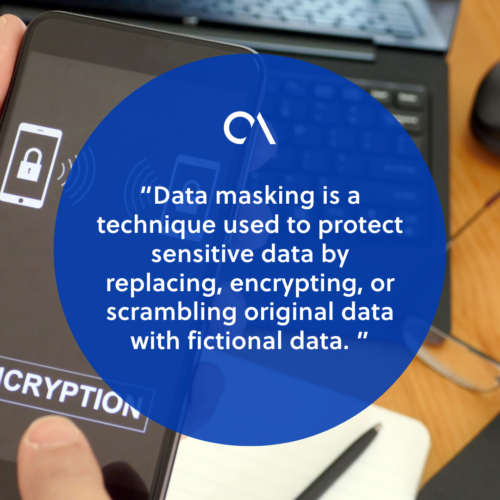
Data masking tools aim to give teams a safe space to work with realistic data. For example, they help with data analysis and software testing.
Data masking can be done in several ways, including:
- Encryption. The encrypted data then needs a secret key to unlock.
- Anonymization. This erases personal details from datasets.
- Tokenization. This swaps sensitive data for non-sensitive stand-ins.
Why is data masking important?
Data masking matters for several reasons. In short, each one helps protect data and keep operations reliable.
Privacy protection
One main reason for data masking is to protect the privacy of people whose data sits in databases. By hiding sensitive details, firms can block unauthorized access. As a result, personal information stays private.
Regulatory compliance
Many industries must follow strict data rules. For example, the General Data Protection Regulation (GDPR) and the Health Insurance Portability and Accountability Act (HIPAA) are two big ones. So data masking tools help firms comply. They do this by cutting the risk of leaks or breaches. Clear cybersecurity frameworks make that job easier.
Development and testing security
In development and testing, teams often need realistic data. However, using real production data poses a big risk. So data masking tools let firms build realistic test datasets. As a result, they keep both security and function.
Risk mitigation
Data breaches can bring severe financial, legal, and reputational harm. So by using data masking, firms cut the risk of a breach. In turn, this limits the damage from any unauthorized access.
Third-party collaboration
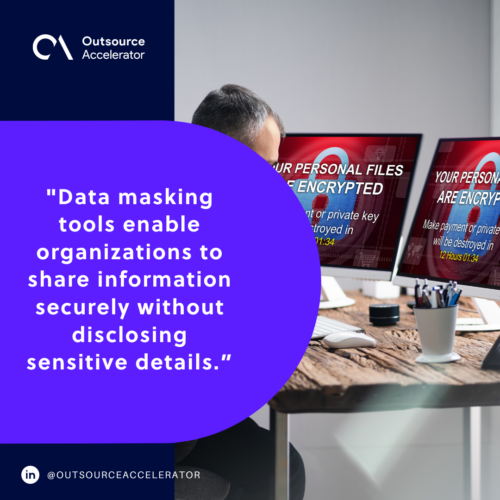
Sharing data is often needed when working with third parties. So data masking tools let firms share information safely, without exposing sensitive details. As a result, these tools support teamwork while keeping data private.
Employee training
Sometimes staff need access to real data for training. So data masking lets firms build realistic training setups. As a result, they train people without exposing real sensitive data.
Customer trust
Showing care for data security helps build trust with customers. When people know their data is safe, they trust the brand more. Because of this, a good masking practice can boost your reputation.
Top 20 data masking tools in 2026
Take a look at the top data masking tools for 2026.
1. Informatica Cloud Data Masking
Informatica offers a full data masking tool. In short, it protects sensitive data while keeping it useful. It uses advanced methods, including dynamic data masking. It also supports substitution, shuffling, and encryption. So it stays flexible for many needs. With a focus on data consistency, it keeps masked data usable for testing and analysis.
2. Oracle Data Masking and Subsetting
Oracle’s tool helps firms provision data safely and at low cost. For example, it suits test, development, and partner environments. It is tuned for the Oracle Database. So it includes sensitive data discovery, data subsetting, and flexible deployment options.
3. Delphix Data Masking
Delphix finds and masks sensitive data on its own. Its profiling can detect private data across many sources, such as files and relational databases. It also provides over 50 out-of-the-box profile sets that cover 30 types of sensitive data. Best of all, you do not need to program, though you can customize or define your own algorithms.
4. Broadcom Test Data Manager
Broadcom’s Test Data Manager tackles the challenge of securing test data. So it has features to keep sensitive data private during testing. It supports many masking methods, including substitution and encryption. As a result, it handles large datasets with ease.
5. Microsoft Azure SQL Database
Azure’s dynamic data masking limits how much sensitive data non-privileged users can see. So it blocks unauthorized access without changing the underlying database. It works within the Microsoft Azure ecosystem. Microsoft also gives an Azure portal to set the policy, so users can define masked fields, functions, and authorized users.
6. K2View Data Masking Tools
K2View anonymizes sensitive data at enterprise scale. So it supports compliant software testing, data analytics, and B2B data sharing. It also enables full automation by fitting masking into CI/CD pipelines. As a result, rollouts are quick and can run on-premises or in the cloud.
7. Immuta Dynamic Data Masking
Immuta offers data masking as part of its data security platform. So it protects sensitive data by hiding values without changing the underlying data. Its dynamic masking adds security and privacy controls at query runtime. As a result, firms get more value from their data without losing security. It also fits many platforms and use cases across industries.
8. IRI FieldShield
Innovative Routines International (IRI) focuses on data management. Its FieldShield tool helps firms protect sensitive data with many masking methods. FieldShield is part of the IRI Data Protector Suite, which offers a full set of data protection and privacy tools.
9. DATPROF Privacy
DATPROF Privacy handles data masking and synthetic data generation. So it protects sensitive data while giving realistic test data for development and testing. It also keeps high speeds even with large databases. The company provides global support, and the tool sees use across many industries.
10. Hush-Hush Data Masking
Hush-Hush focuses on data protection and offers its own masking tool. So it lets users discover and mask sensitive data and stay compliant. Users can pick from many algorithms for anonymization. As a result, it fits outsourcing, testing, development, training, and third-party integration.
11. Imperva Data Security
Imperva’s solution protects sensitive data with full visibility and control. So it aims to prevent breaches and keep firms compliant. The platform is built for hybrid and multi-cloud setups. It also extends data discovery, classification, and protection to managed database services in AWS and Azure.
12. Protegrity Data Security Platform
Protegrity’s tool is part of its Data Protection Platform. So it offers central policy audit logging and monitoring. It fine-tunes protection at the field level, based on sensitivity and use. As a result, firms manage policy centrally while applying protection locally. It also supports third-party products and environments.
13. Solix Data Masking
Solix secures sensitive data in non-production environments. It is part of the Solix Data Management Solutions line. So it discovers sensitive data at scale, then masks it to keep it safe. It also supports popular databases, such as Oracle, MySQL, and Teradata.
14. VGS Platform
Very Good Security (VGS) offers a platform that goes beyond basic masking. So it takes an innovative approach with a robust suite of security and privacy tools. It supports tokenization and encryption. As a result, it helps businesses meet data protection rules and industry standards.
15. BizDataX
BizDataX specializes in managing test data and meeting GDPR rules. So it offers anonymization, discovery, and subsetting. One key feature is finding sensitive user data in databases, even in large or legacy systems. By checking data across systems, firms learn where sensitive data lives.
16. IBM Infosphere Optim Data Privacy
IBM InfoSphere Optim Data Privacy hides sensitive data across apps, databases, and operating systems. So its main goal is to protect data in non-production environments. It offers many transformation methods to swap real data for realistic masked data. As a result, it keeps the context of the original data intact.
17. Data Secure
Data Secure meets the need to secure sensitive information within firms. So it offers a range of features to protect data at different stages of its life. It also keeps data consistent and preserves the links between data elements. Moreover, it is easy to use and simple to fit into existing processes.
18. Redgate Data Masker
Redgate’s Data Masker is built for SQL Server and Oracle databases. So it swaps sensitive data for anonymized test data. As a result, it keeps data private while preserving realism. It also gives consistent masked data for accurate testing. Best of all, it runs fast and efficiently.
19. Mage Data
Mage Data is a data security platform built for enterprises. So it offers many features to tackle sensitive data challenges. For example, firms can identify sensitive data, mask it, monitor database activity, and stay compliant.
20. Salesforce Data Mask
Salesforce Data Mask protects sensitive data during testing and keeps firms compliant. So it swaps sensitive data for dummy values in test environments. One key advantage is its native approach. As a result, all data stays inside Salesforce, with no external code or API calls. It also offers demos, datasheets, and a trial.
How to choose the best data masking tools
Picking the best data masking tool takes care. So weigh several factors first. Here are the key points to guide your choice.
Data masking techniques
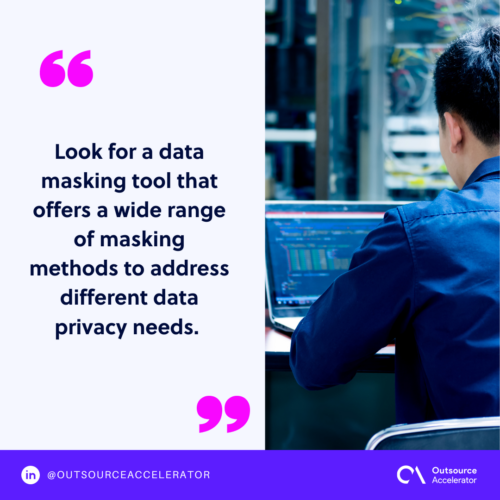
First, check the masking methods the tool supports. Look for a tool with a wide range of methods to fit different privacy needs. Also check for dynamic data masking, which masks data in real time based on user roles. This matters most for live transactions.
Comprehensive data coverage
Next, consider the data types the tool can mask, such as:
- Structured and unstructured data
- Databases
- Files
- Cloud storage
- Personally identifiable information
- Financial data
So make sure the tool handles the data sources and formats your firm uses. If you rely on cloud systems, strong cloud security should be part of the plan.
Usability and scalability
Then check how easy the tool is to use and scale. Look for an intuitive interface and flexible deployment options. Also consider how well it handles large data volumes and future growth.
Security features
Data masking tools should put security first. So review each tool’s security features. This helps ensure your sensitive data stays well protected. Strong cybersecurity best practices should back up any tool you pick.
Data integrity and consistency
Also check that the tool keeps masked data consistent. It should keep the key traits of the data while hiding it from unauthorized users.
Support and documentation
Finally, weigh the vendor’s support and documentation. Good support means issues get fixed fast. Clear documentation also aids setup and daily use. As you weigh these factors and your own needs, you can pick a tool that fits your data security goals.
Frequently asked questions about data masking tools
What are data masking tools used for?
Data masking tools hide sensitive data with fake but realistic values. So teams can test, share, and analyze data safely. As a result, they protect privacy and support compliance.
What is the difference between data masking and encryption?
Encryption scrambles data and needs a key to unlock it. Data masking swaps real data for fake data that stays usable. So masking suits testing and sharing, while encryption suits secure storage and transfer.
Are data masking tools required for compliance?
Many rules, such as GDPR and HIPAA, demand strong data protection. Data masking is a proven way to meet those needs. Because of this, many firms treat it as a core control.
What is dynamic data masking?
Dynamic data masking hides data in real time based on user roles. So a user sees only the data they are allowed to see. This helps protect data during live use.
How do I choose the right data masking tool?
First, match the tool to your data types and scale. Next, check the masking methods and security features. Finally, weigh ease of use, support, and how well it fits your systems. Firms new to this often review AI privacy and security trends first.
Key takeaways
- Data masking tools hide sensitive data with fake but realistic values.
- They support safe testing, sharing, and analysis while keeping firms compliant.
- Top tools include Informatica, Oracle, Delphix, Microsoft Azure, and Salesforce.
- Good tools offer many methods, such as encryption, tokenization, and anonymization.
- The right pick depends on your data types, scale, security needs, and vendor support.






 Independent





