
What are the benefits of a customer service callback?


What are the benefits of a customer service callback?
A customer service callback lets customers skip the hold queue and get a return call, which cuts wait times, lifts satisfaction, and boosts sales.
- It removes the frustration of long holds.
- It raises first-contact resolution and conversion rates.
- It eases pressure on your call center during peak times.
Customer service is a core part of any company. Without it, people would struggle to find answers about the products they buy. However, many people avoid calling support. After all, there is a real fear of wasting time on hold.
A study by Mindful found that customers accept a wait of about 5 minutes for phone calls and 15 minutes for virtual calls. Anything longer breeds indifference. So a customer service callback option can fix this problem fast.
What is a customer service callback?
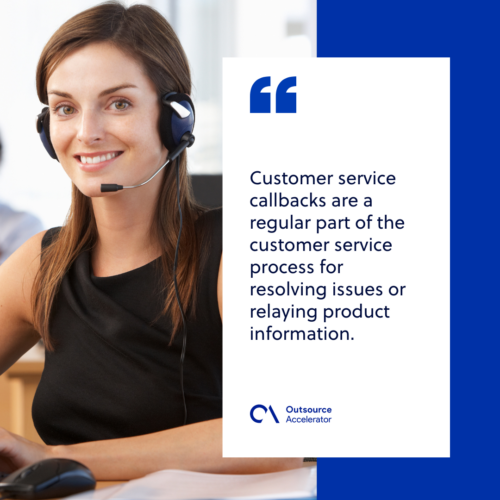
A customer service callback is a return call from a representative (CSR) to a customer. Its goal is to solve an issue or share product details. In short, it replaces the hold queue with a scheduled call.
Callbacks are a regular part of the support process. Most often, the customer starts one. For example, they may visit the company website and ask for a call out of interest.
Firms usually pair a callback with email or live chat. So businesses can offer better help through direct interaction. In this way, they guide the customer instead of leaving them alone online.
Why do customer service callbacks occur?
Here are five common reasons a customer service callback might happen:
- A customer needs more details before they order a product.
- A customer has a question about a product they already bought.
- A customer placed an order but wants to cancel it. So the CSR may try to change their mind.
- A customer is unhappy and wants a return or refund. In that case, the CSR may help solve the problem instead.
- A customer has questions about billing.
Benefits of a customer service callback function
Despite the name, a customer service callback can help your company a lot. So here are the major benefits of adding a callback function.
Increased first-contact resolution rates
First-contact resolution (FCR) counts tickets solved on the first contact. A ticket that is not solved then is called a no-show. Sadly, no-shows hurt your reputation. In addition, you lose money when customers feel ignored. However, a callback lets you prepare better and solve issues faster. To track this well, watch these call center metrics.
Higher conversion rates
A callback gives you a chance to boost sales. For example, a CSR can share more product details on the call. As a result, a customer is more likely to buy than after just reading a website.
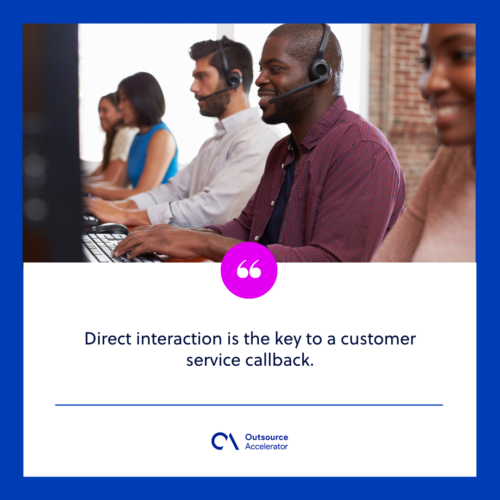
Direct interaction is the key here. So a CSR can ask what interests the prospect and answer on the spot. In turn, that personal touch often seals the deal.
Reduced abandonment rates
In 2022, the IRS tested a callback system for taxpayer questions. According to the agency, the trial saved 1.7 million hours of hold time in total.
When customers sit on hold, they get frustrated fast. So many hang up before anyone answers. In turn, that means lost sales and bad reviews. However, a callback removes this problem. It also assures customers that someone is on their case.
More productive agents
A callback option lets agents solve issues faster. So they reach customers at the right moment. As a result, this cuts handoffs and keeps service steady. In addition, agents spend less time on hold, so they can focus on other tasks.
Smoother peak times
A callback function eases pressure during busy periods. So your staff are not swamped by calls all at once. In turn, they can answer each query more fully. In addition, a callback at a quiet time cuts customer wait time. This kind of balance is central to strong call center optimization.
Decreased operational costs
Call centers often face a flood of calls from upset customers. As a result, they record long waits, low efficiency, and lost revenue. However, a callback spreads calls out over time. So you answer concerns faster without tying up every resource. This also helps you meet your call center service level targets.
Improved customer experience
Finally, a callback option improves your customer experience. You explain the product better and solve problems in real time. As a result, customers feel heard and valued.
These days, unhappy customers often leave bad reviews online. So it helps to address concerns during a callback before they grow. In short, a callback on your contact page is a great way to attend to clients and show a user-friendly brand. Over time, that care also lifts customer retention.
Frequently asked questions
What is a customer service callback?
It is a return call from a support agent to a customer. Instead of waiting on hold, the customer gets a call back at a set time.
How does a callback reduce wait times?
A callback holds the customer’s place in line for them. So they hang up and get a call when an agent is free. As a result, no one wastes time on hold.
Does a callback option cost more to run?
No. In fact, it often lowers costs. It spreads calls over time, so agents work more efficiently during peak hours.
Which businesses benefit most from callbacks?
Any firm with high call volume gains the most. For example, call centers, retailers, and billing teams all see fewer dropped calls.
Key takeaways
- A customer service callback replaces the hold queue with a scheduled return call.
- It cuts wait times and lowers call abandonment rates.
- It lifts first-contact resolution, conversions, and agent productivity.
- It eases pressure on your call center during peak times.
- Over time, it improves customer experience and retention.






 Independent





