
CSAT vs. NPS: Ultimate guide to differentiate one from the other


What is the difference between CSAT and NPS?
CSAT measures short-term happiness after a single interaction, while NPS measures long-term loyalty and how likely customers are to recommend your brand.
- First, CSAT rates one moment, such as a support chat or a purchase.
- Next, NPS rates the whole relationship and referral intent.
- Finally, the two work best together, not as rivals.
Surveys help you read the pulse of the masses. For example, they reveal shifting preferences and the reasons behind them.
The analysis and insights from regular surveys guide the strategic moves of a business. So they help companies scale and rework any weak business models.
The most common surveys are customer satisfaction (CSAT) and net promoter score (NPS). Both try to gauge consumer happiness. In addition, both pinpoint the causes behind it.
These surveys mix rated and open-ended questions. The goal is to capture clear evidence quantitatively and qualitatively.
Both tools measure customer happiness. Still, each has a specific purpose. So this article explains CSAT vs. NPS differences, similarities, and functions.

What are CSAT and NPS scores for?
Winning a project or a sale is not the end of the deal. Instead, it is just the start of the customer journey.
Many factors shape how clients see a brand. Sometimes it is the product itself. More often, however, it is how the company treats the customer.
These perceptions can make or break a brand. For example, a negative view means lower income and a weak reputation. A positive view, by contrast, earns loyalty and brand success. Strong customer loyalty often starts with these everyday impressions.
CSAT and NPS are tools to manage these perceptions. So the data from these surveys feeds new campaigns, product upgrades, and process fixes.
Once new strategies launch, another round of checks follows. As a result, CSAT and NPS form part of a cycle that keeps improving the customer experience.
Comparing CSAT vs. NPS
CSAT and NPS are both survey tools. Still, they differ in use and purpose.
The main difference is simple. CSAT measures short-term happiness. NPS, meanwhile, looks at overall satisfaction and customer loyalty.
Other differences between CSAT and NPS are below.
Methodologies
CSAT
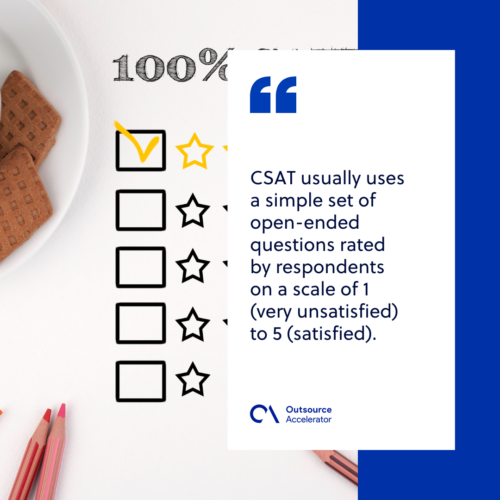
CSAT usually uses a simple set of questions. Respondents rate them on a scale of 1 (very unsatisfied) to 5 (satisfied).
The average CSAT score falls into three groups: high, neutral, and low. For example, a high score means customers are delighted. A neutral score shows indifference, so some aspects need work. A low score, by contrast, signals urgency for management to fix clear flaws.
CSAT questions assess any meaningful touchpoint with a brand. For instance, they cover a completed transaction, a renewed subscription, or product performance.
NPS
NPS, on the other hand, looks at referral intent. In short, it measures how likely customers are to recommend the brand to others.
NPS uses a scale of 0 (most unlikely to endorse) to 10 (highly likely to endorse). So this scale is the main measure for scoring an NPS survey.
The average NPS score falls into these types:
- Promoters. These customers picked 9 and 10. They are loyal, happy, and satisfied with the service and products.
- Passives. Passives picked 7 to 8. They are indifferent, so they may switch to a rival offering the same service.
- Detractors. These customers picked 0 to 6. Some are unhappy and can hurt the brand’s reputation. As a result, reaching out to them is key to winning back trust.
NPS
Timing of use
CSAT is ideal for short-term checks. So you should run it right after key moments in the customer journey.
Some of these milestones are:
- Resolving an issue: to evaluate the support team’s capabilities.
- Finishing a trial period: to assess the usability of the products.
- Closing a sale: to identify pain points or issues.
NPS, meanwhile, is ideal for long-term checks. In most cases, it comes after major events such as:
- Failed service: this helps measure if the company’s image improved after it.
- Changes in subscription: customers get a better feel for product and service quality against competitors.
Which works as the best metric?
Both tools improve customer experience and service quality. Still, CSAT and NPS measure different things.
Even so, they complement one another. So trying to crown one as the better metric is misguided.
The best metric depends on your purpose, goal, and timing. Together, however, the data helps you quantify and qualify how to improve the overall experience. For example, tracking both can flag early signs of customer churn before it spreads.
After all, the main goal of both metrics is the same. Companies must turn these insights into action: that is what matters. A steady voice of the customer program keeps that loop alive.
Frequently Asked Questions (FAQs)
This section answers common questions about CSAT vs. NPS.
What is a good CSAT score?
A good CSAT score depends on your industry. In general, however, a score above 80% is strong. So it is best to track your own trend over time, not just one number.
What counts as a good NPS score?
NPS ranges from -100 to +100. In most industries, a score above 0 is fine, and above 50 is excellent. Still, benchmarks vary, so compare against rivals in your sector.
Should I use CSAT or NPS?
Use both when you can. For example, use CSAT right after a support chat or sale. Then use NPS to track loyalty across the whole relationship.
How often should I run these surveys?
Run CSAT after key touchpoints, so feedback stays fresh. Run NPS on a set cycle, such as each quarter. As a result, you catch both quick wins and long-term trends. Pairing them is also a simple way of measuring customer satisfaction at every stage.






 Independent






