
Rethinking AI usage in the workplace: From hype to execution


What does real AI usage in the workplace look like?
Real AI usage in the workplace means moving past hype and building AI into everyday work, so it delivers measurable results instead of just headlines.
In short, the gap between talk and action is wide:
- Most people say they use AI, but few use it for much of their day.
- The winners focus on execution, not experiments.
- Success depends on culture, training, and clear use cases.
Artificial intelligence is one of the most talked-about technologies at work. Every day brings a new tool and a new promise of change. But when it comes to real AI usage in the workplace, talk and action often differ.
The 546th episode of the Outsource Accelerator Podcast featured Alex Schutte, SVP of Marketing at Hubstaff. According to Alex, “85% of people say they use AI, but in our time tracking data, it makes up only 4% of their actual work time.”
That gap between what people say and what they do is telling. It points to a bigger issue. Many organizations are caught up in the hype, yet they have not figured out how to weave AI into daily work.
So to move past buzzwords, businesses must rethink how they approach AI adoption. First, they must put execution ahead of experiments. Next, they must align strategy with real use cases. This article unpacks why firms keep embracing AI. It also charts a path to AI usage that truly delivers.
Why businesses are embracing AI
The excitement over AI is not baseless. Companies are drawn to the potential of AI to solve old problems. For example, it tackles inefficiency, high labor costs, and data overload. In short, AI promises to do things faster and smarter.
Adoption keeps climbing too. In fact, McKinsey’s State of AI survey found that 88% of organizations now use AI in at least one business function. So the question is no longer whether to use AI. Instead, it is how to use it well.
Business leaders see AI usage as a path to:
- Competitive edge: Firms that use AI well often outpace rivals with better efficiency, faster decisions, and sharper customer experience.
- Efficiency and productivity: AI automates repetitive tasks and frees people for strategic work. So teams finally do more with less.
- Better decisions: AI processes huge datasets at speed. As a result, it surfaces deeper insights than manual review.
As Alex Schutte puts it, “The future belongs to firms that can innovate on outcomes. Whether that’s handling compliance, automation, customer experience or even integrating AI.” These goals tie closely to broader workplace productivity gains.
Common AI applications in the workplace
The number of AI tools keeps growing. Still, many firms are unsure which ones to adopt. Here are five areas where AI usage shows real traction:
- Content and SEO: Marketing and SEO teams lead adoption, often with tools like ChatGPT and Gemini. “We found that SEO, marketing, and executive support roles spend the most time using AI,” says Schutte.
- Customer support: AI chatbots speed up replies and handle routine tickets. So human agents focus on harder cases.
- HR and recruitment: Tools help teams screen resumes and assess fit faster. As a result, hiring moves quicker.
- Predictive analytics: Sales and finance teams forecast revenue and flag anomalies with AI.
- Productivity insights: Platforms like Hubstaff fold AI into time tracking. So they surface patterns and flag waste.
Despite these cases, active AI time stays low. For many teams, there is interest but not full integration. Pairing these tools with AI workflow automation helps close that gap.
5 challenges to AI usage in the workplace
If AI is so promising, why do so few firms use it well? The truth is, adoption brings real practical and cultural hurdles. Many teams lack the setup, policies, or culture to sustain AI usage. Here are the biggest roadblocks.
1. The adoption-integration disconnect
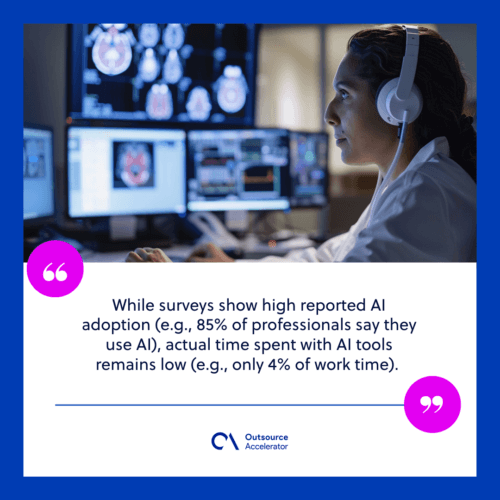
Surveys show high reported adoption. For example, 85% of professionals say they use AI. Yet actual time with AI tools stays low, near 4% of work time. Alex Schutte summed it up: “adoption is high, but that integration is low.” So this gap often comes from not knowing how to use AI beyond basic prompts.
2. Lack of AI fluency and effective training
Many employees are “just kind of poking around” with AI tools. Often, they do not know advanced features. For example, they miss how to switch models, use templates, or train custom agents. So this gap in know-how blocks real value in daily work.
3. Organizational fears and governance gaps
Fear is a common challenge. It includes worries about data privacy, security, and AI to displace jobs. Meanwhile, many firms lack clear AI policies. As a result, staff hesitate to fully embrace new tools. “You’ve gotta lock that down there,” Alex stressed about data security.
4. Enterprise inertia and tool access
Large firms often adopt AI slower than small, nimble teams. Bureaucracy, red tape, and legacy systems create delays. In addition, staff sometimes lack access to approved tools on work devices. So experimentation stalls before it starts.
5. Measuring ROI and demonstrating value
Proving the benefit of AI can be hard. Firms must move past simply installing tools. Instead, they need to show clear impact on output, cost, and strategy. Without solid metrics, the value of AI stays unclear.
5 strategies for successful AI usage and adoption
To move from hype to execution, rethink your approach to AI usage. The key is culture, not just technology. Here are five strategies to make that shift.
1. Start small with clear use cases
Impactful adoption does not need a huge overhaul on day one. Instead, pick specific, high-impact, low-risk workflows that AI can improve. For example, automate admin time or speed up content creation. Then pilot these projects to show early wins. So you build buy-in before a wider rollout.
2. Enable bottom-up experimentation
Adoption thrives when it is not just a top-down order. “I don’t think it can be top down,” Alex Schutte states. Leaders should avoid simply “shoot[ing] off an email or a message to their staff, what are we doing?” Instead, push the work to department heads. So teams find the right AI uses themselves. A clear set of AI adoption strategies keeps that effort on track.
3. Provide enterprise-level tools and guardrails
Teams need the right resources and limits. “You gotta get some formal AI adoption policies in place,” Alex advises. So provide corporate accounts for tools like ChatGPT or Microsoft Copilot. Crucially, lock the data down to prevent proprietary data from training public models. These guardrails keep AI usage secure and compliant.
4. Celebrate wins and share use cases
One of the best ways to drive AI usage is to spotlight success. When teams see AI save time, they adopt it too. First, find your early adopters. These are the curious staff already experimenting with tools like ChatGPT. Then give them a stage. As Alex Schutte asks, “How do you give them a stage and a platform to share some of their learnings?” So recognition rewards innovation and builds momentum.
5. Blend AI metrics with human evaluation
Data is powerful, but context matters. AI tools can show activity rates, focus time, and tool use. Still, these numbers do not tell the full story. So pair them with a human view: what did the person actually achieve? Alex Schutte stresses this balance. “It’s just one data point, not the end-all, be-all. At the end of the day, it’s best to have a human conversation.”
Future outlook for AI usage in the workplace
We have moved past “Will AI change how we work?” Now the question is, “How do we make AI part of daily work?” The firms that succeed will treat AI as a supportive layer, not a silver bullet.
As AI gets built into more software, the line between AI tools and business tools will blur. So expect AI to keep augmenting human work. It will handle the drudgery while people focus on higher-value tasks. Smart automation of routine tasks is central to that shift.
Ultimately, success comes down to one thing: execution. Not flashy pilots, but real, meaningful integration. So the firms that get this right will not just talk about AI. Instead, they will quietly outperform the rest. For more insights, you can download Hubstaff’s latest report, the “AI Productivity Shift,” for free.
Frequently asked questions
Why is actual AI usage so low at work?
Most people try AI, but few build it into daily tasks. Often, they lack training or clear use cases. In addition, privacy fears and weak policies slow them down. So adoption stays high while real integration stays low.
How can a company start using AI effectively?
Start small with one clear, low-risk use case. Next, pilot it and measure the results. Then share those wins to build buy-in. So adoption grows from real proof, not pressure.
What are the biggest barriers to AI adoption?
The main barriers are low fluency, weak governance, and unclear ROI. Large firms also face red tape and legacy systems. So progress depends on training, clear policies, and good metrics.
Should AI adoption be top-down or bottom-up?
Both help, but bottom-up drives real use. Leaders set policy and provide tools. Meanwhile, department heads find the best use cases. So teams adopt AI because it fits their work.
How do you measure the value of AI at work?
Pair hard metrics with human judgment. Track focus time, output, and cost savings. Still, ask what people actually accomplished. So you capture both the numbers and the context.






 Independent






