
When and why you should outsource your accounting


When and why should you outsource your accounting?
You should outsource accounting when your books grow too complex or time-consuming to handle in-house, and you do it to cut costs, reach skilled offshore accountants, and free your core team for growth.
- The start of your fiscal year, the end of it, and just after tax filing are the easiest times to switch.
- Outsourcing can save up to 60% on employment costs while keeping work quality high.
- It also frees your senior staff to focus on revenue and growth.
Outsourcing means hiring a third party to handle some of your business functions. More companies now use it as a core strategy, not a stopgap.
Some outsource within their own country. Many more go offshore to get the full benefit of the practice.
Here in the Philippines, accounting is one of the most popular outsourced services. So why do businesses outsource their accounting services? And when is the best time to do it?
When is the best time to outsource accounting?
Finding a credible, qualified accountant can eat up a lot of time and effort. Good thing there is outsourcing. So if you want to know when to outsource your accounting, here is a quick guide. For a fuller view, this offshore accounting guide walks through the full setup.
The beginning of your fiscal year
It helps to prioritize accounting at the start of the year. This is when many firms add changes to their systems.
At this point, your general ledger is nearly empty, so there is little accounting work to do. As a result, when it is time to close your books and file taxes, you already have a partner who saw your whole year up close.
The end of your fiscal year
You can also start at the end of the fiscal year. A late switch may leave too little time for your accountant to fix errors from the current year.
However, it still gives them a clear angle on your finances. They can study the whole year and build budget plans for the next one. In addition, your outsourced accountant can help you prepare and file taxes, then refine your reports.
After filing your taxes
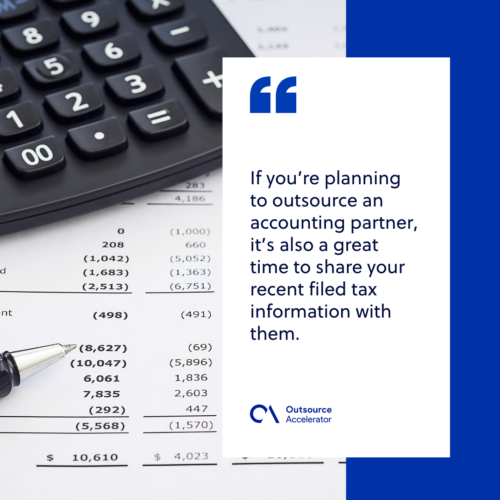
Planning to bring on an accounting partner? Just after filing is also a great time. Your most recent tax returns give the team a full picture of your finances.
In this case, they can learn the financial and operational side of your company in the best way possible. So the handover is smoother, and the first few months run with fewer gaps. If taxes are your main pain point, see this guide to outsourcing tax preparation.
Why should you outsource accounting?
Outsourced accountants cut your labor costs, but that is only the start. Here are the other reasons offshoring accounting roles pays off as you grow. It covers more than the books, from payroll to full finance and accounting services.
Outsourcing can provide access to a range of professional offshore accounting staff!
To compete today, accountants need advanced business know-how and strong soft skills in accounting. These skills make them more in demand.
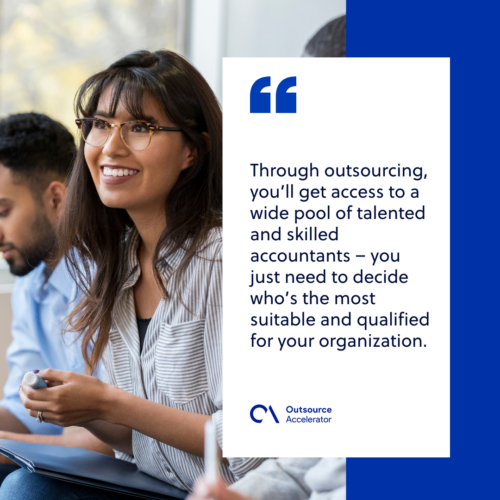
Through outsourcing, you reach a wide pool of skilled accountants. So you just need to pick who fits your organization best. This is also a simple way to add outsourced bookkeeping support without a new hire.
You can save up to 60% on employment costs
Compared with hiring in-house, outsourced finance experts hold the same certifications and qualifications you need. They share the same educational background as your in-house staff. So you can outsource your accounting team offshore at a fraction of the price.
In fact, outsourcing helps companies of all sizes save up to 60% on labor costs without hurting quality. As a result, your books and finances stay well managed, and you skip the heavy overhead.
Focus on your core operations
Accounting is a respected, in-demand profession. Almost every business needs accountants to analyze and interpret its numbers. Still, the work can feel tedious and repetitive.
So it pulls time and effort away from your senior staff. Outsourcing your accounting lets your core team focus on revenue and growth instead. In addition, a trusted provider makes sure the work is accurate and on time. For larger needs, some firms even add outsourced CFO services for strategy and oversight.
Outsource your accounting with Staff Domain
To save money while you grow, it helps to partner with a trusted offshore staffing provider like Staff Domain. Staff Domain offers staffing solutions built around your business needs and targets.
The firm also prides itself on well-versed Filipino accountants. They share best practices, accounting software, and the right expertise to deliver strong results.
With a solid record of building dedicated finance teams, Staff Domain can assure you that your business is in good hands.
Frequently asked questions about accounting outsourcing
Is it safe to outsource accounting offshore?
Yes, when you pick the right partner. A good provider uses secure systems, signs clear confidentiality terms, and follows known standards. So ask about data handling and access controls before you sign. That keeps your financial records safe.
How much can you really save by outsourcing accounting?
Many firms save up to 60% on labor costs. The exact figure depends on the roles, the provider, and the location. Still, most see a clear drop in overhead while quality stays high.
What accounting tasks can you outsource?
You can outsource bookkeeping, payroll, accounts payable, accounts receivable, tax prep, and financial reporting. In addition, some providers handle full CFO-level work. So you can hand off one task or your whole finance function.
Will you lose control of your finances if you outsource?
No. You still set the rules, approve the numbers, and see the reports. A good partner works as an extension of your team. So you keep full oversight while they do the day-to-day work.
How do you start outsourcing your accounting?
First, list the tasks you want to hand off. Next, set a budget and a timeline. Then shortlist providers, check references, and run a short trial. As a result, you move into the partnership with clear expectations on both sides.






 Independent






