
IT staffing augmentation: What you need to know


What is IT staffing augmentation, and why does it matter?
IT staffing augmentation lets you add skilled tech specialists to your team for a set time, so you fill gaps fast while keeping full control of the work.
- It saves the cost and time of hiring full-time staff.
- It gives you access to niche skills on demand.
- You stay in charge, while the talent works as part of your team.
Sometimes a company needs an extra hand with big projects. This is true with tricky tasks in information technology (IT). Most firms now treat IT as a core support function and a key to success. So finding the right people with the right skills is a must.
However, an in-house IT team can be costly to hire and keep. This hits startups and SMBs hardest. So firms often turn to third-party services or outsourcing to meet their tech needs. This is where IT staffing augmentation comes in. It can be a smart way to save cost and time while work keeps running. Read on to learn what IT staffing augmentation is and how it can help your business.
What is IT staffing augmentation?
You can guess the meaning from the words themselves. “Augmentation” means to add to or grow something. IT uses tools like computers to deliver, store, and process data. Put the terms together, though, and it can feel more complex than it is. So let us break it down, starting with staffing augmentation.
Staffing augmentation
Staff augmentation is a fast, productive way to add skilled specialists to your current team. People also call it “resource augmentation” or “business augmentation.” Simply put, you hire a few extra people for a project. As a result, you save money and time on recruiting, training, and upkeep. Many firms follow a clear staff augmentation model to keep this process simple.
Information technology (IT)
IT is the creation, processing, storage, safe transfer, and exchange of electronic data. It covers computers, networking, storage, and other physical devices. Unlike tech for personal use, IT usually serves business needs. Both telecom and computer tech fall under the commercial use of IT.
IT staffing augmentation
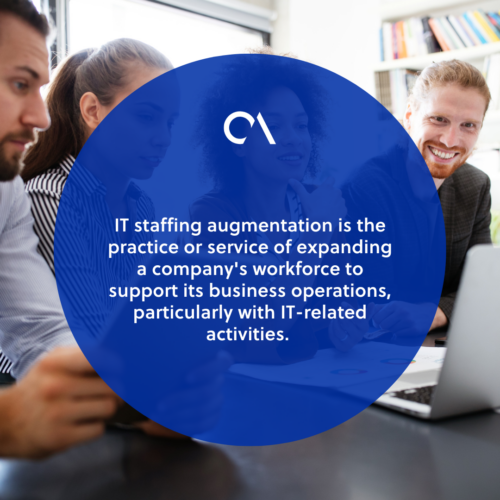
Combine the two, and the meaning is clear. IT staffing augmentation is the practice of growing a company’s workforce for IT-related activities. The idea behind staff augmentation is to bridge gaps in skills, talent, and experience. So it boosts the scale and effectiveness of program management. With this approach, you bring in extra talent while you keep control of your team. That way, you cover temporary gaps and invest in technical resources.
Firms worldwide now use IT staff augmentation to reach their goals faster. As a result, they avoid the usual hurdles of finding and keeping skilled engineers. For example, they can rely on providers such as Arcanys to make the process easier. It also pairs well with full IT staff augmentation programs when needs grow.
Types of IT staffing augmentation
Here are the main types of IT staff augmentation that can fit your needs.
Commodity type
The commodity type fills a role on short notice with similar experience. It does not need special skills. Firms pick it when they need speed, not deep ability. Common examples include retail, manufacturing, and manual labor.
Skills-based type
The skills-based type hires an IT pro for a specific skill the company lacks. So it needs more expertise than the commodity type. Still, it does not always need top-level talent. Typical roles here include clerical tasks like typing or data entry.
Highly-skilled type
The highly-skilled type is what most businesses hire. It brings in outsourced talent with deep skills in IT or software development. These roles need real training and experience. For hard builds, many firms also hire software engineers this way.
Advantages of IT staffing augmentation
IT staffing augmentation brings clear benefits to a company, such as these.
Cost-efficiency
Most staff augmentation firms tap global resources. As a result, they supply talent at a much lower cost. Since staff work remotely, you also save on office space, computers, and furniture. On top of that, many firms use augmentation for short projects. So they pay extra labor cost only for a while and avoid long-term expenses.
Access to a broader pool of talent
You can reach a wider talent pool beyond your local area. So you meet deadlines and recruit niche skills quickly. Many regions also nurture specialized skills. As a result, you can find top expertise in a given field with ease.
Flexibility and adaptability
You can hire as many pros as a project needs. Augmentation works for both long and short tasks. It also removes much of the recruiting and legal burden. So it gives your business real flexibility. On top of that, you skip heavy training, since the talent arrives ready to work.
Maintain full control
With IT staff augmentation, you keep full control of the hire’s duties. They act as an extension of your current team. So some training may help you fold them into your process or project.

Disadvantages of IT staffing augmentation
However, like most staffing plans, IT staff augmentation has its flaws.
Security risks
For example, augmented staff can access private company data. So information leaks are a real risk. But you can lower it with a non-disclosure agreement (NDA) that keeps data safe. Firms should also tighten their security policies, especially on data storage. Strong data security in outsourcing is a must here.
Miscommunication issues
Augmented staff are often offshore. So mix-ups can happen due to time zones and language gaps. One fix is to give clear, direct instructions so the message lands right. Another is to hire talent whose hours overlap with yours.
Management challenges
Blending internal and remote staff takes time and work. New talent may need a while to adjust. So managing them can get tricky at first. You may also see workflow snags while the remote team settles in. Still, a skilled IT staffing firm makes the handover much smoother.
Greater expenses for labor
Top IT pros expect the pay they deserve. So a long project can raise labor cost over time. But you can discuss this with your agency or the talent directly. That way, you meet halfway on the budget.
Lacking institutional knowledge
Agency pros come from outside your company. So they may lack inside knowledge of your task or client. It can take time and small tweaks before they hit full speed. This can hurt when deadlines are tight. On the other hand, talent from trusted agencies often does background research during onboarding.

How does IT staffing augmentation work?
First, a firm needs the right staff and resources to truly succeed. Sometimes, though, it lacks the skills to reach its goals. To boost a team the right way, a business takes a few clear steps. This is where IT staff augmentation helps. So let us look at how it works.
Identify needs
First, map your needs and the goals for the service. For example, run a quick survey to find gaps and problems. That way, you hire only the right specialists for the job. As a result, you save both time and money.
Find the right talents and agencies
Next, seek the right talent by hiring directly or through a trusted agency. IT staffing firms differ in skills and focus. So pick the one that fits your project to avoid trouble later.
Discuss and settle
Once you find the right talent, discuss the project details with them. This covers the roles and duties for the augmented staff. After you lay out the problems and they propose fixes, both sides agree on terms. Then the project can formally start.
Educate and support
Finally, support the new staff once they join the team. Offer mentoring so they perform well and on time. IT staff augmentation works best when internal and outside talent pull together.
Frequently asked questions
What is the difference between staff augmentation and outsourcing?
Staff augmentation adds people to your own team, under your control. Outsourcing hands a whole function to an outside provider. So augmentation gives you more day-to-day say over the work.
When should a business use IT staffing augmentation?
Use it when you face a short-term gap or a tight deadline. It also helps when you need niche skills fast. That way, you avoid the cost of a full-time hire.
How does IT staffing augmentation save money?
You skip long hiring, training, and overhead costs. You also pay only for the time you need. As a result, short projects cost far less than permanent staff.
Is remote augmented staff secure?
It can be, with the right safeguards. An NDA, strong data policies, and trusted agencies all help. So most security risks are manageable with care.
How do I keep augmented staff aligned with my team?
Set clear roles, goals, and communication channels from day one. Pick talent with overlapping hours where you can. Then offer steady support so they settle in fast.






 Independent






