
Outsourcing customer support functions


Why should you outsource your customer support functions?
You should outsource your customer support functions to access skilled agents, cut costs by up to 70%, and deliver fast, reliable help without building a large in-house team. So you keep customers happy while you focus on your core business.
- Outsourcing gives you trained support agents ready to help your customers.
- It cuts labor, office, and training costs. As a result, you save a lot over time.
- The Philippines is a top destination for skilled, English-speaking support teams.
An organization is often judged by the quality of customer support it provides. Yes, products and services matter. Still, strong customer support is the icing on a profitable cake.
One common mistake is a lack of consistency. For example, firms are very hands-on when converting leads. However, once a prospect becomes a paying customer, the focus often drops.
Or worse, existing customers get ignored. As a result, retention falls. So firms that chase leads but fail to follow up end up with weak loyalty. This is why many firms now rethink how they handle customer support.
What is customer support?
Customer support covers the activities that help customers use a company’s products and services. In particular, it focuses on technical help.
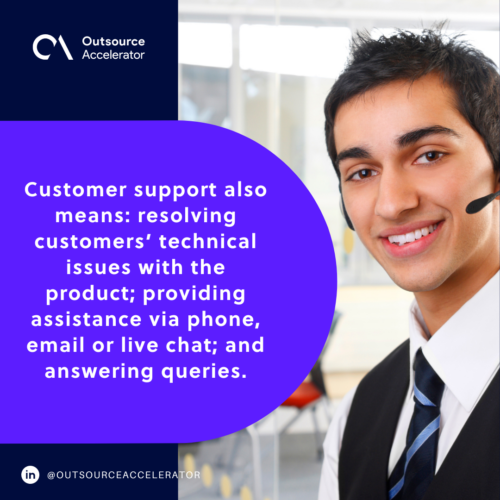
Customer support also means a few key things. For example, it fixes technical issues, offers help by phone, email, or live chat, and answers questions.
People often swap the term with customer service. Still, customer support is more about creating the best customer experience. In short, it is business- or product-centric.
Customer service, by contrast, is customer-centric. In short, it makes sure customers get the services they need.
So the next sections explain the difference in more detail.
Responsibilities of customer support agents/providers
First, let’s look at what a customer support agent does.
As noted above, support agents help customers fix technical issues. Whether a customer reaches out by phone, email, live chat, or social media, the agent’s job is to make the experience the best it can be.
OP360, a leading BPO firm located in the Philippines, provides top-tier customer service functions, particularly live chat support, to multinational businesses.
Further, here are the main duties of a customer support provider:
- Provide strong help with customers’ issues, concerns, complaints, and questions.
- Help customers understand the company’s products and services so they can use them well.
- Use knowledge, patience, and people skills to guide frustrated customers to a fix.
- Drive customer satisfaction.
Customer support vs customer service
It is easy to confuse customer support with customer service. After all, both shape the quality of the customer’s experience.
However, a clear split helps you build a better system. So it pays to master the difference between the two.
Customer service is the umbrella term. In short, it covers all the ways a company works to improve customer experience.
Its main goal is to build stronger ties and lift retention. As a result, it can grow revenue, promote the brand, and boost reputation. Strong customer retention often starts here.
Customer support is more specific. In fact, it sits under the customer service umbrella.
Customer support helps customers answer questions or fix issues with a product. For example, it may cover troubleshooting, maintenance, and upgrades.
Support reps are experts in the company’s product. So they give technical help by call, email, live chat, or social media.
Because support is technical, not every firm needs it. Still, every firm needs a strong customer service plan.
Outsourcing your customer support functions
Firms must deliver strong customer support if they want to keep customers happy. For this, they need skilled, experienced support providers.
Direct hiring a team of support experts is harder than it looks. For example, you must weigh labor costs, office space, management, and training.
Direct hiring also means more than just agents. In addition, you need team leaders, trainers, and supervisors. You may even need a bigger office.
To avoid this burden, many firms, big and small, now outsource their customer support functions. As a result, they free up time and money.
Today, there are many outsourcing options. For example, firms can try onshore outsourcing, nearshoring, or offshore outsourcing. Each route suits a different need, so weigh them against your goals. For a deeper look, see this guide to customer service outsourcing.
Offshore outsourcing is arguably the most popular and efficient path. In fact, it has been a tried-and-tested strategy for decades. Many firms pair it with call center outsourcing to scale support fast.
Why you should outsource your customer support functions
Beyond avoiding the stress of direct hiring, outsourcing brings many benefits. So let’s look at the biggest ones.
Firms like Google, JP Morgan Chase & Co., American Express, Citi, and Canva have outsourced their customer support and service to the Philippines. So what is stopping you?
Here are the top reasons to outsource your customer support functions.
Get access to world-class and dedicated talents
The LA Times calls the Philippines the call center capital of the world for good reason.
The country has a basic literacy rate of 93.1% among people aged 10 to 64, based on a 2024 Philippine Statistics Authority survey. It also has strong English skills. As a result, it is one of the largest English-speaking nations in the world.
Add Filipino workers’ drive, warmth, and natural talent, and you get the perfect mix. So you can build a strong offshore support team. This is why live chat support is one of the most outsourced roles here.
Save up to 70% on employment costs
It is common knowledge that outsourcing cuts labor costs. Still, the savings can surprise you.
In fact, you can save up to 70% on employment costs. That figure includes training, supervision, mandated benefits, and taxes.
The cost of living in the country is far lower than in the West. For example, a Filipino call center agent can live well on a salary of around $6,000 annually.
By contrast, a comparable US-based agent can cost far more each year. So you save a lot on labor costs without losing quality.
Add office gear, internet, and healthcare, and the gap grows. As a result, outsourcing is a clear win for your business.
In addition, you help provide full-time jobs to your support agents. Meanwhile, the taxes you pay benefit the local community.
Overall, outsourcing is a win-win. For example, when you outsource to a reputable third-party solutions provider like SixEleven, you get excellent service in cost-effective, scalable packages. In addition, your trusted provider trains and supervises your team.
So the next question is how to choose an outsourcing provider. Still, that is a topic for another article.
Frequently asked questions (FAQs)
What is the difference between customer support and customer service?
Customer service is the broad term for all customer-facing care. Customer support, by contrast, is the technical side that fixes product issues. So support sits under the wider service umbrella.
Which customer support functions can you outsource?
You can outsource many functions. For example, firms outsource phone support, email, live chat, and social media care. In addition, many outsource technical help desks and after-hours coverage.
How much can you save by outsourcing customer support?
Savings depend on the role and location. In general, though, firms can save up to 70% on employment costs. So outsourcing often frees up a large part of the budget.
Is outsourced customer support good quality?
Yes, when you pick the right partner. A strong provider trains and manages skilled agents for you. As a result, quality can match or beat an in-house team.
Why is the Philippines popular for customer support outsourcing?
The Philippines offers skilled, English-speaking agents at a low cost. In addition, its workers are known for warmth and strong service. So it remains a top choice for support teams.






 Independent






