
Working post-pandemic: What employees and employers need to know

What were the ECQ and GCQ workplace guidelines?
The ECQ and GCQ workplace guidelines were the Philippine rules that set how businesses reopened and kept staff safe during the COVID-19 pandemic.
- They covered employer liability, pay, testing, and safe office setups.
- They followed DOLE and DTI advisories on workplace prevention and control.
- They shaped how firms handled flexible work, closures, and return-to-work steps.
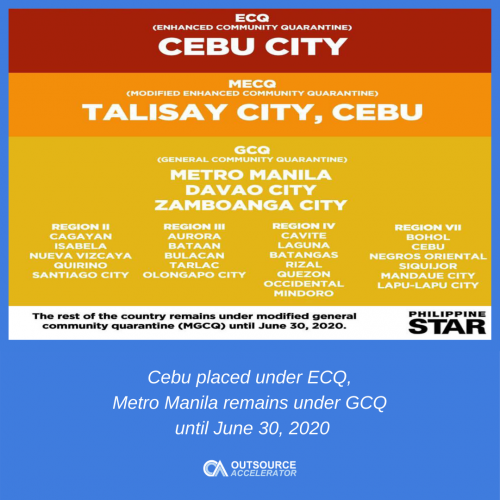
During the pandemic, the Philippines used community quarantine levels to control the virus. The General Community Quarantine (GCQ) for Metro Manila brought looser rules, so more businesses could reopen. As staff returned to work, many faced questions about the new rules and safe office practices.
This guide explains the ECQ and GCQ workplace guidelines that employers and employees followed. It also covers the key labor advisories that shaped return-to-work steps.
Coronavirus BPO sector resources
- [STRATEGY] COVID-19 Business Recovery Action Plan
- [COVID-19 BUSINESS & LEGAL FAQ] Critical advisories & explainers for PH BPO & businesses
- [PODCAST] COVID-19 & BPO Outsourcing – Business Risk Analysis
- [PODCAST] Interview with WHO on COVID-19 & BPO Industry
- [NEWS HUB] Subscribe to OA NewsHub for all BPO industry updates: subscribe here
- Queries, comments and updates c/o: info@outsourceaccelerator.com
- Bookmark & revisit this page for further updates
- Please share with your community
What employers and employees need to know in GCQ
- Are employers liable if their employees contract COVID-19?
- Can employers force employees to go to work?
- Who pays for employees’ COVID-19 testing expenses?
- What happens if an employee is suspected to be positive for COVID-19?
- Do employers do not need to pay staff for days not worked?
- Can employers can put permanent staff on Flexible Work Arrangements (FWA)?
- Can employers put their staff on “Floating Status”?
- Can employers renegotiate lower wages for existing employees?
- Can employers terminate staff for ‘just causes’ and ‘authorized causes’ during ECQ, MECQ and GCQ?
- Can employers operate their businesses now?
- Can employers and employees accept visitors to the business?
- Are employers required to submit monthly health reports?
- Do employers still have time to pay SSS, BIR, Philhealth?
- Can businesses close down without consent or notice to employees?
- Can employers register and incorporate new businesses in GCQ?
10 Things to prepare when opening your business during GCQ:
- Read the DTI and DOLE Interim Guidelines on Workplace Prevention and Control of COVID-19 very carefully.
- Call your local barangay and city hall to check if your company fulfills all LGU requirements.
- Make sure that all your staff are covered by government-mandated benefits like SSS and Philhealth.
- Make sure you’re providing a workplace that ensures one-meter social distancing between each worker.
- If you are going to do Flexible-Work Arrangement (FWA) or WFH for some/all of your staff, make sure you inform DOLE seven (7) days before the start of the FWA.
- Print the Visitor’s Health Questionnaire and have every employee visitor answer it. Submit the DOLE Work Accident/Illness Report Form every month.
- Buy an infrared thermometer and check every guest’s temperature upon entering the Office.
- Make sure you have enough free face masks, soap, and other equipment needed to keep the workplace clean and safe.
- Find a way to get the office disinfected regularly.
- Learn and follow the health protocols when faced with a suspected COVID-19 staff.
1. Are employers liable if their employees contract COVID-19?
Short answer: No. Employers were not liable for employees contracting COVID-19, as long as they had paid for their staff’s SSS and PhilHealth.
Employers had to keep paying their employees’ SSS and PhilHealth benefits. If a worker could not access these benefits due to the employer’s fault, the employer had to cover all medical costs until full recovery.
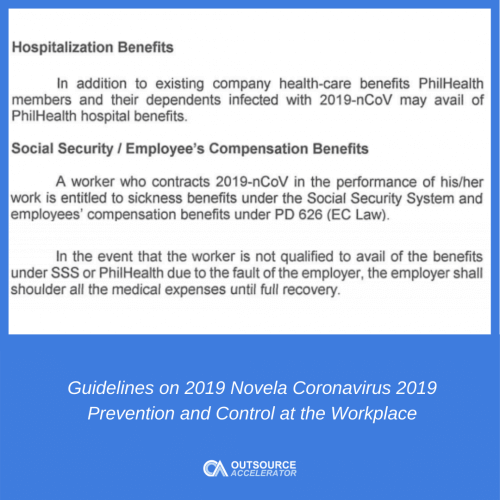
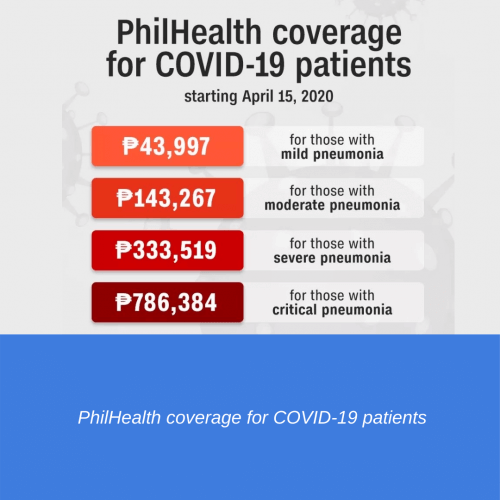
What type of health coverage under SSS and Philhealth do employees get?
Here is a basic guide to the health coverage under SSS and Philhealth.
2. Can employers force employees to go to work?
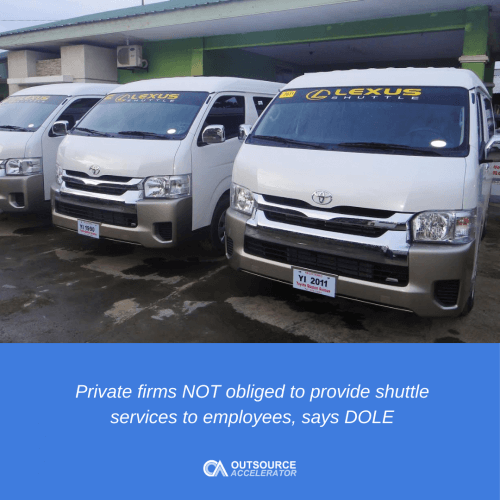
Short answer: No. Employers could not force employees to go to work if the company could not provide shuttle service.
DOLE Secretary Silvestre Bello stated that if companies could not provide shuttle service, employers could not force them to report to work. However, employees could be subject to the no-work, no-pay policy. Equally, DOLE said private firms were not required to provide shuttle services.
3. Who pays for employees’ COVID-19 testing expenses?
Short answer: Employers had to pay for employees’ COVID-19 testing. However, employees were not required to take a test to return to work.
Under DOLE Labor Advisory No. 18, employers had to cover the cost of COVID-19 prevention and control. This included testing, disinfection, hand sanitizers, PPE, signage, and worker training. Whether testing was mandatory depended on the local government unit. Here are some cities that required COVID-19 testing before staff returned to work:
- Paranaque at employer’s expense
- Caloocan at employer’s expense
- Marikina but at city’s expense
For example, Marikina City tested an initial 1,000 private employees as Metro Manila shifted to a Modified Enhanced Community Quarantine (MECQ). Meanwhile, in cities such as San Juan and Quezon City, testing was not mandatory but was highly encouraged.
4. What happens if an employee is suspected to be positive for COVID-19?
Short answer: Employers had to send employees home for 14 days of self-quarantine if a co-worker was suspected positive.
If a worker was suspected of having COVID-19, the workplace had to be decontaminated. Staff in the same area then went on a 14-day home quarantine if the suspect tested positive. However, if the test came back negative, they could return the next day.
The suspected employee, meanwhile, went to the workplace isolation area. There, they waited for transport to the nearest hospital.
5. Do employers do not need to pay staff for days not worked?
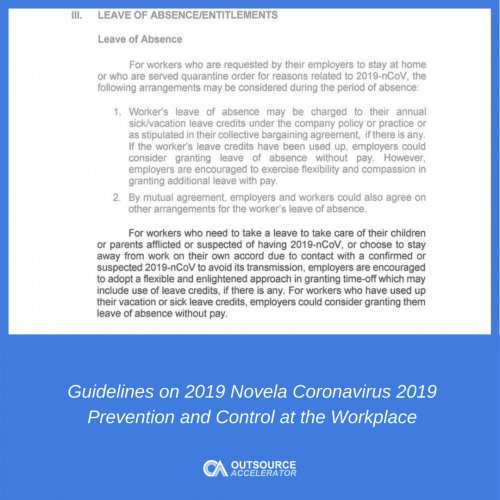
Short answer: No. Employers did not need to pay staff for days not worked (no-work, no-pay). Still, they were urged to show flexibility and compassion.
Under Labor Advisory No. 4, Series of 2020 – Guidelines on 2019 Novela Coronavirus 2019 Prevention and Control at the Workplace, a worker asked to stay home could use vacation or sick leave credits. If those ran out, they could take leave without pay. In addition, both sides could agree on another arrangement for the leave.
6. Can employers can put permanent staff on Flexible Work Arrangements (FWA)?
Short answer: Yes. Employers could put staff on Flexible Work Arrangements (FWA), provided they informed DOLE seven (7) days prior.
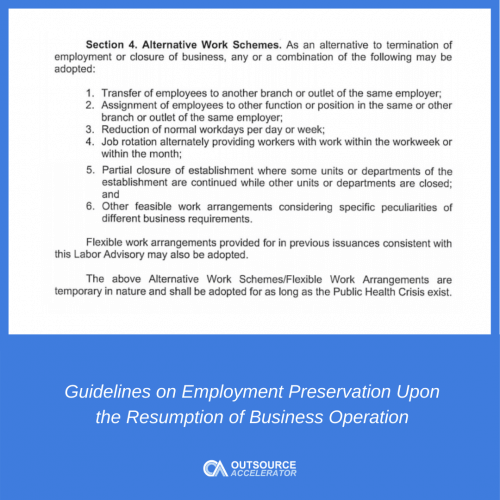
In fact, DOLE preferred that employers put their staff on FWA arrangements instead of terminating them. For an FWA, firms filled up the Establishment Report on COVID-19 and the Report on the Adoption of Flexible Work Arrangements During Economic Difficulties and National Emergencies. Then they emailed a copy to the local DOLE office and later submitted two hard copies.
7. Can employers put their staff on “Floating Status”?
Short answer: Employers could put their staff on “Floating Status” under certain conditions.
At the end of a contract or Service Agreement, employees could wait three months to resign or move to another employer. Under Section 13 of Department Order No. 174, if the employer failed to provide new work, the employee was entitled to separation benefits. The amount followed the law or the Service Agreement, whichever was higher.
8. Can employers renegotiate lower wages for existing employees?
Short answer: Yes. Employers could legally negotiate lower wages and wage-related benefits for a limited time.
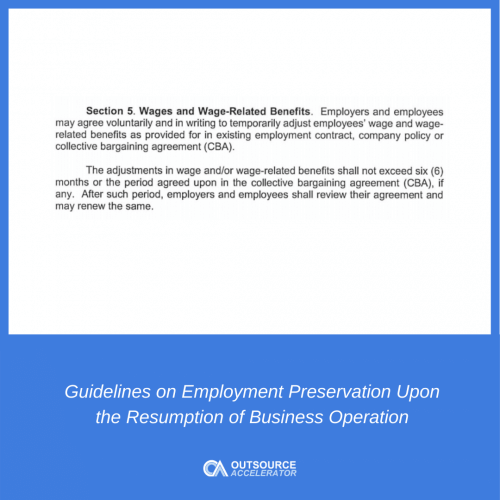
If a company needed to tighten its belt without layoffs, it could adjust wages and benefits for six months. In addition, the two sides could renew the agreement after that period.
9. Can employers terminate staff for ‘just causes’ and ‘authorized causes’ during ECQ, MECQ and GCQ?
Short answer: Yes. Employers could legally terminate staff for ‘just causes’ and ‘authorized causes’, even during ECQ, MECQ, and GCQ.
The pandemic and its lockdowns did not shield employees from termination for serious offences. As long as the company followed due process, it could dismiss staff for just and authorized causes.
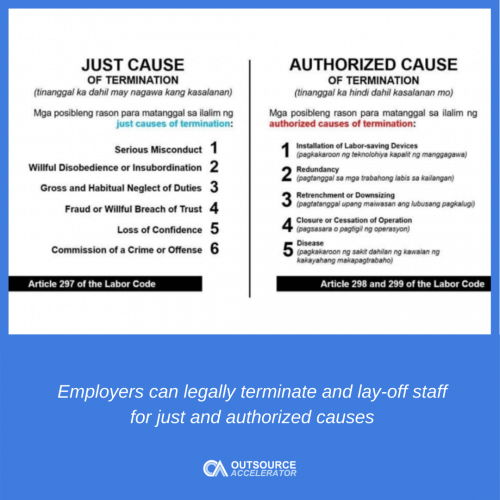
Both just and authorized causes were allowed, under these conditions:
- Just Causes: There had to be a valid offence, with the twin-notice rule and proper due process followed.
- Authorized Causes: The company reported to DOLE that it would cut staff, gave 30 days notice, and paid severance. Severance pay worked as follows: one-half month pay per year of service for retrenchment, closure, or a disease not curable within six months. It was one-month pay per year of service for labor-saving devices, redundancy, or impossible reinstatement.
Also, employees had the right to refuse to go to work. Still, employers could legally terminate those who did so under just cause, such as serious misconduct or willful disobedience.
10. Can employers operate their businesses now?
Short answer: Yes. Employers could operate provided they followed the DTI and DOH health guidelines.
More sectors were allowed to reopen. Still, safety precautions and health standards applied. These followed the DTI and DOLE Interim Guidelines on Workplace Prevention and Control of COVID-19, dated April 30, 2020.
Other rules also applied. For example, Department Order No. 35, Series of 2020, covered construction safety. In addition, DOH Department Memorandum No. 2020-0220 set interim return-to-work guidelines.
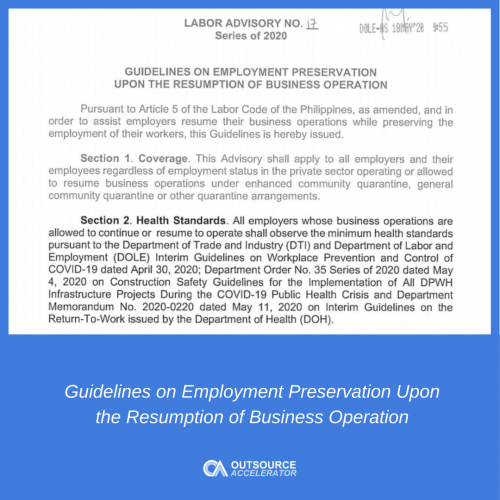
Telecommuting and work-from-home setups, along with other alternative schemes, were still highly encouraged.
To protect everyone at work, the DTI and DOLE released an Interim Guideline Workplace Prevention and Control of COVID. It stressed that employers and employees shared a duty to keep each other safe.
Moreover, employees could not simply refuse work out of fear. In such cases, DOLE assessed whether the workplace was truly dangerous. If it was, DOLE issued a Work Stoppage Order to suspend operations. Without such an order, employees had to report when asked. So employers could issue warnings and sanctions for those who refused.
11. Can employers and employees accept visitors to the business?
Short answer: Yes. If necessary, companies could accept business visitors.
Prolonged face-to-face contact was strongly discouraged. Still, if truly needed, companies could accept visitors for essential concerns. To ensure safety and tracing, visitors had to fill out the Visitor’s Health Checklist Form. It was available on DOLE’s Facebook page and official website.
12. Are employers required to submit monthly health reports?
Short answer: Yes. DOLE required employers to prepare and submit a monthly health report.
Every employee had to accomplish a daily health symptoms form and undergo a temperature check. The results went into the health symptoms questionnaire. Then the employer submitted the monthly report using the DOLE Work Accident/Illness Report Form (WAIR) to the DOLE Regional Office.
13. Do employers still have time to pay SSS, BIR, Philhealth?
Short answer: Yes. Employers were given extended deadlines to catch up on SSS, BIR, and Philhealth contributions.
Social Security System (SSS)
The contribution deadline for regular employers from February to April 2020 was extended until June 15.
Bureau of Internal Revenue (BIR)
BIR Memorandum Circular No. 48-2020 extended tax filing and payment until June 14. Until then, taxpayers could file and pay at the nearest Authorized Agent Banks (AABs), regardless of RDO jurisdiction. They could also pay the concerned Revenue Collection Officers (RCOs) of the nearest RDO.
Philhealth
February to April Philhealth contributions were extended until May 31 only. After that, all premium contributions had to be made through the online payment facility of the Electronic Premium Remittance System (EPRS).
14. Can businesses close down without consent or notice to employees?
Short answer: Yes. Businesses could legally close down without the consent of employees.
To close a business, companies had to follow the due process. The following steps were needed to legally close a business in the Philippines.
a. Employees must be properly terminated to avoid issues on illegal dismissal.
All employees had to be properly terminated. The notice of closure and termination went to the employee and DOLE at least 30 days before the date. If not, the company risked an illegal dismissal lawsuit. In addition, if the closure was not due to business losses, separation pay was due.
b. The company should send a Notice of Closure to BIR, SSS, Philhealth, and Pag-ibig.
Failure to notify or secure clearances from these agencies had consequences. As a result, the company kept getting assessed for mandated contributions, since it stayed active on record.
c. Inform other government agencies of your Notice of Closure
Some firms held licenses from other agencies, such as PEZA or the Board of Investments (BOI). So they had to send a notice of closure to those agencies too.
d. Retirement/Closure of business with the local government, DTI, or SEC
A business starts and ends at the mayor’s office. So to close, the company submitted a notice of closure and other documents to the city that issued its permit.
Finally, a sole proprietorship also filed with the DTI. Corporations filed their documents with the Securities and Exchange Commission (SEC). In total, closing a business could take about six months to one year.
15. Can employers register and incorporate new businesses in GCQ?
Short answer: Yes. Employers had an easier way to register new businesses.
DTI Central Visayas rolled out an online portal for new business names. So it made registration easier during lockdown. To register, people could visit the Business Name Registration System (BNRS) Next Gen web portal.
Applicants could pay through options like GCash and Paymaya. Once approved, the certificate of business name registration and official receipt went to the applicant’s email.
Five million employees may lose their jobs
At the height of the crisis, DOLE estimated that up to five million employees could lose their jobs during the pandemic. So if you kept your job, or your business stayed open, you were fortunate. In that environment, firms had to follow strict rules on health, employment, and labor.
1. Read the DTI and DOLE Interim Guidelines on Workplace Prevention and Control of COVID-19 very carefully.
This eight-page document set out all the rules for running a business during GCQ. So firms had to know it well before they reopened. It also listed the duties of employers and employees and gave rules on workplace safety and health.
2. Call your local barangay and city hall to check if your company fulfills all LGU requirements.
National rules were one thing. Local government unit (LGU) rules were another. Every locality had its own set of rules. So firms had to stay updated on the decisions of their mayors and governors.
Some rules were not about reopening at all. For example, some cities required travel passes plus a certificate of employment for commuting staff. Others did not. So it helped to call the local barangay or city hall to confirm all requirements.
3. Make sure that all your staff are covered by government-mandated benefits like SSS and Philhealth.
These benefits are required by law for a reason. If a worker was not covered by SSS and Philhealth, the employer had to “shoulder all medical services until full recovery.“
Source: Labor Advisory No. 4
4. Make sure you’re providing a workplace that ensures one-meter social distancing between each worker.
The DTI and DOLE Interim Guidelines made one rule clear. Firms had to keep a one-meter distance between each employee. So office tables had to be spaced out, and long face-to-face contact was discouraged. In addition, shifting schedules and work-from-home were encouraged where possible.
Source: DTI and DOLE Interim Guidelines on Workplace Prevention and Control of COVID-19
5. If you are going to do Flexible-Work Arrangement (FWA) or WFH for some/all of your staff, make sure you inform DOLE seven (7) days before the start of the FWA.
The DOLE Labor Advisory No. 17 Series of 2020, Guidelines on Employment Preservation Upon Resumption of Business Operation, highly encouraged the WFH setup where feasible. If WFH did not fit, DOLE encouraged employers to consider the following flexible work arrangements:
- Compressed workweek;
- Reduction of workdays;
- Rotation of workers;
- Forced leave;
- Broken-time schedule; and
- Flexi-holidays schedule.
Source: http://bwc.dole.gov.ph/images/Issuances/DepartmentAdvisory/DA_02_09_2.pdf
If a company chose a flexible working arrangement, it had to do the following:
- Fill out the Establishment Report on COVID-19. You could first send it by email. Then you had to follow up with two hard copies stamped at the DOLE offices, within seven days.
- Submit the form to the closest DOLE Regional Office which has jurisdiction over the workplace as soon as possible.
- Post a copy of Labor Advisory No. 9, Series of 2020 in a visible area in the workplace.
6. Print the Visitor’s Health Questionnaire and have every employee visitor answer it. Submit the DOLE Work Accident/Illness Report Form every month.
The Employer’s Work Accident/Illness Report form was a required questionnaire. Staff had to fill it out and submit it to DOLE. The deadline was on or before the 20th day of the month after the accident or illness.
7. Check every guest’s temperature upon entering the office.
This rule came from the DTI and DOLE Interim Guidelines on Workplace Prevention and Control of COVID-19. So all workers and visitors had their temperature checked and recorded in the health symptoms questionnaire.
Everyone went through a no-contact temperature scan. Here was the protocol. A person with a temperature of 37.5°C or higher, even after five minutes of rest, was isolated in a set area. So they were not allowed to enter the office.
8. Employers are required to provide staff with face masks, soap, and other equipment needed to keep the workplace safe. These should be free of charge.
For contractual workers, the cost of COVID-19 prevention fell to the principals or clients of the contractor. So these control measures could not be charged to the workers, directly or indirectly.
9. Find a way to get the office disinfected regularly.
The rules required regular disinfecting of the office. This covered the room, door knobs, and handles. In addition, sanitizers had to be available where workers passed. So it helped to keep cleaning staff on call to disinfect the office often.
10. Learn and follow the health protocols when faced with a suspected COVID-19 staff.
It was vital to know the protocols for a suspected COVID-19 case. So firms assigned an isolation room, saved the DOH COVID hotline, and disinfected the area right away.
If the suspected employee tested positive, everyone who reported that day went on a 14-day quarantine. If the test was negative, they could return to work.
Frequently asked questions
What did ECQ, MECQ, and GCQ mean?
They were community quarantine levels in the Philippines. ECQ was the strictest, MECQ was a modified version, and GCQ was more relaxed. So each level set how much of the economy could reopen.
Were employers liable if staff caught COVID-19?
No, as long as they had paid SSS and PhilHealth contributions. However, if a worker could not access those benefits due to the employer, the employer covered the medical costs.
Could employers force staff to return to the office?
Not without shuttle service, in many cases. Still, the no-work, no-pay policy could apply. In addition, DOLE could issue a Work Stoppage Order if a workplace was truly unsafe.
Who paid for COVID-19 testing?
Employers had to cover testing and other prevention measures. Yet testing was not always mandatory to return to work. It depended on the local government unit’s rules.
What flexible work options did DOLE allow?
DOLE encouraged work-from-home first. If that did not fit, options included a compressed workweek, reduced workdays, worker rotation, forced leave, and broken-time schedules.
Key takeaways
- The ECQ and GCQ workplace guidelines set how Philippine firms reopened safely.
- Employers had to cover SSS, PhilHealth, testing, and prevention costs.
- DOLE preferred flexible work over layoffs, with prior notice required.
- Firms could still terminate or close for valid, documented reasons.
- Safe office setups, distancing, and health reports were core rules.






 Independent





