
Outsourcing is not cheap labor


Is outsourcing the same as cheap labor?
No, outsourcing is not cheap labor. Outsourcing cheap labor is a myth, since BPO firms must follow local wage laws and provide safe, fair work.
- Cheap labor means very low pay, long hours, and unsafe conditions.
- By contrast, outsourcing gives decent jobs, benefits, and legal protection.
- As a result, outsourcing helps many countries grow their economies.
In the past, people tended to look away from the issue of cheap labor in different countries.
Now, companies care more about ethical conditions in their operations. This is thanks to consumers, who have grown more aware of the issue.
However, no matter how strong the labor laws are, cheap labor is still practiced. This is true in many developing countries. So immigrants and low-income workers still fall prey to it.
Business process outsourcing can save costs and resources. Still, it is not cheap labor in general.
This article covers what cheap labor is, how countries regulate against it, and why outsourcing cheap labor is a false idea.
What is cheap labour
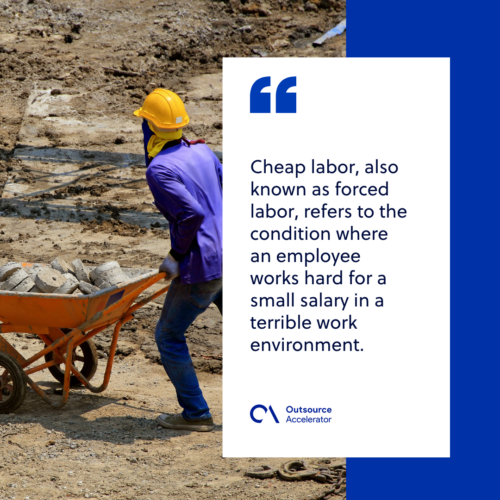
Cheap labor, also known as forced labor, is when an employee works hard for a small wage in a terrible setting.
In some cases, people call cheap labor “modern slavery.” This is due to the inhumane conditions the workers face.
To cut costs, some businesses use these methods. As a result, they sacrifice worker welfare. For example, those in Bangladesh and Vietnam often face such conditions.
Cheap labor practices usually involve the following:
- Using child labor
- Setting 90 to 120-hour work weeks
- Underpaying employees with less than a penny an hour
- Avoiding employee benefits and labor protection set by the country
- Forcing employees to work in sub-par conditions
According to the International Labour Organization (ILO), there are around 25 million people worldwide who are victims of this practice. By the ILO’s most recent 2022 estimate, that number has since risen to 27.6 million in forced labour.
Physical vs digital labor
Today, cheap labor goes two ways. It shows up through both physical and digital labor.
- Physical labor. This is the abuse of manual labor in factories, sweatshops, and farms.
- Digital labor. Cheap labor also hits online workers. Some earn below the standard rate, around $1 to $2 an hour. According to a report by PayPal, 58% of freelancers in their poll even went unpaid at times.
History of cheap labor
Cheap labor practices began with the rise of the industrial revolution. For example, fierce contractor rivalry and a crowded job market “kept wages low and work hours high.”
The United States, Britain, and Germany were said to lead this trend for their factories. So their first workers were often migrants or people from the countryside who needed work.
Still, the labor movement in the US helped workers improve their pay and welfare. As a result, they won better hours, standard pay, and benefits for each worker.
Cheap labor in different countries
Groups and institutions still fight cheap labor practices. However, the problem remains in both developing and developed nations. For example, these include:
China
China is now developing fast, so cheap labor there is not that cheap anymore. However, at its peak, some factories used workers under 16. They forced them to work 28 days a month and beat them when they misbehaved.
In a report by the Chinese labor bulletin, teens from poor families drop out to work in factories and restaurants. In some cases, they are taken from their families and forced into labor.
India
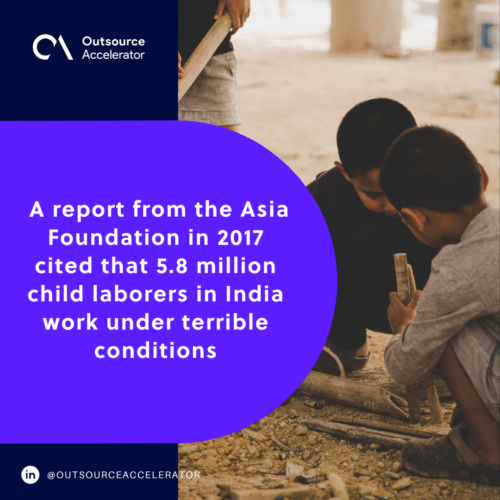
Child labor is still common in rural India, even with a growing outsourcing economy. A report from the Asia Foundation in 2017 found 5.8 million child laborers in India. That is the highest in South Asia. In addition, 100,000 of them work about 14 hours a day in Delhi sweatshops.
This problem has worsened alongside a rise in extreme poverty. Most of these children are trafficked or promised a salary of 3,000 rupees (around $41).
The Philippines
The Philippines also has a share of cheap labor conditions. Most of it sits in the informal or underground sector. In fact, 88.1% of jobs in the country come from there.
As the Philippine Institute for Development Studies notes, these practices cover many jobs and workers that the state does not regulate or protect.
Meanwhile, women are the most vulnerable in this sector. So they face lower pay, longer hours, and poor conditions.
The government and labor organizations work to make things better. Still, there are still recorded cases in recent years.
Mexico
Migrant workers in Mexico also face harsh conditions. In the account of migrant farmworkers, employers do not let them leave the farms. As a result, they must buy goods at the employer’s overpriced store.
In addition, they have no contracts, social security, or rest. For example, one worker said she worked more than 12 hours for a few dollars, even while sick.
Bangladesh
Sweatshops and clothing factories are most common in Bangladesh. Big brands like H&M, Zara, and Gap send work there, despite the conditions.
In a report by The Guardian in 2019, staff earned 35 pence an hour for a 54-hour week. So they were pushed to work overtime to hit hard targets, and many fell ill from the heat.
Europe
Even now, forced labor still rises in Europe and Central Asia. Almost 3.6 million workers there face modern slavery, and 91% of them do forced labor.
A report from a UK institution found that most forced work in nine EU countries covers domestic service, farming, and clothing. In addition, 60% of these workers came from nearby countries like Romania and Bulgaria.
Ethiopia
Lastly, big companies also use cheap labor in Africa. For example, H&M and Calvin Klein source products from Ethiopia. A few UK brands go there for leather goods too.
However, this became a burden for workers. They earn AU$26 a month, or just GBP 13. That is tagged as the lowest wage in the world. As a result, it barely covers their living costs.
Regulations against cheap labor
Today, countries keep enforcing labor laws to protect worker rights.
In the United States, for example, the Fair Labour Standards Act (FLSA) sets a federal minimum wage, overtime pay, and youth work rules.
In the United Kingdom, meanwhile, labor laws cover anti-discrimination, maternity leave, and flexible hours.
In addition, the International Labour Organization (ILO), founded in 1919, brings together employers, workers, and governments from 187 UN member states. So it sets global labor standards to protect all workers.
Outsourcing is not cheap labor
Despite its growth, some labor movements criticize outsourcing conditions. For example, they call it exploitation of workers in developing countries.
However, outsourcing should not be seen as cheap labor. In fact, many governments encourage it. So BPO companies follow local labor rules and give workers a safe setting.
In the Philippines, for example, BPO staff receive a US$ 500 minimum salary. In addition, they get bonuses, incentives, and company events.
Meanwhile, social media virtual assistant rates can reach up to $20. So most employers now aim to pay a fair wage with benefits.
Call centers also follow the rules on wages and benefits. As a result, they take care of staff to keep them happy at work.
In South Africa and other developing countries, impact sourcing helps people rise above the poverty line. So it gives them jobs and builds their skills.
Outsourcing has helped many countries grow by giving decent jobs to their people. So calling it cheap labor does not do justice to its impact.
Outsourcing cheap labor FAQs
What is cheap labor?
Cheap labor is when workers earn very low pay for long hours in poor, often unsafe, conditions. In its worst form, people call it modern slavery.
Is outsourcing cheap labor?
No. Outsourcing firms must follow local wage and labor laws. So they provide fair pay, benefits, and safe work.
How do countries fight cheap labor?
Countries pass labor laws on minimum wage, hours, and safety. In addition, the ILO sets global standards to protect workers.
How much do BPO workers earn in the Philippines?
Entry BPO staff earn about a US$500 minimum salary, plus bonuses. Meanwhile, skilled virtual assistants can earn up to $20 an hour.
What is impact sourcing?
Impact sourcing hires people from poor communities and builds their skills. As a result, it helps them earn a stable income.
Key takeaways
- Cheap labor means very low pay, long hours, and unsafe conditions.
- It still exists in many countries, from India to Bangladesh to parts of Europe.
- Labor laws and the ILO work to protect workers worldwide.
- Outsourcing is not cheap labor, since BPO firms follow local wage rules.
- As a result, outsourcing gives decent jobs and helps economies grow.






 Independent





