


Software Developer
HR Manager
Team Leader
Accountant
Copy Writer
Customer Service
Virtual Assistance
 Join the upcoming Outsource Insights live session. OA's Zoom room is open! Come chat with our outsourcing expert now.
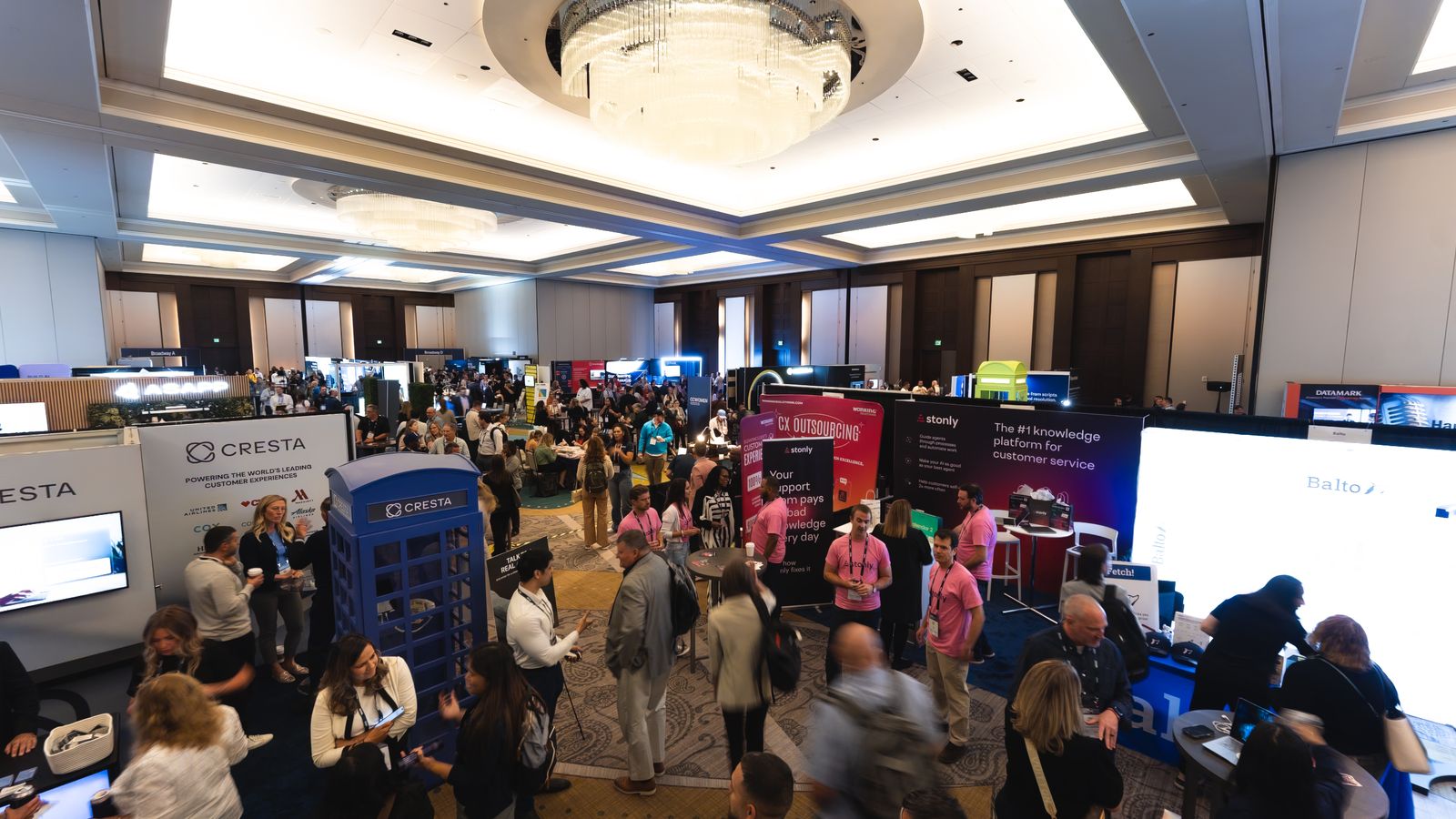


I spent two days walking the expo hall at Customer Contact Week (CCW) Nashville 2026 with a camera and a simple tally: how many stands led with “AI”. On the first day I photographed 34 exhibitors. Fifteen put AI in their main headline and another five worked it into their signage. Counting the AI-native firms that didn’t bother saying so, 24 of the 34 were contact centre AI vendors, and my impression of the rest of the floor was higher still. Yet when I asked exhibitors whether many buyers were walking the aisles, several, BPOs and technology vendors alike, said no, at least compared with Las Vegas. A market with this much supply and this many cautious buyers has a name: a buyer’s market. Most buyers have not noticed yet.
The research backs up what the floor felt like. CMP, the company that runs CCW, tracks 40 to 50 providers in each major contact centre technology category, and told one session that the median provider is known to fewer than 10% of buyers. Chatbot and voice bot vendors scored around 7% to 8% awareness. One vendor, six years into the business, told me there is “a new vendor in every deal I’ve never heard of.”
The money keeps coming. Sierra raised $950 million in May at a $15.8 billion valuation. Decagon reached $4.5 billion in January, Parloa $3 billion the same month, and HappyRobot, which had a stand in Nashville, $1.2 billion in August. At mid-October prices, Sierra’s private valuation alone exceeds the combined stock-market value of NICE, Five9, Concentrix, TaskUs and TTEC. That says less about any one company than about how investors are pricing the shift from people to software.
Demand itself is not the problem. CMP says 60% of executives plan to spend more on chatbots by the end of 2027. They are simply taking longer, and involving more people, to choose: only 31% of contact centre executives now have sole authority over technology purchases.
Abundance rarely lasts. Over the past 18 months, the large platforms have been buying AI specialists. NICE completed its $955 million purchase of Cognigy. Thoma Bravo bought Verint for about $2 billion and merged it with Calabrio. Salesforce agreed to buy Fin, formerly Intercom, for about $3.6 billion in June. Zendesk bought Forethought. SoundHound has rolled up Amelia, Interactions and, pending completion, LivePerson. CallMiner, whose stand I visited, bought the Czech voice AI firm VOCALLS last year and now sells it as OmniAgent.
Buyers have noticed. One AI sales executive described an objection prospects now raise that has nothing to do with the product: “Why would I sign a one-year contract when in seven months someone’s going to come knocking on my door saying I’ve got something better?” It is a fair question. In this market, the safest vendor might be the one that has already been bought.
Pricing is shifting as fast as ownership. Fin charges $0.99 per resolved conversation. One generative AI vendor’s sales engineer told me they bill only for resolved interactions, not tokens. On stage, a customer care director went further, arguing that if a customer asks for a human, the AI vendor should not be paid for that conversation at all.
Outcome pricing sounds like a gift to buyers, but it hides a question nobody can answer yet: what does AI really cost at scale? An audience member at one CMP session warned that companies building their own AI tools “don’t understand the token cost yet.” CMP’s Nicole Kyle then put the question directly: “Will there ever be a reality where human labor is cheaper than machine labor? … That’s never happened before… Could it happen for the first time? Maybe.” It is not often an analyst says that out loud at a technology conference.
Not everything with “agentic” on the banner deserves the label. Gartner has estimated that only around 130 of the thousands of companies claiming agentic AI are the real thing, and that more than 40% of agentic AI projects will be cancelled by the end of 2027. Among the crowd, a handful of messages stood out because they addressed the questions buyers are really asking.
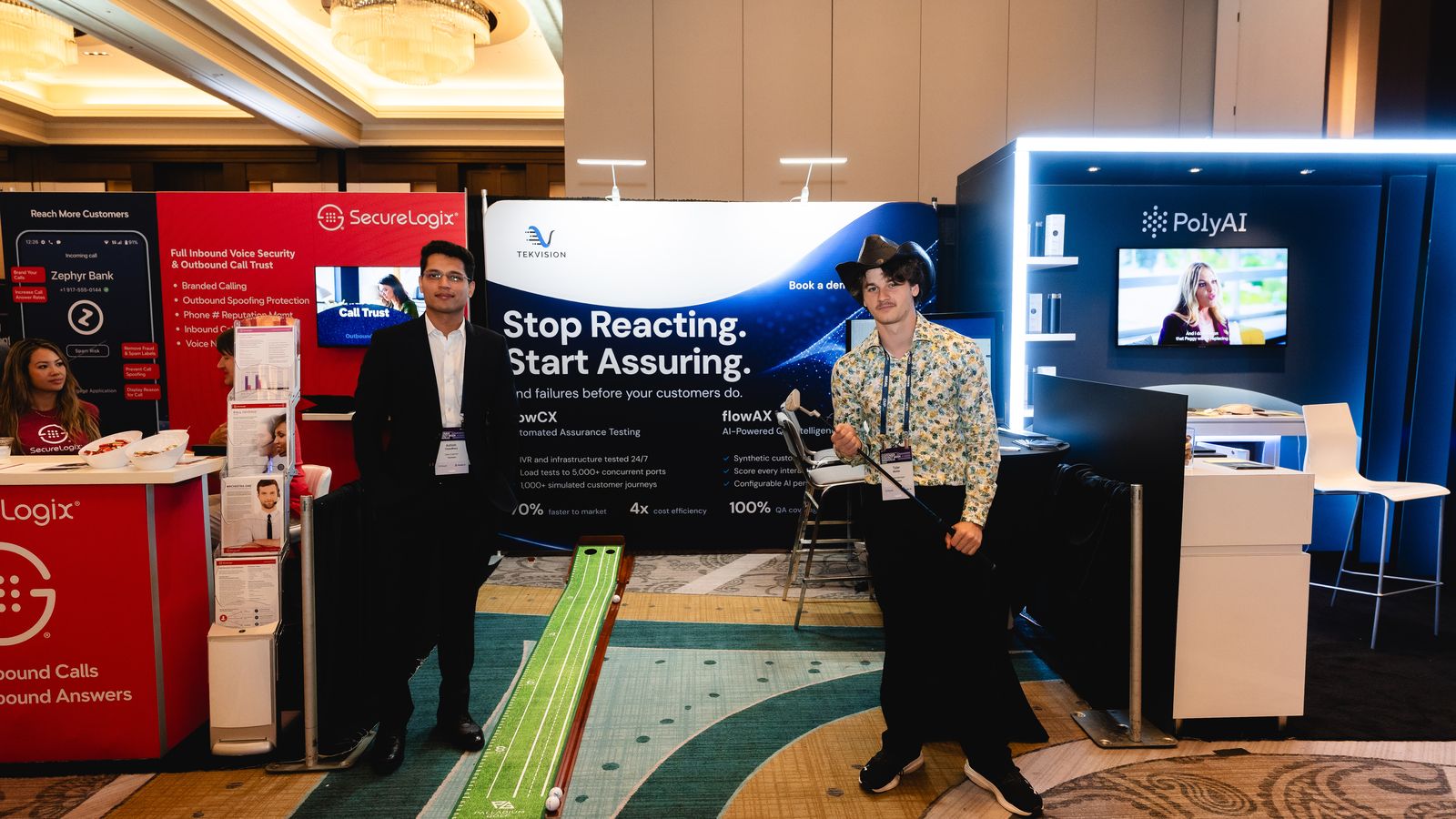
Trust over demos. “Demos are easy. Audits aren’t,” read the backdrop at Guava, which enforces scripts and compliance rules in code rather than relying on prompts and pitches its product for regulated calls such as collections. Tekvision sells independent testing of other vendors’ AI. Several firms run their own models to control cost and latency.
Humans, deliberately. UJET’s tagline was “Keep the Humans. Cut the Software.” Whatfix pitched training for “the conversations AI can’t handle.” Jabra’s representative described the company as “the I without the A.”
Language as a commodity. At least three exhibitors offered live translation. One, TransVoix, currently in beta, translates calls in the speaker’s own cloned voice in under three seconds. If any agent can serve any language, the premium for bilingual nearshore teams narrows. Eventually, so does the English advantage that built the Philippine industry, and scale, training and judgement become the differentiators. The ethics are unresolved: accent technology from Sanas, a premium sponsor, has drawn criticism as “digital whitening”, even as some agents say it helps them.
Security for distributed teams. One remote-workforce vendor said a client used its platform to catch two people in North Korea and China posing as US-based remote agents. Remote and offshore work is here to stay, and so is the need to verify who is on the other end.
Lengthening sales cycles and a crowded vendor field give buyers bargaining power. Use it. Run short pilots instead of long commitments. Pay for resolved outcomes, with a definition of “resolved” that excludes customers who simply gave up. Ask every vendor how its AI is audited, what happens to your roadmap if it is acquired and how it hands a customer to a human with context. And ask which outsourcing partners already deploy it, because many of these vendors reach the market through BPOs, and those partners will have seen the product fail as well as succeed.
The expo hall in Nashville showed how much capital has poured into customer service AI. The next year will show how much of it buyers can actually absorb, and on whose terms.
More from CCW Nashville 2026: Outsourced Customer Service to Drop From 30% to 22%, Vegas Sold Autonomy. CCW Nashville Bought Oversight..
If your AI vendor were acquired tomorrow, what would happen to your roadmap?
 IndependentSecureTransparent
Scale your business fast while reducing costs —
the average all-in employment costs
in the
Philippines are typically 70% less than its
Western counterparts
You can save 70% on staff costs, whilst driving quality & growth. Connect with an outsourcing expert to see how outsourcing can transform your business.







How many staff to outsource?



Outsource Accelerator is the trusted source of independent information, advisory and expert implementation of Business Process Outsourcing (BPO).
Outsource Accelerator offers the world’s leading aggregator marketplace for outsourcing. It specifically provides the conduit between world-leading outsourcing suppliers and the businesses – clients – across the globe.
The Outsource Accelerator website has over 5,000 articles, 450+ podcast episodes, and a comprehensive directory with 4,700+ BPO companies… all designed to make it easier for clients to learn about – and engage with – outsourcing.
Derek Gallimore has been in business for 20 years, outsourcing for over eight years, and has been living in Manila (the heart of global outsourcing) since 2014. Derek is the founder and CEO of Outsource Accelerator, and is regarded as a leading expert on all things outsourcing.
Outsource Accelerator in the media
See all media mentions