
AI voice agent integration in BPO call centers

This article is a submission by Innovature BPO, an AI-driven BPO company with offshore teams in Vietnam and the Philippines. Innovature BPO delivers finance and accounting, customer experience, data and analytics, and digital creative services to businesses across the U.S., Europe, and beyond.
AI voice agent integration in BPO call centers combines AI-powered voice technology with existing telephony, CRM, and customer service workflows. It enables BPO providers to automate routine interactions while routing complex cases to human agents with the relevant customer context. A hybrid AI-human model enables businesses to scale customer support while maintaining service quality.
What is AI voice agent integration in BPO?
In a BPO environment, AI voice agent integration connects voice AI with the systems and workflows used to manage customer calls. These workflows can include inbound inquiries, order support, complaint handling, and other customer service operations where outsourced teams interact directly with customers.
Rather than replacing agents, AI handles repetitive voice inquiries, provides instant responses, and transfers complex conversations to the appropriate representative with the full interaction context.
Compared with traditional call automation solutions, AI voice agents offer several key advantages:
- Unlike traditional IVR, AI voice agents understand natural speech instead of relying on menu-based navigation and keypad inputs.
- Unlike chatbots, they communicate through voice calls rather than text-based channels.
- Compared with traditional scripted voicebots, they can support more contextual, multi-turn conversations and generate dynamic responses rather than relying solely on fixed scripts.
- Through CRM integration, they can retrieve customer information and deliver personalized, real-time support.
AI voice agents combine several AI technologies to enable natural conversations:
- Speech-to-text (STT): converts customer speech into text.
- Natural language processing (NLP): identifies customer intent and extracts meaning.
- Large language models (LLMs): generate context-aware responses.
- Text-to-speech (TTS): converts AI responses into natural-sounding speech.
Traditional IVR vs AI voice agent
| Feature | Traditional IVR | AI voice agent |
|---|---|---|
| Customer interaction | Menu-driven using keypad inputs | Natural voice conversations |
| Understanding | Predefined commands only | Understands intent and conversational context |
| Flexibility | Fixed call flows | Dynamic, adaptive conversations |
| CRM integration | Limited or basic | Real-time CRM and knowledge base integration |
| Personalization | Minimal | Personalized responses based on customer data |
| Escalation | Manual or rule-based | Intelligent handoff with full conversation context |
How AI voice agents work in outsourced call centers
AI voice agents support both inbound and outbound operations by automating routine interactions while working alongside human agents.
Integrated with telephony platforms, CRM systems, and knowledge bases, they can understand customer requests, retrieve relevant information, and respond in real time.
When a request exceeds predefined rules or requires human judgment, the AI transfers the conversation to the appropriate agent without interrupting the customer experience.
Handling inbound customer calls
For inbound customer service, AI voice agents act as the first point of contact, providing immediate assistance without requiring customers to wait for an available representative. A typical workflow includes:
- Answer calls 24/7 to ensure customers receive support at any time, including outside business hours.
- Recognize speech and customer intent using AI to understand the purpose of the call.
- Handle frequently asked questions such as product information, service policies, or account-related inquiries.
- Retrieve real-time data from CRM systems to check order status, account details, appointment schedules, or service requests.
- Transfer complex cases to the appropriate human agent with the conversation history and customer context.
This setup can reduce queue pressure while allowing human agents to focus on escalations, exceptions, and interactions that require human judgment.
Supporting outbound calling campaigns
AI voice agents can also automate high-volume outbound campaigns that traditionally require large agent teams. They consistently deliver scripted conversations, collect responses, and update customer records automatically.
For businesses looking to outsource telemarketing, AI voice agents can support routine promotional calls and lead qualification while human agents handle conversations that require more detailed engagement.
Common outbound use cases include:
- Appointment reminders for healthcare, financial services, or professional consultations.
- Payment and subscription renewal reminders to reduce missed payments and customer churn.
- Customer satisfaction surveys after purchases or support interactions.
- Lead qualification by collecting key information before transferring qualified prospects to sales representatives.
- AI-powered outbound telemarketing for promotional campaigns, product launches, or event invitations.
By automating repetitive outbound calls, BPO providers can scale campaigns more efficiently while maintaining consistent customer communication.
Customer authentication and security
Before providing account-specific information, AI voice agents can perform identity verification to protect sensitive customer data and reduce the risk of unauthorized access. Depending on business requirements, AI can:
- Authenticate customers using voice biometrics or registered voiceprints.
- Verify identity through OTPs or security questions before accessing confidential information.
- Protect customer data by following secure authentication workflows and encrypted data transmission.
- Support security and compliance requirements through appropriate authentication, access controls, encryption, and data-handling procedures.
These capabilities help BPO providers deliver secure customer service while maintaining regulatory compliance.
Intelligent escalation to human agents
Hybrid CX operations achieve up to 45% higher resolution efficiency by deploying intelligent escalation protocols between AI voice agents and human teams.
While AI voice agents resolve up to 60% of routine inquiries autonomously, complex cases require a seamless transition to specialized staff. Comparing AI voice agent vs human call center models shows that automated contextual handoffs eliminate repetitive customer inputs and maintain first contact resolution (FCR) rates above 88%.
The escalation process typically includes:
- Detecting complex requests that require human judgment, such as complaints, technical issues, or exceptional cases.
- Routing calls to the most suitable agent based on skills, language, or department.
- Passing the complete conversation context, including transcripts, customer information, and previous actions.
- Reducing customer effort by eliminating the need to repeat information after the transfer.
This hybrid model allows AI to handle routine interactions while human agents focus on complex, sensitive, or exception-based cases.
Key benefits of integrating AI voice agents in call centers
For BPO call centers, the value of AI voice agents goes beyond automating calls. They can take over repetitive interactions, extend service availability, and give human agents better access to customer information.
When integrated properly, these capabilities can help businesses improve customer experience outsourcing while scaling support operations.
Reduce operational costs
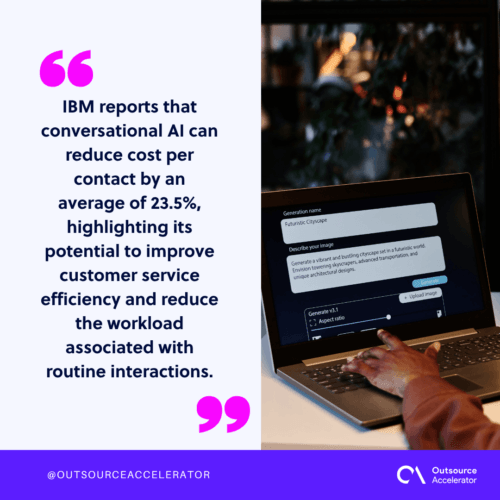
IBM reports that conversational AI can reduce cost per contact by an average of 23.5%, highlighting its potential to improve customer service efficiency and reduce the workload associated with routine interactions.
In a BPO environment, one of the main opportunities comes from automating repetitive calls such as order tracking, appointment scheduling, and account inquiries. This allows human agents to spend more time on complex cases while reducing the manual work required to handle routine customer requests.
Eliminating hold times and 24/7 scalability
The Salesforce State of Service report found that 77% of customers expect to interact with someone immediately when contacting a company.
AI voice agents can help BPO call centers meet this expectation by handling multiple calls at the same time and remaining available around the clock. This is particularly valuable during peak periods or for businesses serving customers across multiple time zones.
Seamless CRM and data synchronization
Connecting AI voice agents with CRM systems allows customer information and call data to move between systems without relying entirely on manual updates.
The AI can retrieve relevant customer details during a call, record the interaction, and pass the conversation history to a human agent when escalation is required. This creates a more continuous customer journey and reduces repetitive data-entry work for BPO teams.
Personalized and multilingual support
CSA Research found that 76% of consumers prefer purchasing products and services when information is available in their native language.
For international BPO operations, multilingual AI voice agents can help address this expectation at scale. They can also complement multilingual customer support, allowing businesses to maintain consistent service across different languages and markets.
Standardized AI voice agent implementation process for BPO providers
A structured implementation process helps BPO providers integrate AI voice agents into existing call center operations without disrupting customer service.
The process typically includes five key steps:
- Step 1: Audit call data and map customer intents. Analyze historical call data to identify high-volume, repetitive inquiries that are suitable for AI automation.
- Step 2: Integrate telephony infrastructure and CRM. Connect the AI voice agent with existing systems through SIP trunking, WebRTC, Twilio, or Genesys, and synchronize relevant CRM data.
- Step 3: Design prompts and establish guardrails. Define the AI’s tone, response rules, and knowledge boundaries to maintain brand consistency and reduce inaccurate or unsupported responses.
- Step 4: Configure contextual handoff. Automatically route complex or sensitive cases to the right human agent, together with the conversation transcript and customer context, so customers do not have to repeat their information.
- Step 5: Pilot, monitor, and optimize. Launch the AI voice agent with a limited call type, monitor containment, escalation accuracy, CSAT, and QA results, then refine the workflow before broader deployment.
The result is a hybrid AI-human workflow: AI handles routine Tier-1 interactions, while professional BPO agents take over cases that require human judgment, empathy, or specialized expertise. In practice, the flow works like this:
- Customer call goes to the AI voice agent for Tier-1 handling (sub-300ms response).
- Routine calls, around 70 to 80%, resolve with an automatic CRM update.
- Complex calls are handed off with the transcript to a professional BPO agent.
This model allows BPO providers to automate suitable Tier-1 interactions while maintaining human oversight for complex, sensitive, and exception-based cases.
How to evaluate your readiness for AI voice agent integration in BPO
Before implementing an AI voice agent, BPO providers should assess whether their current call center operations have the right data, processes, and infrastructure for automation. A readiness assessment helps identify suitable use cases, estimate potential ROI, and reduce implementation risks.
The following steps provide a practical starting point:
- Review the last 90 days of call center performance data. Analyze call volume, average handling time (AHT), first contact resolution (FCR), service level, abandonment rate, and common customer inquiries to identify operational patterns.
- Identify which call types are suitable for AI automation. Prioritize high-volume, repetitive, and rule-based interactions such as appointment reminders, order status checks, account inquiries, or payment notifications.
- Estimate ROI with a hybrid AI-human support model. Compare current staffing and operating costs with the expected impact of AI automation, while accounting for human agents who will continue handling complex or sensitive cases.
- Launch a pilot with a high-volume, repetitive call type. Start with one clearly defined use case rather than automating the entire contact center at once. A controlled pilot makes it easier to test performance and identify issues before scaling.
- Measure results against key BPO performance metrics. Track KPIs such as AHT, FCR, service level, customer satisfaction (CSAT), QA score, containment rate, transfer rate, and cost per interaction to determine whether the AI voice agent is delivering measurable improvements.
Moving from manual call handling to a hybrid AI-human model
After assessing your call data, automation opportunities, and expected ROI, the next step is to determine which interactions are suitable for AI voice agent automation.
An experienced BPO partner can help businesses identify practical AI use cases, integrate AI voice agents with existing customer support systems, and combine automation with skilled agents for complex interactions.
With experience in outsourced customer support operations, an established provider can support the transition from manual call handling to a hybrid AI-human model, while maintaining the processes, oversight, and service quality that BPO operations require.
Ready to move toward a hybrid AI-human call center? Book an AI voice readiness audit to map out the transition.






 Independent





