
Outsourcing vs in-house IT: which is right for you?

At a glance
- Outsourced IT usually wins on cost, speed to scale, and access to specialized skills, while an in-house team wins on control, context, and immediate physical presence.
- The right choice depends less on company size alone and more on how central IT is to your product, how sensitive your data is, and how predictable your workload is.
- Most companies land on a hybrid: a small internal core for strategy and critical systems, with outsourced partners for help desk, infrastructure, security monitoring, and overflow development.
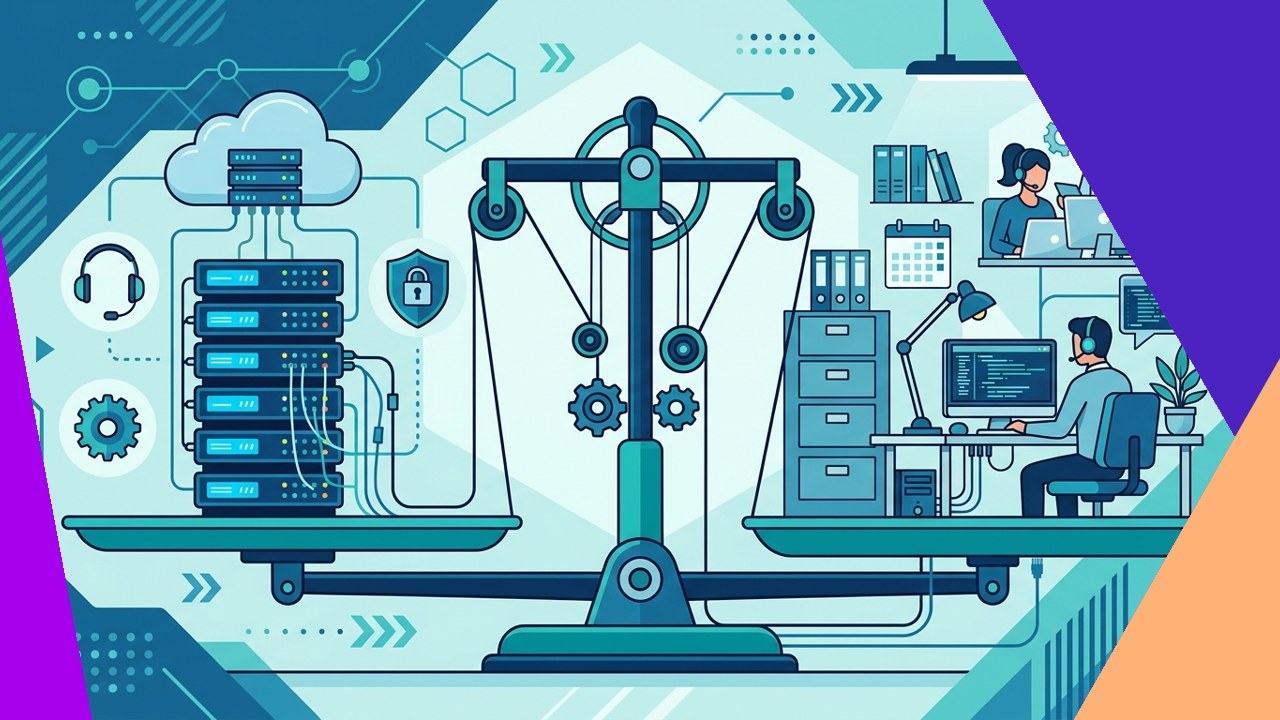
The choice of outsourcing vs in-house IT comes down to a trade-off between control and flexibility. An in-house team sits inside your business, learns its quirks, and answers only to you. An outsourced partner brings broader skills, faster scaling, and a lower fixed cost, but adds a layer of distance you have to manage.
Neither model is universally better. A five-person startup and a 500-person manufacturer will weigh cost, security, and response time very differently. This guide compares both options across the factors that actually decide the outcome, then gives you a simple way to choose.
What each model actually covers
IT is not one job. Before you compare, separate the four buckets most companies need to cover, because the answer can differ for each.
Help desk and end-user support
Password resets, laptop issues, software access, and onboarding. This work is high volume and fairly standardized, which makes it one of the easiest functions to outsource without losing much.
Infrastructure and networks
Servers, cloud environments, connectivity, and backups. Cloud has shifted much of this to managed and outsourced models, though companies with heavy on-premise or compliance needs often keep a hand on it internally.
Security and compliance
Threat monitoring, patching, access control, and audits. Specialized security talent is scarce and expensive, which pushes many firms toward outsourced monitoring even when they keep other IT in-house.
Development and application support
Building and maintaining the software your business runs on. If that software is your product, the case for internal ownership is strongest here. If it is a supporting tool, external teams often make sense. Outsource Accelerator’s overview of the five main areas of IT outsourcing services breaks these categories down further.
Outsourced IT vs in-house IT: a side-by-side comparison
The table below maps the two models across the factors that most often decide the call. Read it as tendencies, not absolutes, since a strong provider or a strong internal hire can shift any single row.
| Factor | Outsourced IT | In-house IT |
|---|---|---|
| Cost structure | Variable and predictable; you pay for a defined scope with no benefits or overhead | Fixed; salaries, benefits, training, and idle time whether or not work is flowing |
| Control and context | Lower; governed by contracts and SLAs, less day-to-day visibility | Higher; direct oversight and deep knowledge of your systems and culture |
| Response time | Fast for covered scope, often 24/7; slower for anything outside the agreement | Immediate for on-site issues; limited to team size and working hours |
| Security | Access to specialized tools and analysts; adds third-party data exposure to manage | Full internal control; harder to staff scarce security expertise affordably |
| Scalability | High; add or reduce capacity quickly without hiring cycles | Slow; constrained by recruitment, ramp-up, and headcount budgets |
| Specialized skills | Broad bench across many technologies on demand | Limited to what you can hire and retain; deep in your stack, narrow elsewhere |
| Best fit | Startups, lean teams, variable workloads, non-core IT | IT-centric firms, strict compliance needs, product engineering |
Cost, control, and the skills gap
Cost is where outsourcing makes its clearest case. An in-house hire carries salary plus benefits, tools, training, and downtime between projects. An outsourced arrangement converts that fixed load into a variable expense tied to actual scope.
Rising demand keeps internal IT expensive. Gartner forecast that worldwide IT spending would grow 9.8 percent in 2025, a signal that talent and tooling costs are climbing, not easing.
Security is the sharpest example of the skills gap. The U.S. Bureau of Labor Statistics projects employment of information security analysts to grow 29 percent from 2024 to 2034, “much faster than the average for all occupations,” with a median wage of $124,910. For most small and midsize firms, hiring and keeping that talent full time is out of reach, which is why outsourced security monitoring is often the pragmatic route.
Control is the counterweight. When IT lives inside the building, you set priorities directly, resolve issues face to face, and keep sensitive knowledge in-house. That matters most when systems are core to how you make money.
Which fits which company
Company stage is a useful proxy, even if it is not the whole story.
Startups and small teams
Limited budgets and no room for idle specialists make outsourcing attractive. Outsourced help desk, cloud management, and security let a lean team run enterprise-grade IT without enterprise headcount.
Growing mid-market companies
This is hybrid territory. Keep a small internal lead who owns strategy and vendor relationships, and outsource volume work like support and monitoring. The advantages and disadvantages of outsourcing tend to balance out best at this stage.
Large or IT-centric enterprises
When software is the product or compliance is strict, internal ownership of core systems is worth the cost. Even here, most enterprises still outsource commodity functions to keep internal teams focused on high-value work.
How to decide
Work through these questions in order, and the answer usually becomes clear.
1. Is this function core to your product?
If IT is what customers pay for, keep it in-house. If it supports the business but is not the business, outsourcing is safer to consider.
2. How sensitive and regulated is the data?
Highly regulated data may argue for internal control, or at minimum a partner with proven compliance credentials and tight contractual safeguards.
3. How predictable is the workload?
Steady, full-time demand favors a permanent hire. Spiky or seasonal demand favors a partner you can scale up and down.
4. What can you realistically staff and retain?
If the skills you need are scarce or expensive to keep busy year-round, an outsourced bench often delivers more capability for less risk.
Frequently asked questions
Is outsourcing IT cheaper than hiring in-house?
Usually, for a defined scope. Outsourcing removes benefits, training, and idle-time costs and converts them into a variable fee. In-house can be cheaper only when demand is high, constant, and core enough to keep a specialist fully utilized.
Can I outsource only part of my IT?
Yes, and most companies do. A common split keeps strategy and critical systems internal while outsourcing help desk, infrastructure monitoring, and security. This hybrid captures cost savings without giving up control of what matters.
Does outsourcing IT create security risks?
It changes them rather than simply adding them. A capable provider brings tools and expertise most firms cannot staff alone, but you take on third-party access to manage through contracts, access controls, and audits. Vet the partner’s security posture before signing.
How fast can an outsourced team respond compared to in-house?
For issues inside the agreed scope, outsourced teams often respond faster and around the clock. For anything outside the contract, or for hands-on physical fixes, an on-site internal team is quicker.
Key takeaways
- Outsourced IT leads on cost, scalability, and specialized skills; in-house IT leads on control, context, and on-site response.
- Split the decision by function: help desk, infrastructure, and security are common outsourcing wins, while core product development often stays internal.
- Decide with four questions: is it core, how sensitive is the data, how predictable is the workload, and can you realistically staff it.
- For most companies the strongest answer is hybrid, pairing a lean internal core with outsourced partners for volume and specialized work.






 Independent





