
Why startups are building their AI teams offshore before hiring a single local employee


- The global AI talent shortage is pushing startups offshore before local pipelines are exhausted
- Offshore AI teams offer access to ML engineers, data scientists, and LLM specialists at a fraction of local hiring costs.
- Going offshore-first extends startup runway and cuts time-to-hire significantly, enabling product development to begin before a local engineering function is even established.
- Offshore AI teams that are integrated into the product workflow — not isolated task executors — produce materially better outcomes than bolt-on contractor arrangements.
- Outsourced connects startups with dedicated AI professionals from the Philippines through an AI-augmented recruitment process.
The old startup playbook said hire locally first, then expand offshore once the product scales. A growing number of AI-era startups are doing the reverse.
Before posting a single local engineering job, they are building dedicated offshore AI teams.
This is not purely a cost play. It is a response to an AI talent market where local pipelines are slow, salaries are inflated, and competition from well-resourced incumbents makes early-stage hiring increasingly difficult.
This article covers what is driving the shift, what an offshore AI team actually includes, and what determines whether the model accelerates or slows product development.
Why the local AI talent market is not working for most startups
In high-cost engineering markets, the scarcity is genuine. Machine learning engineers, LLM fine-tuning specialists, and AI infrastructure engineers are in short supply relative to demand.
According to a Forbes Business Council analysis of the AI talent market, 85% of tech leaders have delayed critical AI initiatives due to talent shortages, and 67% report that filling top engineering roles takes four months or more.
The problem compounds for startups. Big Tech and well-funded scale-ups can offer salaries and equity that pre-product companies cannot match. Startups that wait for local hires often wait months and still lose candidates to better-resourced competitors.
Offshore markets in Southeast Asia have grown AI engineering capacity significantly. The gap between available talent and accessible talent has become exploitable for founders who move early.
What building an offshore AI team actually means
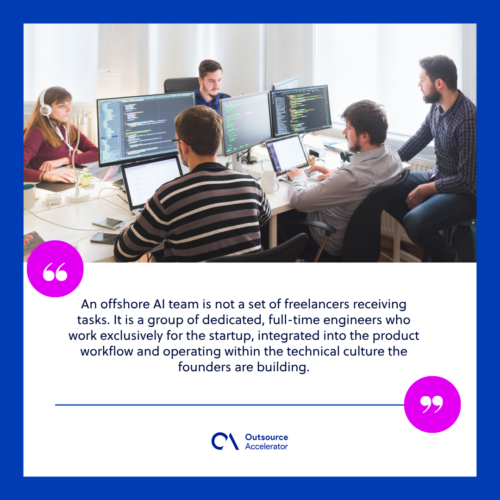
An offshore AI team is not a set of freelancers receiving tasks. It is a group of dedicated, full-time engineers who work exclusively for the startup, integrated into the product workflow and operating within the technical culture the founders are building.
The most common roles in an offshore AI team include:
- ML engineers and deep learning specialists
- Data scientists and data pipeline engineers
- Python developers and backend engineers supporting AI infrastructure
- NLP and LLM fine-tuning specialists
- MLOps engineers managing model deployment and monitoring
- AI infrastructure engineers
Including QA and at least one offshore technical lead from the start significantly reduces coordination overhead. The temptation to offshore only the coding function — keeping architecture and QA onshore — creates the bottlenecks it was meant to avoid.
The speed and cost case for going offshore-first
Offshore hiring timelines for specialist AI roles are typically shorter than local equivalents. Without the bidding wars of high-cost engineering markets, a startup can move from brief to offer in two to four weeks for roles that would take three to five months locally.
The cost difference is substantial. Analysis of distributed work patterns across industries finds that approximately 70% of managers report well-structured offshore configurations enhance overall productivity.
The offshore-first advantage compounds cost savings with faster development velocity.
For a seed-stage startup, the burn rate difference between an offshore-first and a locally-anchored AI team often determines how many product iterations are possible before the next fundraise.
Offshore-first teams also reach early development milestones faster, because they are not waiting for local hiring timelines to resolve before writing the first line of product code.
What to get right before you build offshore
- Define AI role profiles precisely — “ML engineer” covers a wide range of specializations, and mismatches in technical background are harder to correct offshore than locally.
- Plan the integration structure upfront — How will the offshore team attend planning and retrospectives, who owns escalation, and what async documentation standards will apply across time zones?
- Establish IP and confidentiality frameworks early — Offshore AI development should operate under the same IP assignment and NDA protections as any local engineering hire.
- Name an offshore technical lead from day one — This single decision determines whether the offshore team operates with product context or in isolation.
- Choose a partner with AI-specific hiring capability — A generalist staffing provider sourcing AI engineers will take significantly longer and produce weaker technical matches than one with a specialist AI talent pipeline.
Build your offshore AI team with Outsourced
Outsourced connects startups and growing businesses with dedicated AI professionals from the Philippines, from ML engineers and data scientists to LLM fine-tuning specialists and AI infrastructure engineers.
Their AI-augmented recruitment process matches candidates to the startup’s technical stack and culture, with HR, compliance, and facilities handled end to end.
- 98% staff retention rate across a client base that includes Mimecast and Genesys
- AI-specific talent sourcing covering ML engineers, data scientists, NLP specialists, MLOps engineers, and AI infrastructure roles
- Dedicated model — offshore engineers work exclusively for the client and integrate into sprint cycles, not a pooled contractor arrangement
- Full back-office coverage spanning HR, compliance, payroll, and IT infrastructure so founders stay focused on the product
Explore Outsourced’s AI staffing capabilities and start building the offshore AI team your startup needs.
Frequently Asked Questions
Common questions about building and managing an offshore AI team as a startup.
What AI roles can realistically be hired offshore?
ML engineers, data scientists, Python developers, AI model trainers, NLP and LLM specialists, MLOps engineers, and AI infrastructure engineers are all commonly hired offshore. The Philippines in particular has a growing pool of AI-trained professionals with experience in mainstream frameworks and cloud platforms.
Is offshore AI talent as capable as local hires?
At the right partner, yes. Output quality depends on the selection process, technical vetting rigor, and how well the offshore team is integrated into the startup’s product workflow.
An isolated offshore team receiving task lists will underperform relative to one embedded in sprint planning and product context.
How quickly can a startup build an offshore AI team?
Offshore typically moves faster than local for specialist AI roles. With a partner who has an existing AI talent pipeline, initial placements can happen within two to four weeks of a confirmed brief. Timelines vary by role complexity and the partner’s depth of specialization.
Key takeaways
- Local AI talent markets are expensive and slow for most startups, particularly in high-cost cities where competition from larger employers is most intense.
- Offshore AI teams offer comparable technical skill at significantly lower cost, with faster hiring timelines that do not require a local engineering market to clear.
- Going offshore-first extends startup runway and accelerates product development by removing the dependency on slow local pipelines.
- Outsourced provides dedicated AI talent from the Philippines with a specialized recruitment process, a 98% retention rate, and full back-office management for founders.






 Independent





