
What healthcare organizations should look for in a HIPAA-compliant BPO partner


What should healthcare organizations look for in a HIPAA-compliant BPO partner?
Look for a signed BAA, verified administrative, physical, and technical safeguards, and real healthcare BPO experience, because the covered entity keeps the compliance responsibility.
- HIPAA compliance for a BPO partner isn’t a certification. Instead, it is a set of administrative, physical, and technical requirements that govern how protected health information is handled, and it’s the covered entity’s responsibility to verify them.
- The Business Associate Agreement (BAA) is the legal foundation. Without one in place before any PHI is shared, the arrangement is non-compliant regardless of the BPO’s internal practices.
- Beyond the BAA, healthcare organizations need to assess staff training, access controls, breach notification protocols, and audit trail capabilities before engaging any offshore or outsourced service provider.
- ContactPoint 360 provides HIPAA-compliant BPO services for healthcare organizations, covering patient support, revenue cycle operations, and healthcare contact center delivery.
Healthcare organizations outsource many tasks that touch patient data. For example, this includes billing, patient support, prior authorization, and clinical scheduling. So they take on a compliance duty that does not transfer to the vendor.
The vendor can be HIPAA-ready. Still, the job of choosing a compliant vendor, checking their practices, and keeping the contract in place stays with the covered entity.
This is why choosing a healthcare BPO partner needs a different process than choosing one for general work. So the compliance checklist is neither optional nor one-time. For a baseline, the HIPAA compliance glossary covers the core rules that these arrangements must follow.
What HIPAA compliance actually requires from a BPO
Any BPO that handles PHI becomes a business associate. So its duties fall into three categories under the HHS Security Rule.
Administrative safeguards
The BPO must keep documented policies for handling PHI. In addition, it must name a Privacy and Security Officer and run regular staff training. So staff who handle patient data need training on what PHI is, how to use it, and what counts as a breach. Annual training is not enough when turnover is high. Instead, training must finish before access is granted, not once a year in bulk.
Physical safeguards
Access to workstations that handle PHI must be controlled. For example, this means locked workstations, screen privacy filters, and restricted entry to PHI areas. In addition, policies should block personal device use or photos near PHI. For offshore BPO sites, these safeguards need in-person checks, not just a policy document.
Technical safeguards
Technical safeguards cover encryption for PHI at rest and in transit. In addition, they include unique user IDs, automatic session timeouts, and audit logs. So the logs record who accessed what data and when. The audit trail matters most here. In fact, it is the evidence base for breach investigations and for proving compliance to regulators.
The BPO vetting checklist for healthcare organizations
| Requirement | What to verify |
|---|---|
| Business Associate Agreement | Executed before any PHI is shared; covers all required elements under 45 CFR 164.504 |
| Staff HIPAA training | Pre-access training, not annual-only; documented completion records |
| Access controls | Unique user IDs, role-based access, automatic lockout, no shared credentials |
| Physical environment | Controlled access, screen privacy, no PHI on personal devices |
| Data encryption | At rest and in transit; encryption standards verified, not self-certified |
| Breach notification protocol | Defined timeline for notifying covered entity; meets 60-day HIPAA requirement |
| Audit trail capability | System logs that record access by user, timestamp, and data type |
| Subcontractor management | Any subcontractor the BPO uses to handle PHI must also be under a BAA |
The HHS Office for Civil Rights breach portal makes clear that business associates play a role in many reported HIPAA breaches. So picking a BPO on price or capability alone, with no compliance review, is a common path to a reportable incident. For back-office tasks, a provider with proven healthcare back office services can lower that risk.
What healthcare-specific BPO experience actually provides
A general BPO that adopted HIPAA policies is not the same as one that has served healthcare for years. So healthcare-specific BPO experience means the following.
- Staff who grasp the sensitivity of PHI without needing to be convinced of it
- Managers who recognize compliance edge cases
- Processes built around healthcare workflows, not adapted from general service models
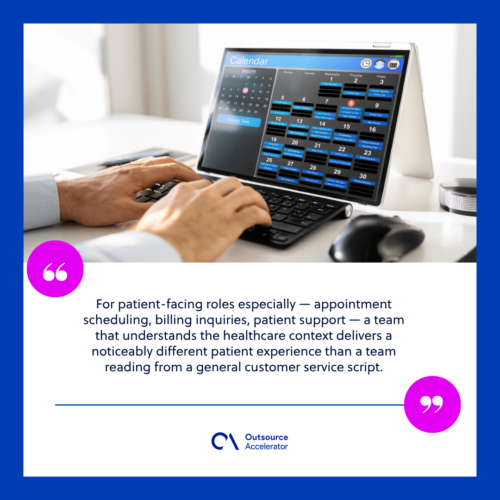
For patient-facing roles especially, like appointment scheduling, billing inquiries, and patient support, context matters a lot. So a team that knows healthcare delivers a better experience than one reading a general script. Steady patient care management depends on that know-how.
The broader context of healthcare outsourcing and how it supports patient-centric care is well-documented. Meanwhile, outsourced medical call centers address the patient-facing model specifically. For billing-heavy work, strong revenue cycle management and medical billing support keep claims moving.
How ContactPoint 360 serves healthcare organizations
ContactPoint 360 provides BPO services for healthcare organizations with HIPAA-compliant infrastructure, trained healthcare operations teams, and the BAA framework required for any engagement involving PHI.
- HIPAA-compliant contact center operations: patient support, scheduling, and billing inquiries
- Revenue cycle support: claims processing, prior authorization follow-up, and payment support
- BAA executed as standard for all healthcare engagements
- Staff training on HIPAA requirements and healthcare communication standards
- Technical infrastructure: access controls, encrypted data handling, and audit trail capability
Learn more at contactpoint360.com.
FAQs
Is a BAA enough to make a BPO arrangement HIPAA compliant?
No. The BAA is necessary but not sufficient. For example, it sets the legal framework. Still, real compliance depends on whether the BPO meets the administrative, physical, and technical safeguards. So a covered entity that signs a BAA with a weak vendor lowers its exposure a bit. However, it has not removed its compliance duty. In short, you must verify actual practices.
Can offshore BPO teams handle HIPAA-regulated work?
Yes. HIPAA does not ban offshore handling of PHI. Instead, it requires proper safeguards regardless of location. So the covered entity must confirm the offshore partner meets HIPAA rules. In addition, the BAA must be in place, and technical safeguards must apply to the offshore setup, not just US-based systems.
What should a healthcare organization do if a BPO experiences a breach?
The BAA should require the business associate to report breaches fast. As a result, the covered entity can meet HIPAA’s 60-day deadline. The covered entity then checks whether the breach meets the notification threshold under the Breach Notification Rule. So review the BPO’s breach protocol before signing the BAA. In short, it is part of standard due diligence.
How often should you re-verify a BPO’s HIPAA compliance?
Treat it as ongoing, not one-time. For example, re-check training records, access controls, and subcontractor BAAs on a set schedule. So annual reviews plus checks after any major staffing or system change work well.
Key takeaways
- HIPAA compliance for a BPO isn’t self-certified. Instead, it requires verified administrative, physical, and technical safeguards, plus a BAA executed before any PHI is shared.
- The covered entity retains compliance responsibility: selecting a vendor without verifying their practices doesn’t transfer liability.
- Healthcare-specific BPO experience matters for patient-facing roles: teams trained in healthcare context deliver better patient experiences and handle compliance edge cases more reliably.
- ContactPoint360 provides HIPAA-compliant BPO for healthcare organizations, with the contractual framework, trained staff, and technical infrastructure required for PHI-handling engagements.






 Independent





