
A marketer’s guide to modern account-based marketing (ABM)

- Account-based marketing flips the traditional funnel by targeting specific high-value accounts rather than broad audiences.
- Alignment between sales and marketing teams remains the single most important factor for ABM success.
- Agentic AI now allows businesses to scale hyper-personalized outreach without losing the human touch.
- Measuring ABM success requires a focus on account engagement and pipeline velocity rather than raw lead counts.
Global B2B commerce operates in an environment of extreme noise. Data from ITSMA shared by Insights ABM reveals that 87% of marketers say that account-based marketing (ABM) delivers higher ROI than any other marketing investment.
You can’t afford to waste your budget on broad-spectrum campaigns that reach thousands of people who will never buy your product.
Modern business growth requires a surgical approach. You need to identify the accounts that provide the highest lifetime value and treat each one as its own individual market.
So, this guide explores how you can leverage current technology and human psychology to dominate your niche using ABM.
What is account-based marketing (ABM)?
Account-based marketing or ABM is a strategic growth framework where marketing and sales teams collaborate to create personalized buying experiences for a mutually identified set of high-value accounts. You essentially ignore the masses to focus on the few.
In a traditional inbound model, you cast a wide net and hope to catch a few qualified leads. With ABM, you start by identifying the exact fish you want to catch and then design a specific lure for each one.
This approach acknowledges that B2B buying decisions are rarely made by one person. On average, Forbes says six to ten stakeholders are involved in a typical B2B purchase.
ABM ensures you are influencing every member of that buying committee with content that addresses their specific pain points. Remember, you’re not selling to a person, but are selling to an entire organization.
5 benefits of using an ABM strategy
Adopting a targeted framework allows your organization to concentrate its most valuable resources on the opportunities most likely to generate significant revenue. Here are the advantages:
1. Improved marketing and sales synergy
Most organizations struggle with the handoff between marketing and sales. ABM eliminates this friction by making both teams accountable for the same revenue goals.
You no longer argue about lead quality because both teams agreed on the target account list from day one. This unity results in a seamless experience for the prospect, who feels like they’re dealing with one cohesive brand rather than disconnected departments.
2. Higher Average Contract Value (ACV)
When you focus your energy on high-value targets, your contract sizes naturally increase. You wouldn’t be chasing small, low-margin deals to hit a lead quota.
By providing a premium, personalized experience to enterprise-level accounts, you justify a higher price point. Your team spends more time on deep-value conversations and less time on transactional volume.
3. Zero-waste resource allocation
Traditional marketing often leads to spray-and-pray tactics, where half of your budget is effectively wasted.
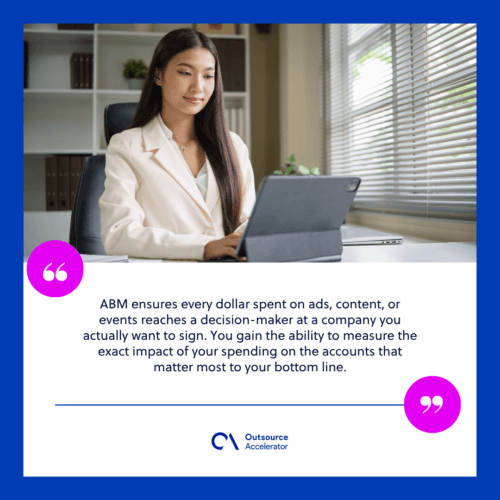
ABM ensures every dollar spent on ads, content, or events reaches a decision-maker at a company you actually want to sign. You gain the ability to measure the exact impact of your spending on the accounts that matter most to your bottom line.
4. Faster sales cycles
B2B sales often stall because one stakeholder remains unconvinced. ABM targets the entire buying committee simultaneously. By proactively answering the CFO’s questions about ROI and the CTO’s questions about security, you remove bottlenecks before they appear.
This coordinated pressure leads to faster consensus within the target company and a quicker path to a signed contract.
5. Enhanced account resilience and expansion
Beyond the initial sale, ABM builds a foundation of deep institutional trust that protects your footprint within an organization. You become indispensable, making it significantly harder for competitors to displace you by continuously delivering personalized value to multiple stakeholders.
This multi-threaded relationship also uncovers hidden opportunities for upselling and cross-selling that standard account management often misses.
Advancements in account-based marketing
The original iterations of account-based marketing relied heavily on manual research and high-effort outreach. You had to spend weeks mapping a company’s hierarchy and guessing which messages would resonate.
Today, intent data (enhanced by the rise of AI) has become the enabler of the modern ABM stack. You can now see when a target account is researching specific keywords or visiting competitor websites before they ever land on your own page.
The Insight Collective even revealed the prominence of this. It shared that around 40% of organizations are allocating over half of their marketing budget to collecting intent data. Almost 70% of those businesses are also planning to increase their investments in it.
Furthermore, dark social and community-led growth have changed how influence works. Modern ABM platforms can now deanonymize website traffic, telling you exactly which companies are lurking on your site, even if they haven’t filled out a form.
You’d be moving from a reactive stance to a proactive one. You’re engaging with accounts at the exact moment their interest peaks, which gives you a significant competitive advantage.
Scaling ABM personalization with agentic AI
The biggest historical hurdle for ABM was scalability. You could personalize for 10 accounts, but personalizing for 1,000 felt impossible. Agentic AI has solved this problem.
Unlike simple chatbots or generative text tools, agentic AI can perform tasks autonomously across different platforms. These agents can research a prospect’s latest quarterly report, find a specific pain point mentioned by their CEO, and draft a unique value proposition tailored to that information.
You can now use AI to create micro-sites for individual accounts automatically. These sites can display case studies relevant only to that account’s industry and region.
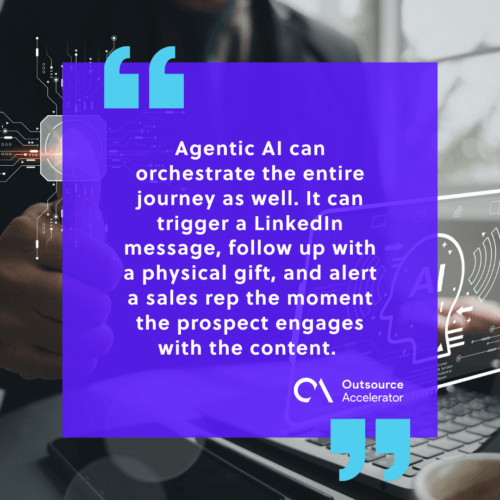
Agentic AI can orchestrate the entire journey as well. It can trigger a LinkedIn message, follow up with a physical gift, and alert a sales rep the moment the prospect engages with the content.
This allows you to maintain a tier-one level of personalization for hundreds of accounts simultaneously.
Navigating the human side of modern ABM
Despite the technological leaps, B2B buying remains a deeply human process. People buy from people they trust.
The danger of AI-driven ABM is the uncanny valley, where communication feels just “off” enough to be annoying. You must guard against over-automation. Use your technology to handle the research and the initial heavy lifting, but ensure your sales reps provide the final layer of human empathy.
Success in modern ABM requires your team to act as consultants, not just vendors. You need to show that you understand the target account’s internal politics, its competitive threats, and its long-term vision.
This level of insight can’t be faked by a machine. Your marketing should open the door by demonstrating relevance, but your human team must walk through it by building genuine rapport.
Gain strategic momentum by leveraging modern ABM
Strategic momentum occurs when your marketing efforts build on themselves, creating a snowball effect of authority and trust. By consistently appearing where your target accounts spend their time, you become the obvious choice.
The key to this momentum is consistency. Account-based marketing is not a one-off campaign but a fundamental shift in how you go to market. It requires patience.
The sales cycles for high-value accounts can be long, but the rewards are transformative. When you stop chasing every lead and start pursuing the right accounts, you regain control over your company’s growth trajectory.
The market has shifted toward precision, too. You can either continue to compete for scraps in the broad market, or you can focus your resources on the accounts that will define your future.
ABM is the most effective way to ensure your message reaches the right ears at the right time. By combining the scale of agentic AI with the irrefutable power of human connection, you position your firm as a leader in your field.
FAQs
What is the first step in starting an ABM program?
The most critical first step is defining your ideal customer profile (ICP). You must look at your current most successful clients and identify the common traits they share, such as industry, annual revenue, and technology stack.
Once you have this profile, you can build a list of target accounts that match these criteria perfectly. Without a clear ICP, your ABM efforts will lack the focus required to succeed.
Does ABM work for small businesses or just large enterprises?
While ABM is often associated with large enterprise deals, it’s highly effective for any business that has a specific, high-value target market.
Small businesses often benefit more from ABM because they have limited resources and can’t afford to waste the budget on broad advertising. By focusing your limited spend on 20 or 50 high-potential accounts, you can compete with much larger competitors who are distracted by broad-market volume.
How do you measure the success of an ABM campaign?
Veer away from traditional metrics like cost per lead or click-through rate. Instead, focus on account-level KPIs:
- Account Engagement (the percentage of target accounts interacting with your content)
- Pipeline Velocity (the speed at which those accounts move through your sales cycles)
- Target Account Pipeline Value (the total revenue potential generated specifically from your target list)
Ultimately, the most important metric is the win rate within your target account group compared to your non-ABM leads.
Key takeaway
Account-based marketing is the ultimate strategy for high-stakes B2B growth. By aligning your sales and marketing teams around a core list of high-value accounts, you eliminate waste and build deep, lasting authority.
Use technology to scale your research, but use your people to build the trust that ultimately closes the deal.






 Independent





