
5 common types of inbound customer support (and how to implement effectively)


- Reliable inbound customer support drives customer loyalty, increases revenue, and creates a strong competitive advantage in global markets.
- Knowing the five types of inbound customer support helps businesses structure service operations effectively.
- Clear signs, such as long response times and scaling challenges, indicate when outsourcing becomes a smart move.
Reliable customer support is among the major defining factors in business success and brand loyalty. Exceptional support experiences not only resolve issues but also strengthen trust, drive repeat purchases, and differentiate a company from competitors.
According to Zendesk’s customer experience research, 3 in 4 consumers will spend more with businesses that provide a good customer experience. This only highlights how impactful quality support can be on revenue and customer retention.
For many organizations, offering consistent, responsive support is no longer a nice‑to‑have, as it is a strategic advantage that shapes long‑term growth.
This article covers the signs that a business might benefit from outsourcing support functions, and the most effective types of inbound customer support. More importantly, how does partnering with a leading BPO, such as SixEleven, improve customer care operations?
Signs companies need external inbound customer support
Growing businesses often reach a point where internal teams can no longer manage customer demand efficiently. Rising inquiries, higher service expectations, and expanding markets can stretch resources thin.
When support quality starts to decline, leadership should evaluate external inbound customer support as a strategic solution.
Common signs include:
- Longer response and resolution times. Customers wait too long for replies, leading to frustration, negative reviews, and lost revenue opportunities.
- Overwhelmed in-house teams. Employees juggle multiple roles, which affects productivity, morale, and service consistency.
- Inconsistent customer experiences across channels. Phone, email, and chat interactions deliver varying service quality, damaging brand credibility.
- Difficulty scaling during peak seasons. Sudden spikes in inquiries create backlogs that internal teams cannot manage effectively.
- Limited access to advanced tools and analytics. Companies lack the infrastructure or expertise to optimize performance and track meaningful metrics.
- Expansion into new markets or time zones. Global growth demands round-the-clock coverage and multilingual support.
Recognizing these indicators early allows companies to maintain service standards while supporting long-term growth.
5 common types of inbound customer support
Every customer reaches out for a reason. Some need quick answers, others require detailed assistance.
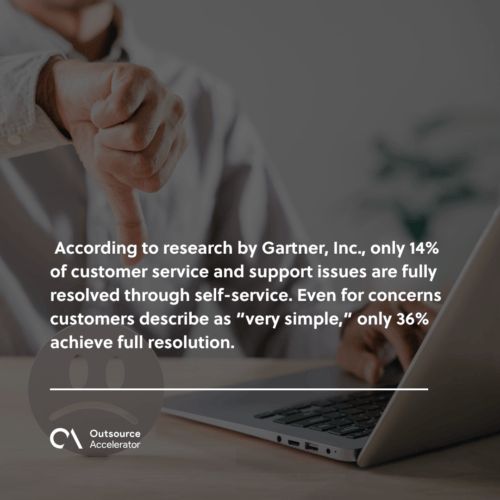
Self-service helps, but it does not solve everything. According to research by Gartner, Inc., only 14% of customer service and support issues are fully resolved through self-service. Even for concerns customers describe as “very simple,” only 36% achieve full resolution.
Human-led inbound support still plays a critical role in delivering meaningful customer experiences.
| Type | Primary focus | Business impact |
| Customer service | General inquiries and complaints | Improves satisfaction and loyalty |
| Technical support | Product or system troubleshooting | Reduces churn and downtime |
| Order processing | Purchases and transactions | Streamlines revenue flow |
| Help desk | Product guidance and non-technical issues | Strengthens product adoption |
| Customer retention & upselling | Account management and upgrades | Increases customer lifetime value |
Here we have the five common types of inbound customer support:
1. Customer service
Customer service forms the backbone of inbound support. Agents handle inquiries, complaints, billing questions, and product information requests across phone, email, chat, and social media.
Companies implement this type effectively by defining clear KPIs such as response time, first-call resolution, and satisfaction scores. Skilled agents who communicate clearly and empathetically can turn routine interactions into positive brand experiences.
2. Technical support
Technical support assists customers facing product or system-related challenges. Agents troubleshoot software errors, guide hardware setup, and resolve complex issues using CRM systems, knowledge bases, and remote support tools.
AI-powered assistants can handle repetitive tasks, allowing specialists to focus on complex cases. Strong product knowledge and structured workflows improve resolution speed and customer confidence.

3. Order processing
Order processing teams manage purchases, payments, order tracking, and related inquiries. Automation tools reduce manual errors and speed up workflows, while CRM integration allows agents to access purchase history for personalized service.
Efficient order management supports revenue growth and creates a smoother buying journey.
4. Help desk
Help desk support addresses non-technical questions about products or services. Agents provide guidance, clarify policies, and assist customers who need deeper product understanding.
Comprehensive training and accessible knowledge systems help agents deliver accurate responses quickly across multiple communication channels.
5. Customer retention and upselling
Retention-focused inbound teams handle cancellation requests, subscription changes, and upgrade inquiries. Agents identify opportunities to offer better-fit plans or added services based on customer needs.
Thoughtful conversations during critical touchpoints can strengthen loyalty and increase long-term value.
Reliable inbound customer support solutions with SixEleven
SixEleven helps global businesses strengthen customer relationships through scalable, high-performance inbound support solutions. Experienced agents, advanced technology, and data-driven strategies allow companies to improve response times and elevate service quality.
Connect with SixEleven today to build a customer support operation that drives loyalty, growth, and measurable results!
Frequently Asked Questions (FAQs)
Below are additional insights that address common concerns about inbound customer support outsourcing.
How does data security work in outsourced inbound customer support?
Reputable BPO providers implement strict data protection protocols, including secure networks, encrypted systems, role-based access controls, and compliance with international standards such as GDPR.
Regular audits and staff training also reduce security risks and protect sensitive customer information.
How long does it take to transition inbound support to an external provider?
Timelines vary depending on complexity, volume, and required integrations. Many transitions take several weeks and include discovery, process mapping, agent training, system setup, and pilot testing.
A structured onboarding plan minimizes disruption and maintains service continuity.
Can outsourced inbound teams match a company’s brand voice?
Yes. Dedicated onboarding, brand immersion sessions, and detailed knowledge bases help external agents align with tone and messaging guidelines.
Ongoing quality monitoring and feedback loops refine communication styles and maintain a consistent customer experience.
Key takeaways
Understanding the different types of inbound customer support helps businesses choose the right structure to meet customer expectations and operational goals.
Partnering with an experienced BPO like SixEleven allows companies to scale efficiently, improve service quality, and strengthen long-term customer relationships.






 Independent





