
Philippines BPO 2.0: Why AI-augmented Filipino teams are winning global contracts

This article is a submission by Kinetic Innovative Staffing, a leading offshoring solution provider based in Australia. Kinetic Innovative Staffing offers access to a diverse, international talent pool, serving roles across operations, customer support, marketing, IT, and back-office functions.
The Philippine IT-BPM sector finished 2025 strong, generating over $40 billion in export revenues and providing jobs for 1.9 million digital workers. Revenue climbed by 5%, and employment grew by 4%—both outpacing the global averages, which hovered around 3%.
For 2026, the IT and Business Process Association of the Philippines (IBPAP) projects $42 billion in revenues and nearly 1.97 million jobs.
This isn’t just more of the same. Traditional outsourcing, or BPO 1.0, is evolving into the Philippines’ BPO 2.0 model. This fresh strategy involves top-tier Filipino professionals working hand-in-hand with cutting-edge AI.
The result? Faster solutions, a deeper grasp of customer needs, lower costs, and better overall business results. Companies globally, especially those in fintech, e-commerce, healthcare, and SaaS, are now awarding more significant, long-term contracts to providers based in the Philippines.
The blend of human empathy and AI’s rapid processing capabilities is proving to be a compelling advantage.
Below, we answer the key questions decision-makers are asking in 2026 and show exactly how AI-augmented Filipino teams create winning advantages.
What is AI-augmented staffing in outsourcing — and why does it matter now?
AI-augmented staffing pairs talented human professionals with smart tools, enabling each individual to accomplish significantly more while maintaining a personal connection. The intention isn’t to replace humans with machines.
Instead, it’s about creating teams that combine artificial intelligence, which handles repetitive tasks, with human workers, who can use their judgment, empathy, and ability to solve complex problems.
In practice, leading Philippine operations run on three clear layers:
- Autonomous AI agents manage 75–85% of routine inquiries (billing checks, status updates, simple resets) across chat, email, or voice, escalating only when nuance is needed.
- AI copilots for human agents deliver real-time suggestions, instant customer history, and drafted replies so agents can concentrate on building relationships and solving issues.
- Specialized human experts handle high-stakes escalations, compliance, cultural context, and revenue-generating conversations—now with perfect data at their fingertips.
Forward-thinking providers already deliver ready-to-deploy AI-augmented teams. The best firms don’t just search for Filipino candidates who speak English and know their stuff. They also consider how well they adapt to AI tools.
New hires get immediate access to client-approved platforms, streamlining the onboarding process and immediately increasing their output.
This model transforms every outsourced role into a powerhouse. A single Filipino professional can now manage several AI instances simultaneously, all while delivering the personal touch and reliability that customers appreciate.
The result? Higher first-contact resolution, better satisfaction scores, and contracts that reward outcomes rather than just headcount.
Why are Filipino teams particularly well-suited for AI-augmented work?
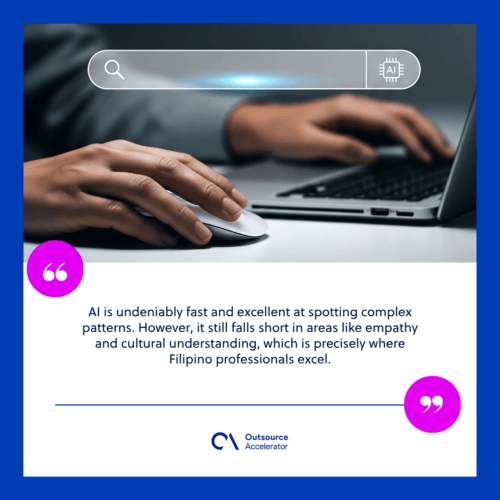
AI is undeniably fast and excellent at spotting complex patterns. However, it still falls short in areas like empathy and cultural understanding, which is precisely where Filipino professionals excel.
The Philippines has been a leader in global outsourcing for years. This is due to a combination of near-native English skills, neutral accents, and a deeply ingrained “malasakit” culture, which resonates well with Western clients, particularly those in the US and UK.
While AI can handle the mundane tasks, Filipino agents enhance the overall experience through genuine connection and sound judgment.
In head-to-head comparisons in 2026:
Versus India
India may have a significant technical advantage for back-end operations, but Philippine teams frequently achieve higher Net Promoter Scores in customer-facing roles. This is often due to better cultural fit and lower turnover in voice and customer experience positions.
Versus Vietnam
The Philippines presents an attractive and economically viable option for development, although it is still cultivating the level of English proficiency required for high-volume, empathy-driven support services.
Versus nearer-shore options (Eastern Europe or Latin America)
When contrasted with nearer-shore alternatives, such as Eastern Europe or Latin America, the Philippines faces limitations in scalability due to higher operational costs and smaller talent pools.
Furthermore, Philippine providers benefit from favorable policies, including the CREATE MORE Act, which permits up to 50% remote work while maintaining tax incentives, and a 20% corporate income tax rate for qualifying exporters.
Coupled with government and industry-led upskilling initiatives, this framework fosters a continuously evolving workforce prepared for collaboration with artificial intelligence.
Global clients choose Philippine AI-augmented teams because they get cost savings of 60–75% compared with onshore operations, plus the cultural fit that feels almost local — all powered by intelligent automation.
What real performance gains are companies seeing with AI-augmented Philippine teams?
Numbers tell the story best. Multi-client benchmarks from Philippine AI-augmented operations in 2025–2026 show consistent, impressive results:
| Metric | Traditional Model | AI-Augmented Philippine Teams | Improvement |
| Average resolution time | 4 minutes | 35 seconds | 85% faster |
| First-contact resolution | 73% | 91% | +18 points |
| Complex issue success rate | 78% | 94% | +16% |
| Customer satisfaction (CSAT) | 82% | 95% | +13 points |
| Agent productivity | 6–8 contacts/hour | 22–24 contacts/hour | 200%+ |
| Cost per contact | $6.50 | $2.15 | –67% |
Agents now spend roughly 85% of their time on high-value activities instead of repetitive tasks. AI-certified roles often come with 30–50% higher compensation, which improves retention and attracts stronger talent.
Many clients have moved to outcome-based pricing (paying for resolved cases rather than hours), which perfectly aligns incentives.
These gains explain why companies that once piloted 50-seat traditional teams are now comfortably scaling to 200+ AI-augmented seats — with positive ROI appearing in the first quarter.
Why are global companies signing bigger contracts with Philippine AI teams in 2026?
Decision-makers evaluating outsourcing partners in 2026 repeatedly cite five decisive advantages:
- Instant scalability — AI absorbs volume spikes (holiday surges, product launches) without massive hiring.
- Superior customer experience — AI speed combined with Filipino empathy consistently outperforms pure automation or lower-empathy alternatives.
- Built-in risk management — Human oversight prevents costly AI errors, especially important in regulated sectors like finance and healthcare.
- Strong compliance and security — Philippine providers maintain SOC 2, GDPR, and HIPAA-ready environments with secure “clean room” setups.
- Deep, continuously upskilled talent — IBPAP’s multi-million-dollar reskilling initiatives plus private programs keep the workforce ahead of the curve.
IBPAP President and CEO Jack Madrid captured the mindset shift: “What got us here will not be enough to take us where we need to go next.”
The industry’s focus on responsible AI scaling, higher-value services, and relentless upskilling is clearly working — non-voice work (analytics, digital marketing, AI oversight) now makes up nearly 50% of the market.
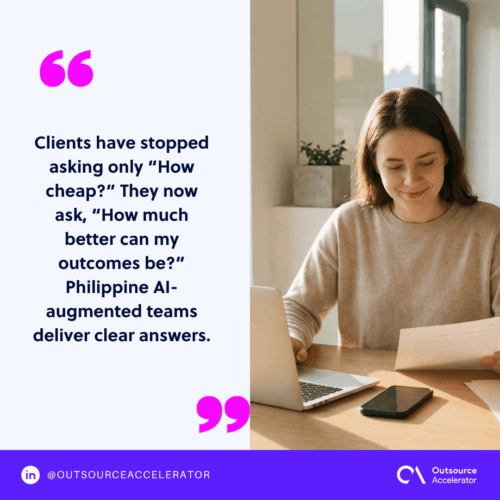
Clients have stopped asking only “How cheap?” They now ask, “How much better can my outcomes be?” Philippine AI-augmented teams deliver clear answers.
How can you successfully introduce AI-augmented outsourced staff to your operations?
Moving to AI-augmented staffing doesn’t have to be overwhelming. Here is a practical 90-day framework used successfully by many Philippine partners:
Weeks 1–2: Assess and plan
Map your current processes. Identify routine tasks ideal for autonomous AI and complex work best suited for humans. Set clear KPIs such as first-contact resolution, CSAT, cost per contact, and revenue per agent.
Weeks 3–4: Choose the right partner
Look for providers with proven AI integration experience, outcome-based pricing options, and robust data security. Providers can supply pre-vetted Filipino talent already trained on modern AI tools, so you avoid lengthy onboarding.
Weeks 5–6: Select and integrate tools
Choose enterprise-grade platforms (many Philippine BPOs have preferred, secure stacks). Start with no-code automation where possible and test integrations in a controlled environment.
Weeks 7–8: Train and manage change
Invest in targeted “AI-Human Synergetics” training — typically 50+ hours per agent covering prompt engineering, escalation protocols, and quality oversight. Filipino teams adapt quickly because they already embrace technology and continuous learning.
Weeks 9–12: Pilot, measure, and scale
Launch with a small group (10–20 agents) on one channel, such as chat or email. Track results closely, refine workflows based on data, then expand. Most organizations see clear ROI by week 10.
Tip: Begin with high-volume, lower-complexity channels before adding voice. This builds confidence and minimizes risk.
How do you measure the true ROI of AI-augmented Philippine teams?
Use these straightforward calculations:
- Productivity ROI = (New contacts handled per agent × Average value per contact) – Training and tool costs
- Cost ROI = (Traditional cost per contact – New cost per contact) × Monthly volume
- Experience ROI = (CSAT or NPS uplift × Estimated increase in customer lifetime value)
Realistic expectations for 2026: 150–250% productivity gains, 50–70% reduction in cost per contact, and 10–15 point improvements in satisfaction scores within six months. Many clients recover their transition investment in under 90 days.
What are the common challenges—and how do you overcome them?
Every transformation has hurdles. Here are the most frequent ones and proven solutions:
- Fear that AI will replace agents → Address it early and transparently. Emphasize role evolution, not elimination, and highlight the compensation uplift for AI-proficient talent.
- Data privacy and security concerns → Work with Philippine providers using private LLMs and full compliance certifications (SOC 2, GDPR, etc.).
- Integration with legacy systems → Start simple with no-code tools and phase in API connections. Most experienced BPOs have dedicated integration specialists.
- Internal resistance to change → Involve stakeholders in the pilot and celebrate quick wins publicly.
Philippine partners excel at change management because they have successfully navigated this transition themselves.
What does the future hold for the Philippines BPO 2.0?
By 2028, the industry aims for $59 billion in revenue and 2.5 million jobs. The winning formula will continue to be Filipino talent + responsible AI + continuous upskilling. Emerging opportunities include AI governance roles, predictive analytics teams, and fully outcome-based global capability centers.
Companies that adopt AI-augmented Philippine teams today will build compounding advantages: stronger customer loyalty, faster innovation, and lower operational risk.
Ready to move your outsourcing into BPO 2.0?
Philippines BPO 2.0 is not about surviving artificial intelligence — it is about thriving because of it. The unique blend of world-class English-speaking talent, cultural empathy, supportive policies, and mature AI integration gives global businesses a powerful edge.
If you are still operating with traditional outsourced teams, the opportunity to upgrade is wide open — but the window is narrowing. The contracts being signed right now strongly favor partners who can deliver both intelligence and humanity at scale.
The Philippines is ready. The talent is ready. The technology is ready.
The only remaining question is: Are you?






 Independent





