
Ghost growth: When progress on paper isn’t progress in reality


Ghost growth is the newest workplace trend quietly spreading through offices. The world of work keeps changing, and fresh trends keep reshaping how people feel about their careers. First came quiet promotion, where workers take on extra duties without formal recognition. Then came job hogging, where staff cling to roles that block internal mobility. The dry promotion trend added to the pressure too. Now ghost growth has joined the list.
According to a recent MyPerfectResume survey of 1,000 U.S. professionals, 53% say they face this hidden form of career stagnation. So let us look at what ghost growth really is, why it keeps spreading, and how it hurts both staff and the companies they work for.
What is ghost growth?
Ghost growth is the illusion of career progress without any real rise in pay, title, or authority.
- It happens when you take on more work but get no promotion, raise, or real recognition.
- It rewards visible effort rather than true skills, growth, or results.
- It leaves staff stuck between the look of success and the reality of a stalled career.
For example, a worker may lead new projects or train colleagues and expect a step up. Instead, they stay in the same role. As a result, ghost growth creates a false sense of progress. The effort looks real, but the career movement never comes.

How does ghost growth affect employees and businesses?
Career progression often looks like packed schedules, endless meetings, and new duties. Many people believe that doing more will move them up. Yet, over time, the promised growth never arrives. As a result, this quiet trap hurts both workers and the company through hidden costs.
For employees, ghost growth can lead to the problems below.
Burnout and emotional exhaustion
Ghost growth often pushes staff to take on heavier workloads with no fair reward. They put in extra hours and try hard to prove their worth. Instead of a promotion, they get more tasks and little support. As a result, energy and motivation drain away. Over time, workers start to link hard work with stress rather than pride. Chronic exhaustion also cuts focus and creativity, so steady performance gets harder to keep up.
Loss of motivation and engagement
Staff soon notice that extra effort does not lead to real advancement. As a result, early excitement turns into frustration. Raises and recognition stay out of reach, so people start to disengage. They do tasks out of duty, not passion. Meanwhile, spirit across the team suffers. Team morale drops because effort no longer brings growth. Strong employee engagement fades fast in this kind of setting. Still, even ambitious workers may stop chasing new challenges, and minimal effort becomes the norm.
Career stagnation and skill decay
Ghost growth traps staff in repeat tasks that look important but teach nothing new. Instead of growing, they get stuck in roles that only seem to advance. Over time, this limits their chances in the job market. Skills that once felt valuable start to lose their edge. Because of this, long-term growth gets harder, and the illusion of progress turns into real decline. Clear professional development goals help workers avoid this trap.
For businesses, ghost growth brings its own costs.
Decreased productivity and innovation
When staff lose energy, output drops across the board. Disengaged workers focus only on urgent tasks. As a result, they rarely explore new ideas or better ways to work. This lack of fresh thinking slows the company down. Meanwhile, a team trapped in ghost growth turns reactive, so it struggles to adapt or seize new chances.
High turnover and recruitment costs
Talented people eventually leave firms that ignore their work. High turnover then starts a costly cycle of hiring and training. It also drains time and management focus. In addition, losing skilled staff breaks up workflows and weakens the team. Because of this, quality and consistency both suffer, and so does the customer. Many retention problems trace back to this exact pattern.
Damaged reputation and employee trust
Firms that let ghost growth linger slowly lose credibility. Workers talk, and word spreads fast about places where advancement is fake. As a result, the brand looks like a poor place to work. Internally, staff begin to distrust leaders who make empty promises. Once trust breaks, rebuilding loyalty takes a long and costly effort.
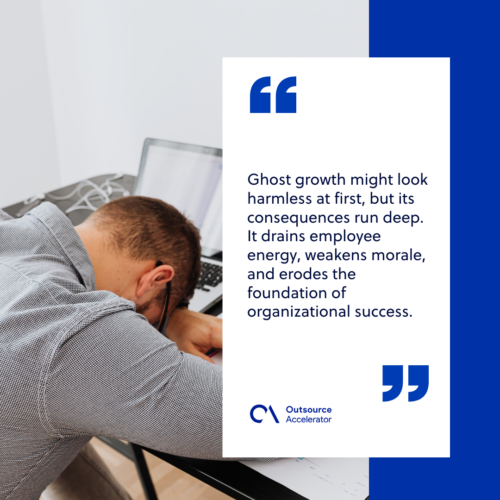
Ghost growth may look harmless at first. Still, its effects run deep. It drains energy, weakens morale, and chips away at the base of success. So for both people and companies, true progress must mean real growth, fair recognition, and genuine advancement.
3 ways to prevent ghost growth
To prevent ghost growth, leaders need to focus on real development instead of surface-level wins. Here are three simple steps that help.
1. Set transparent growth criteria
Staff need to know what real progress looks like at work. So managers should set clear milestones for raises, promotions, and new skills. When people see how effort links to reward, they focus on useful work. As a result, clear standards build accountability and push honest growth.
2. Promote skill development and learning
Real advancement depends on steady learning. So companies should fund training, mentoring, and upskilling. For example, workers can learn new tools, leadership techniques, or industry trends. Because of this, they add value and confidence. Real growth happens when people gain skills for bigger roles, not just repeat old tasks.
3. Recognize and reward meaningful progress
Praise for real work keeps staff engaged. So managers should highlight results, not just visible effort. In addition, regular feedback and reviews help align goals. As a result, people see that growth is both noticed and valued. When reward matches contribution, staff feel seen and keep improving.
In short, preventing ghost growth takes intent, openness, and steady support. With these habits, apparent progress can turn into genuine advancement.
Ghost growth: Essential FAQs
Ghost growth raises questions many workers are afraid to ask. So here are the key FAQs that clear up this hidden workplace issue.
Is ghost growth more common in fast-growing companies?
Yes, it often is. Fast-growing firms lean on staff to absorb extra work quickly. As a result, the role can look bigger without a real promotion when systems fail to keep up.
Can ghost growth happen to new employees?
It can. New hires often take on extra tasks to prove themselves. However, without clear role limits, early duties may feel like growth while offering no real progress.
Does remote work make ghost growth harder to detect?
Often, yes. Remote work can hide ghost growth because managers read more activity as development. Without a visible role change, staff may quietly carry more work unnoticed.
How can employees tell if they are experiencing ghost growth?
Watch for a few warning signs. These include more duties with no pay change, vague timelines, repeated promises with no action, and projects that do not match your career goals.
Is ghost growth always intentional on the company’s part?
Not always. It often comes from unclear processes, heavy workloads, or poor communication. Still, even unplanned ghost growth harms morale when leaders fail to act fast.






 Independent






