
Avoid worker misclassification: Complying with International Labor Laws when hiring global talent


This article is a submission by Globaltize. Globaltize is a boutique staffing agency established by seasoned entrepreneurs who have leveraged global talent to grow their businesses. They provide comprehensive staffing solutions, delivering tailored, cost-effective global talent.
What is worker misclassification and why does it matter?
Worker misclassification is labeling a full-time employee as an independent contractor, which can trigger fines, back taxes, and lawsuits.
- It denies workers benefits and legal protections they are owed.
- It exposes companies to penalties and reputational damage.
- Clear compliance and EOR support help you avoid the risk.
Hiring global talent is now easier than ever. Tools like Wise, PayPal, and Deel make cross-border payments simple. So companies can widen their reach and work with skilled people worldwide. However, easy payments do not remove the legal duties of hiring abroad.
One of the biggest risks in global hiring is compliance. In particular, worker classification causes the most trouble. Worker misclassification means hiring full-time staff under the label of independent contractors. As a result, it can lead to serious legal and financial harm.
Understanding worker misclassification
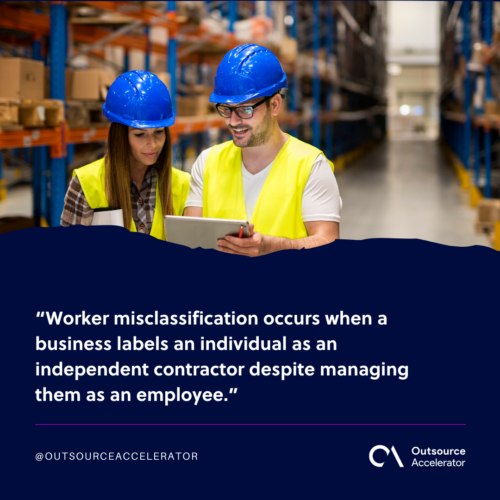
Worker misclassification happens when a business calls someone a contractor but manages them as an employee. This gap matters a lot. After all, misclassified staff miss out on key protections and benefits. For example, they lose health insurance, paid leave, and other perks.
Employers often pick the contractor model for ease and cost savings. That is because contractors do not get the same benefits as employees. However, misclassification can also start from simple confusion. Each country has its own labor laws and its own tests for worker status.
The line between an employee and a contractor is not just about titles. Instead, it is about autonomy, work patterns, and legal standing. Contractors usually work on their own. They handle several clients, set their hours, and run their own affairs.
Employees rely more on one organization. They work set hours, follow direction, and depend on that firm for steady income. So when a company hires a contractor but manages them like staff, it risks non-compliance. As a result, penalties and back payments may follow.
Pitfalls of paying global talent as contractors
Payment platforms make transfers simple. Still, they do not fix legal classification. It is easy to pay a contractor abroad. Yet that does not ensure compliance with local labor laws.
Consider the control test. A contractor should control how they do the work. But what if a company sets the tasks, the hours, or acts as the main income source? Then the worker may legally count as an employee. So hiring under contractor terms just for convenience can create real exposure.
This model may suit short projects or special tasks. However, it gets risky when the arrangement runs on and on. It is riskier still when the work is full-time and core to the business. In the gig economy, these lines can blur fast.
Key differences between independent contractors and employees
The main split comes down to autonomy and dependence. Independent contractors usually run as their own business by:
- Setting their schedules
- Owning their equipment
- Serving multiple clients
Employees, on the other hand, are usually required to:
- Follow company schedules
- Use company-provided resources
- Depend on a steady paycheck from one organization
Getting this wrong can cause serious compliance issues. That risk grows as labor laws tighten worldwide. For example, an employer that controls a worker’s methods and hours shows an employee relationship. In that case, the worker is likely an employee, even if labeled a contractor.
Contractors, by contrast, get more freedom on when and how they work. This split goes beyond legal terms. In fact, it also shapes the working bond and what each side can expect.
Consequences of worker misclassification
Global labor laws now treat classification with more care. So many countries crack down on firms that label employees as contractors. After all, this often strips workers of key benefits and protections. Penalties for non-compliance can include:
- Fines
- Lawsuits
- Obligation to pay retroactive benefits
For example, in the US, guilty firms may owe back taxes, benefits, and penalties. They may also have to correct tax forms such as the 1099-NEC for contractors. In the European Union, penalties can be even harsher. That is because worker protections there are very strong.
Financial penalties are not the only risk. Worker misclassification can also hurt a company’s name. It can damage trust with both staff and the public. As a result, legal issues can scare off good hires. They can also strain ties with current staff, especially in today’s open global job market. In addition, fixing the problem later drains time and resources from real growth.
How EOR services simplify global hiring
To avoid these risks, many companies now use Employer of Record (EOR) services. An EOR acts as the legal employer for international hires. So it handles compliance with local labor laws. It also manages everything from payroll to benefits.
Because the EOR handles the hard parts, global hiring gets simpler. As a result, firms lower their risk as they expand across borders. An EOR lets a business scale abroad while staying compliant in each country. So instead of learning every local law, firms rely on the EOR to manage duties, taxes, and benefits.
This setup cuts admin work and protects fair treatment under local rules. For businesses, it is a smart way to run a global team. Best of all, they do not need a legal entity in every country. Many pair an EOR with global payroll software to keep pay accurate.
Importance of compliance for sustainable growth
Compliance with labor laws is more than a legal box to tick. In truth, it is a core part of steady growth. In the rush to expand, some firms overlook the rules of hiring. However, non-compliance can stall that growth fast.
Governments now enforce stricter rules to prevent worker misclassification. So companies must take compliance seriously. If they do not, they risk big fines, legal trouble, and lasting damage to their name.
Remote work and global hiring have raised the stakes even more. As labor laws adapt, firms face closer scrutiny. So a compliant workforce shows a real commitment to fair, ethical practices. That message resonates with staff and customers alike. In a tight market, a strong reputation is an asset, while compliance gaps are a liability.
Why worker misclassification is a growing concern for global companies
Misclassification is not a new issue. But it has grown as firms tap into global talent pools. Many businesses do not know local laws. Others assume contractor ties are simply easier to manage. However, authorities now clamp down hard. So these arrangements need real care.
In the US, firms may face penalties under IRS guidelines. In Canada, the Canada Revenue Agency enforces strict classification rules. Similarly, European countries keep adding new worker protections. Meanwhile, Asia-Pacific nations set rules to manage the rise in freelancers.
Labor law breaches also carry the risk of retroactive benefit payments. As a result, cash flow can take a serious hit. In addition, lawsuits may lead to costly settlements. They may even force a full overhaul of employment policies. So the stakes around global hiring keep rising. Because of this, firms must learn and follow the laws in each country where they hire.
How businesses can ensure compliance in global hiring
To manage compliance, take a proactive approach in every country you enter. First, learn the local labor laws. Next, consult legal experts who know international employment law. As a result, you can make smart calls about classification.
Another option is to work with EOR providers. They simplify cross-border hiring by managing payroll, benefits, and compliance. A structured strategy also lowers the risk of misclassification. This includes:
- Conducting regular audits of international hires
- Reviewing contractual agreements
- Ensuring that each worker’s classification aligns with their work arrangements
These steps cut legal exposure and protect your name. They also keep your team engaged and productive. In many cases, a global staffing partner helps you dodge the pitfalls. It does so by streamlining compliance, payroll, and benefits across countries. Firms that hire abroad often pair this with offshore staffing support for extra coverage. Watching current hiring trends also helps you stay ahead of new rules.
Prevent worker misclassification when hiring global talent
Hiring globally offers huge upside. It brings growth, diverse talent, and more innovation. However, as you expand, compliance must come first. Misclassifying workers as contractors can bring serious legal, financial, and reputational fallout.
So stay informed about labor laws in each market. In addition, partner with trusted EOR providers like Globaltize. This way, you can hire international talent with confidence and lower your risk. Global expansion is full of opportunity. Still, a clear grasp of your legal duties is what keeps your workforce resilient and compliant.
Frequently asked questions about worker misclassification
How do I know if a worker is misclassified?
Look at control and dependence. Do you set their hours, tasks, and tools? Are you their main source of income? If yes, they may be an employee, not a contractor. When in doubt, ask a local employment lawyer.
What penalties can worker misclassification lead to?
Penalties vary by country. In general, they include fines, back taxes, and lawsuits. Firms may also owe retroactive benefits. In addition, they can suffer real damage to their reputation.
Can an EOR fully remove misclassification risk?
An EOR greatly lowers the risk. It acts as the legal employer and handles local compliance. Still, you should keep clear records and review roles often. So treat the EOR as a strong partner, not a set-and-forget fix.
How often should companies audit worker classification?
Run an audit at least once a year. Also review roles whenever duties change. Laws shift often, so regular checks keep you safe. As a result, you catch problems before they grow costly.






 Independent






