
How do you navigate the healthcare staffing crisis?


How do you navigate the healthcare staffing crisis?
You navigate the healthcare staffing crisis by mixing better recruitment, smart technology, and outsourcing so clinical staff can focus on patients.
- The crisis is a deep shortage of nurses, doctors, and support staff.
- Short staffing hurts patient care, raises wait times, and lifts infection risk.
- Outsourcing back-office work frees clinical teams for hands-on care.
Right now, the healthcare industry faces a staffing crisis that puts real pressure on patient care. In fact, the gap touches nearly every facility. According to Time Magazine, the US healthcare system has a severe shortage of personnel. This shortage has a big impact on the quality of care.
So it helps to understand the crisis, its effects, and the strategies that work. In the Outsource Accelerator podcast, Select VoiceCom CEO Mark Shapiro shared his insights on the healthcare staffing crisis in the United States.
What is a healthcare staffing crisis?
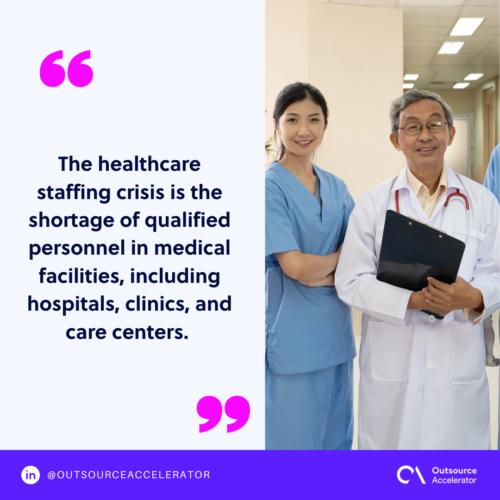
The healthcare staffing crisis is the shortage of qualified staff in medical facilities. This includes hospitals, clinics, and care centers. It spans many roles, from nurses and physicians to support staff. As a result, it creates a wide gap between supply and demand.
This gap is not short term. In fact, the US Health Resources and Services Administration projects that the registered nurse shortage will persist through 2037. So leaders need plans that last, not quick fixes.
What are the effects of staffing shortages on patient outcomes?
Staffing shortages can hurt patient outcomes in several clear ways.
Decreased quality of care
One of the biggest effects is a drop in the quality of patient care. With fewer staff, providers struggle to meet the needs of a growing patient population. Because of this, standards of care can slip.
Increased wait times
Staffing shortages often lead to longer wait times for patients. Long waits do more than annoy people. In some cases, they worsen health by delaying needed treatment.
Higher risk of infections
Low staffing can also cause lapses in infection control, increasing the risk of healthcare-associated infections. Good hygiene and sanitation get harder when too few staff are on hand.
Strategies for mitigating the crisis
To ease the healthcare staffing crisis, organizations can use several strategies at once.
Recruitment and retention incentives
Fixing the crisis needs a many-sided approach. One key step is strong effective recruitment and retention incentives. By offering more than pay, healthcare organizations can attract and keep top talent.
Training and development programs
Ongoing training and development is essential. Good programs close skill gaps and lift staff satisfaction. As a result, teams become more skilled and more adaptable over time.
Flexible work arrangements
Work-life balance matters for keeping staff and reducing burnout. So flexible schedules can meet individual needs and preferences. In turn, this builds a healthier work environment.
Utilizing technology
Technology is key to smoother healthcare operations and better care. For example, the right tools can fill gaps left by staffing shortages. Many facilities also lean on healthcare BPO services and healthcare outsourcing to scale support fast.
How outsourcing can help with the healthcare staffing crisis
In the podcast, Mark described a long-running shortage of high-quality nurses in the US. He noted that COVID-19 made that gap worse.
“There is always a shortage of quality nurses in the U.S. Certainly, COVID didn’t help that. And COVID ramped up the demand, the salaries, and therefore the cost of getting nurses to provide the services.”
In short, the shortage pushed costs up fast. So the goal became simple.
“We want to let the U.S. nurses focus on what they must do on the ground. They have to meet with the patients and provide the in-person healthcare,” he pointed out.
“What we want to be able to take off their shoulders is all of the back-end paperwork that the nurses then have to do after they meet with the clients and provide the care. The U.S. system requires this ton of paperwork, and it does require medical knowledge.”
In other words, the paperwork, not the care, is the real drain. As a result, outsourcing that admin work frees up clinical hours. Mark also talked about software built to manage this admin workload. “There’s now a whole software environment where we can handle that work HIPAA-compliantly. HIPAA is the Health Insurance and Portability Act, which is the health insurance privacy law in the U.S. There are precise ways to manage private health information, and we can use that to handle all of that backend paperwork and relieve the duty of nurses,” he explained.
He was clear that this is not a full rebuild of the process. “I wouldn’t say it’s a rebuilding. It involves educating about your debt situation, usually by discussing how we can offer these services with a healthcare facility executive [through outsourcing]. Still, they all realize that this paperwork can be done in other places, in different ways, for much less money. Some nurses earn six figures annually, and their time should be spent with patients, not on paperwork,” he clarified.
“It takes a little time to figure out the process, and we don’t dictate it to our clients. We look at every client, and all aspects involve intake and insurance. Then there’s the paperwork and the quality assurance aspect to ensure their documents are filled out correctly,” he noted.
This is where support roles help the most. For example, a medical billing virtual assistant can handle claims and records. Many clinics also outsource healthcare back office services so nurses stay focused on patients.
Is it possible to overcome the healthcare staffing shortage?
The healthcare staffing crisis is hard, but it is not impossible to solve. In many ways, it is like a puzzle waiting for the right pieces.
So we can tackle it with creative incentives, smart technology, and better policies. These steps help providers get through hard times. Insights from leaders like Mark show both the problems and the path to a lasting fix.
In the end, it helps to remember one thing. Behind every hospital door is a story we have the power to change by facing this crisis head on.
Frequently asked questions about the healthcare staffing crisis
What is causing the healthcare staffing crisis?
Several forces drive the shortage at once. For example, an aging workforce, high burnout, and rising demand all play a part. In addition, the cost of training new clinical staff adds more pressure on top.
Which healthcare roles are hardest to fill?
Nurses top the list, but the gap is wider than that. For example, facilities also struggle to hire physicians, aides, and specialized technicians. In addition, back-office and billing roles can be hard to staff.
How does outsourcing ease the staffing crisis?
Outsourcing moves admin and paperwork to trained offshore teams. This lets in-house clinicians spend more time with patients. Done under HIPAA rules, it also cuts costs without lowering care quality.
Can technology replace missing healthcare staff?
Technology cannot replace hands-on clinical care. Still, it can take over routine tasks and reduce manual work. So the best plans pair smart tools with the right people, not one or the other.
Is the healthcare staffing shortage expected to improve soon?
The shortage is likely to last for years. Federal projections expect a nurse gap well into the next decade. Because of this, organizations should plan for the long term, not just the next hiring cycle.






 Independent






