
Why the US Government should encourage outsourcing


Why should the US government encourage outsourcing?
The US government should encourage outsourcing because it grows the economy, lifts shareholder wealth, and frees Americans to move into higher-value work.
- Outsourcing raises US GDP and overall national wealth.
- It helps Americans improve their career growth options.
- It puts labor and resources to their most efficient use.
Well-meaning officials sometimes push rules that tax or limit outsourcing. In their view, sending work overseas hurts US workers. But is that true? In fact, outsourcing often benefits US workers and strengthens the wider economy.
Here’s why: Outsourcing means getting a good or service from an outside or foreign supplier. In many cases, it means contracting work to an international provider at a lower cost, since labor is cheaper abroad.
Outsourcing is also known as BPO, or Business Process Outsourcing. For example, the most common form is the call center, where staff take inbound customer calls. In addition, BPO covers data entry, medical billing, website development, and any task a remote worker can do with a good internet connection. To see how these models differ, compare offshoring versus outsourcing.
The top countries for outsourcing include many in Asia. However, the Philippines stands out as the “Call center capital of the world” and the “World’s Premier Outsourcing Destination”. Its workforce is well educated and quality-focused. In addition, English is one of its national languages, so English fluency is very strong.
Tremendous resources such as OutsourceAccelerator.com and The Source help simplify the journey. So companies get support at every step as they start to outsource.
A US-based employer faces a daunting set of costs when hiring a US-based worker. For example, these costs include the following:
- Recruiting.
- Office space, supplies, and furniture.
- Computer equipment.
- Supervision, training, and quality assurance.
- FICA, human resources, employee turnover, compliance oversight, and payroll.
- Wage or salary, plus Medicare, unemployment insurance, workman’s comp, benefits, retirement, vacation, paid holidays, and sick days.
In contrast, employers can avoid these costs by outsourcing them. The process is simple. First, they share their expectations with a BPO firm. Next, they pay a small hourly fee. As a result, the employer saves up to 60 percent on overall labor costs. For more on this upside, see the benefits of outsourcing.
The US Government should encourage outsourcing for three main reasons:
- Outsourcing increases US GDP and therefore overall wealth.
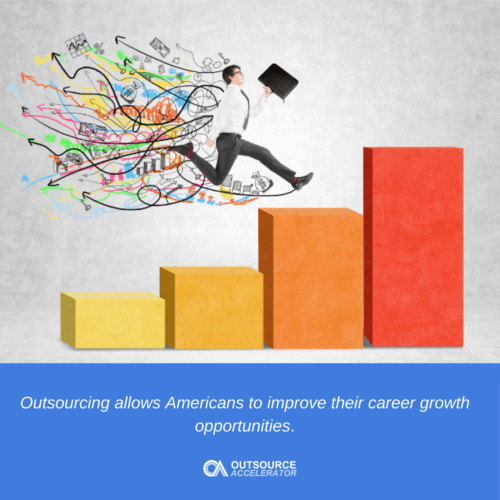
- Outsourcing allows Americans to improve their career growth opportunities.
- Outsourcing is an appropriate allocation of resources.
Greater US Growth, GDP, Wealth
Critics say managers who outsource spend fewer dollars on labor, since costs drop. However, that is not always the case, and it is not a bad outcome. In fact, saving money lifts US GDP and the wealth of the economy.
Standards of corporate governance say firms exist to serve shareholders. Employees, customers, and communities all matter as constituents. Still, shareholder interests come first.
After all, a firm that is not profitable will fail, and then nobody is served. So shareholders elect a board, and the board hires managers to run the company. In turn, everyone works to serve shareholders by raising revenue, cutting costs, and improving profits.
So when outsourcing lifts profits, shareholders benefit. Critics may call American shareholders a greedy elite. However, that is not the case.
In fact, shareholders include any retirement fund invested in equities. For example, that means teachers’ unions, police and firefighter pensions, and any American with a pension or retirement plan. So outsourcing gains flow to ordinary savers too.
Managers who keep the same labor budget but add outsourcing get more value for those dollars. As a result, outsourced labor often costs 60 percent less.
Therefore, such firms gain from a better use of labor. In turn, the important growth tasks get done, and the company benefits.
Walmart has effectively “outsourced” the making of many products to China. By doing so, the company puts its resources to their best use. Meanwhile, American consumers gain from cheaper labor, and Walmart shareholders benefit. Many other US companies that outsource follow the same logic.
More importantly, it helps Americans buy more with each paycheck. For example, forced US-only sourcing (or an import tax) would raise these prices by roughly 300 to 500 percent, according to the Huffington Post. As a result, consumers would lose, US GDP would drop, and living standards would fall.
So if the US government were to restrict outsourced labor, it would hurt career growth for American workers. In addition, it would cut US GDP and shareholder wealth. In turn, it would block the efficient use of resources in the labor market.
Furthermore, such rules would raise a hard question. First, the government would have to stop firms like Walmart from outsourcing US manufacturing jobs. As a result, hundreds of US firms could fail, the stock market could lose a large share of its value, and living standards would drop for almost every citizen.
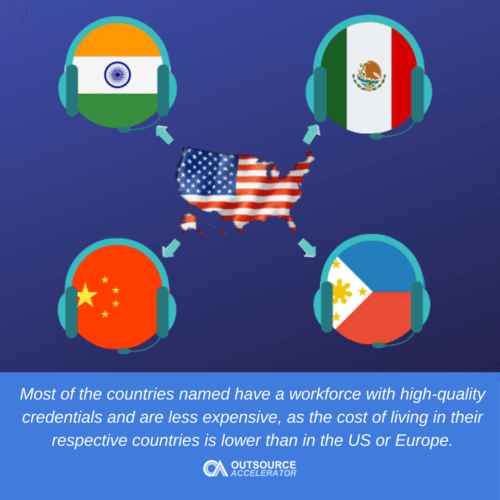
Why does the US outsource to India, China, Mexico, and the Philippines
One top reason US firms outsource to these developing countries is cost-cutting.
Most of these countries have skilled, credentialed workers at a lower cost. After all, the cost of living there is lower than in the US or Europe.
For example, the cost of living in Metro Manila is a fraction of that in major US or European cities. So it covers rent, utilities, food, transport, and some room for other expenses.
Compared with pricey US and European cities, workers in these countries accept pay that others would call low. In turn, both sides find the trade worthwhile.
Does outsourcing hurt the US economy?
Short answer: no.
In fact, outsourcing gives US firms an edge in a global market. So they can trade worldwide while running offices abroad. Some people still argue that it hurts the economy. However, the data says otherwise.
According to The Balance, the U.S. overseas affiliates employed 14.4 million workers. Four sectors feel the effects most: technology, call centers, human resources, and manufacturing. For a wider view, browse the latest outsourcing statistics. Meanwhile, the gains also reach the destination countries, since outsourced jobs help build their local economies. To weigh the domestic side, see this analysis of outsourcing and onshore jobs.
In short, outsourcing is an excellent use of resources. So it supports US GDP growth. In turn, it helps American firms lift profits and gives workers new career growth opportunities.
Frequently asked questions
What is outsourcing?
Outsourcing means getting a good or service from an outside supplier. Often, that supplier is based abroad, where labor costs less. So firms use it to cut costs and reach new skills.
Does outsourcing take jobs away from Americans?
The picture is more nuanced than it looks. In fact, outsourcing lets US firms grow and hire for higher-value roles. As a result, many Americans move into better career paths.
How does outsourcing help the US economy?
It lowers costs and lifts company profits. In turn, that raises GDP and shareholder wealth. Meanwhile, cheaper goods stretch every American paycheck further.
Why is the Philippines a top outsourcing destination?
The Philippines has a skilled, English-speaking workforce. In addition, its cost of living is far lower than in the US. So it delivers strong quality at a competitive price.
Key takeaways
- Outsourcing raises US GDP and lifts wealth for ordinary savers, not just the rich.
- It frees American workers to move into higher-value careers.
- It puts labor and resources to their most efficient use.
- Restricting it would raise prices and cut living standards for most citizens.
About the author: Mr. Warren Walborn is the President and CEO of Pentwater Group, a BPO company located in Mindanao, Philippines where he lives part of the year with his Filipina wife and two children. He is the former CEO of two other start-up companies – a renewable energy company and a medical device company. Mr. Walborn received his BA in Economics from Brigham Young University, and his MBA in Finance with Honors at the University of Chicago Booth School of Business. He can be reached at Warren@PentwaterGroup.com.






 Independent





