
How executive assistants enhance the reputation of executives


This article is a submission by Virtual PA Services. Virtual PA Services is a prominent company based in Turner Business Centre, Greengate, Middleton, Manchester M24 1RU, providing a comprehensive array of support services to businesses and executives.
How do executive assistants protect an executive’s reputation?
Executive assistants protect an executive’s reputation by managing communication, guarding time, and representing the leader well in every interaction.
- They act as trusted representatives with clients, colleagues, and the media.
- They keep the executive prepared, punctual, and consistent day to day.
- They protect privacy, quality, and brand voice on the leader’s behalf.
Executive assistants (EAs) are far more than admin support. Instead, they work as strategic partners and trusted problem solvers. As a result, they shape how a leader is seen inside and outside the company. Because of this, they add real value to both the executive and the wider team.
By acting as liaisons, EAs help executives build trust and credibility. So they can also influence clients, colleagues, the media, and the public. In short, a strong EA is a reputation asset.
Roles and responsibilities of executive assistants
Here are some best practices EAs follow to boost the image and reputation of their executives. Together, they show why the role is so valued.
Understand the executive’s goals, vision, and values
First, EAs need a clear view of what their executive wants to achieve. They also learn how the leader wants to be seen and what they stand for. As a result, they can align their actions with the executive’s brand and message.
Good EAs also know the leader’s strengths and weak spots. So they help the executive lean on strengths and cover gaps. This is one reason many firms weigh an executive versus a personal assistant before they hire.
Manage the executive’s communication channels
EAs handle email, calls, social media, and other channels with care. In practice, that means they are in charge of:
- Filtering out spam or low-value messages
- Prioritizing urgent or important ones
- Drafting or editing responses
- Following up on pending issues
They also speak for the executive with the right tone and etiquette. Meanwhile, they watch the leader’s online presence and reputation. So they can flag both praise and criticism early. For many leaders, smart inbox management alone saves hours each week.
Coordinate the executive’s schedule and meetings
EAs run the calendar so the leader stays prepared and on time. As part of the job, they book travel, rooms, transport, and catering for trips and events. They also prep agendas, notes, minutes, and action items for meetings.
Still, plans change fast at the top. So EAs must handle last-minute shifts and small crises with a calm head. Strong time management skills make this far easier.
Represent the executive in internal and external interactions
Sometimes the leader is busy, away, or delegating a task. In those moments, the EA acts as their spokesperson or proxy. As a result, they must speak with confidence and clear knowledge on the leader’s behalf.
EAs also build rapport with clients, colleagues, the media, and the public. Meanwhile, they field queries and handle complaints with tact. This is why the top traits of a great assistant matter so much at this level.
Uphold the executive’s standards and expectations
Great EAs show the same professionalism and integrity as their leaders. So they aim to deliver high-quality work on time and on budget. They also follow company policy and legal rules.
On top of that, they guard privacy. For example, they secure sensitive files and keep confidential details safe.
Showcase the executive’s achievements and contributions
EAs take pride in what their leaders accomplish. So they share those wins with the right people. For example, they may craft short stories or decks that show the leader’s impact.
They also spot chances for recognition, such as awards, testimonials, or endorsements. Meanwhile, they celebrate milestones alongside the executive.
Provide feedback and advice to the executive
The best EAs stay honest and helpful with feedback. So they offer clear ideas that improve performance or fix problems. They also give support when the leader hits a setback.
Still, they challenge the executive when a reality check is needed. In this way, they act as a trusted sounding board.
Learn from the executive and emulate their best practices
EAs are eager to learn from their leaders. So they watch how the executive works, thinks, and leads. Then they adopt the habits that fit their own style. They also stay open to guidance on how to grow.
Advocate for the executive’s interests and needs
EAs stay loyal to their leader’s goals and well-being. As a result, they spot issues or openings before they grow. They also push for good outcomes on the executive’s requests. Finally, they show gratitude for the leader’s trust and support.
Collaborate with the executive and other team members
EAs are team players at heart. So they share information, ideas, and resources that help projects move. They also coordinate or hand off tasks to lift quality and speed.
In addition, they gather and give feedback that boosts results. By following these habits, EAs raise the image and reputation of their leaders. This helps the executive, and it earns the EA more respect and opportunities for career advancement too.
Executive assistants FAQs
Here are common questions about executive assistants.
What is an executive assistant?
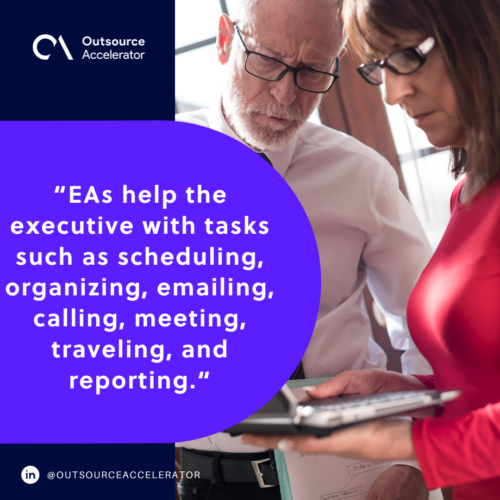
An executive assistant provides administrative and communication support to a senior leader. So they help with scheduling, email, calls, meetings, travel, and reports. They also act as the leader’s representative with many stakeholders.
What skills do executive assistants need?
Executive assistants need a mix of skills to do the job well. Here are the most important ones:
- Organization. EAs juggle many tasks, set priorities, and track every deadline and detail.
- Communication. EAs must communicate clearly in speech and writing. They also listen well and reply with care.
- Discretion. EAs handle private data with respect. So they keep the trust of the leader and others.
- Problem-solving. EAs spot and fix issues in schedules, travel, and daily work. As a result, they keep things moving.
- Technology. EAs use tools for docs, email, calendars, and more. For a wider view, see the core skills to look for in an assistant.
How is an executive assistant different from a personal assistant?
An executive assistant focuses on business support for a senior leader. So the work centers on strategy, meetings, and stakeholder ties. A personal assistant, by contrast, leans more on personal errands and lifestyle tasks. Still, some roles blend both.
Can a business hire an executive assistant remotely?
Yes. Many firms now hire skilled EAs who work fully online. As a result, leaders can find strong talent beyond their local area. Clear tools and set check-ins keep the remote setup smooth.
How does an executive assistant add value to a company?
An EA frees the leader to focus on high-value work. So the executive spends less time on admin and more on strategy. Meanwhile, the EA protects the leader’s time, image, and relationships. In short, a great EA lifts the whole team.






 Independent






