
AI trends to watch out for: What’s next after 2026?

This article is a submission by Safnah. Safnah is an Iraq-based information technology services provider with over eight years of experience in the MENA region.
What are the top AI trends shaping application development?
AI trends are reshaping how apps get built, from smart coding tools and cloud AI services to new roles like the AI engineer.
- AI tools now speed up coding, testing, and debugging.
- Cloud platforms offer ready-made AI features through simple APIs.
- Security, trust, and MLOps skills grow more important each year.
Artificial intelligence (AI) has already begun to transform application development. In addition, it will keep disrupting the field in the years ahead. As AI grows more capable, developers need to see how it affects their work. So they must get ready for what comes next. This article explores emerging AI trends and what they mean for app developers.
8 AI trends that will transform application development
Here are the AI trends that will boost application development.
1. AI-powered development tools
First, AI-powered tools for software development keep spreading. Advanced machine learning now powers:
- Code auto-completion programs
- Error detection capabilities
- Automated code reviews
- Debugging solutions
For example, TabNine’s auto-completer suggests whole lines or blocks of code as you type. So these AI tools will grow more common and more capable. For application developers, this means AI will speed up parts of app building. In addition, tasks like boilerplate code, bug fixes, and reviews can be automated.
However, developers still need to check auto-generated code. They also need to add core logic and train models. So creativity and strategy stay essential. The key is balance. You want AI’s speed while you keep control of big design choices. Many firms now explore AI outsourcing to build these skills faster.
2. Building trust in AI applications
For people to adopt AI apps, developers must focus on trust. So they need transparency, clear reasoning, and fairness. Apps that feel opaque will struggle to win users.
For example, developers can use local explainability and counterfactual testing. These make an AI’s inner workings clearer. In addition, showing what data is used and how outputs form builds trust.
However, too much openness can expose IP or trade secrets. So developers must balance honesty with competitive secrecy. They must also account for algorithmic bias and the risk of unfair outcomes. As a result, diverse training data, fairness testing, and outside audits will grow as best practices. By building AI responsibly, developers can create apps people rely on.
3. AI cloud services streamline development
Third, major cloud platforms now offer AI services to help developers build apps. These cloud tools provide ready-made AI features. So developers do not build from scratch.
For example, Microsoft Azure, Google Cloud, and Amazon Web Services offer AI for vision, speech, language, and recommendations. So instead of coding AI by hand, developers plug it in with API calls and settings. As a result, this cuts development and training time by a lot.
In addition, it lets small teams use powerful AI. However, leaning on one cloud platform raises concerns. For example, you may face vendor lock-in and limited customization.
4. Emergence of AI-powered apps and features
Driven by deep learning, AI-powered apps are spreading across fields. Today, apps can:
- Understand speech and images
- Respond to text or voice
- Automate complex analysis
- Generate content on their own
For instance, AI writing apps like Jasper and Rytr create marketing copy with little human input. The rise of generative AI pushes this trend even further. Similarly, an AI presentation maker like Pitch can adapt slides and templates to your brand from an AI draft. This platform uses AI to generate, discover, or build new templates. So teams can then edit them with smart features.
Developers must decide how to add AI to new or existing apps. First, they weigh target user needs. However, they also face ethical questions around privacy, bias, and transparency. So the right balance between use and responsibility is key. Overall, AI expands what is possible when applied with care.
5. Impact of AI on app security
As AI spreads into more apps, security becomes a top concern. AI apps can carry risks based on how they are built. So developers must guard against threats like data poisoning, model theft, and tampering.
AI systems depend heavily on data. So protecting access points and preventing leaks is vital. For example, apps should encrypt user info, usage patterns, and models where possible. In addition, rigorous testing can find gaps in AI logic before attackers do.
Developers will also use AI to boost security. For instance, AI-powered cybersecurity tools can predict threats, automate defenses, and run advanced analytics. AI can also help with fraud checks in fintech, threat detection in messaging, and identity checks across domains. Overall, securing AI apps brings new challenges. So developers must choose wisely on data use, model strength, and risk control.
6. Rising prominence of MLOps
To put AI models into real apps, Machine Learning Operations (MLOps) will gain ground. Among the AI trends, MLOps blends DevOps practices with ML workflows. So teams can keep deploying apps with built-in intelligence.
Key MLOps tasks will join the development cycle. For example, these include automated testing, reproducibility, model monitoring, explainability, and governance. So developers must gain MLOps skills to build and manage AI apps well. A solid base in both software engineering and machine learning will be highly valued. In addition, teams will use dedicated MLOps platforms like Allegro, WhyLabs, and Seldon.
7. AI specialization across industries
Next, AI use will differ more by industry. For example, healthcare apps will use AI very differently than e-commerce apps. So developers must study the needs of their field. Specializing in finance, transport, healthcare, or defense reveals unique ways to apply AI.
Because of this, domain knowledge will be crucial. For instance, developing applications for clinical decision support or self-driving cars needs deep expertise. So strong industry insight, not just coding, will be essential.
8. The rise of ‘AI engineers’
A new role, the AI engineer, will emerge. It blends software developer and ML expert. So these engineers turn business needs into software and then build and deploy complex AI-powered apps.
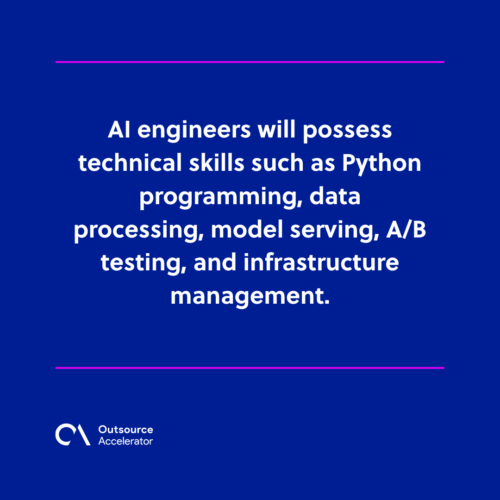
AI engineers will hold technical skills like Python, data processing, model serving, A/B testing, and infrastructure work. However, they will also grasp product design and business goals. So they make AI work for real problems. As this machine learning engineer role grows, app developers may need to skill up or pivot to stay competitive.
AI trends: Continuous learning will be critical
AI moves fast. So continuous learning will be critical for developers who want to stay relevant. For example, courses, certifications, conferences, and reading all help you avoid falling behind. In addition, soft skills like creativity, communication, and teamwork stay key differentiators.
Overall, these AI trends will transform application development by boosting human skill. However, AI will not replace developers. In fact, demand for strong developers may grow as firms race to build AI apps. So developers who adapt, specialize, and collaborate will keep shipping great solutions. In short, preparing today helps developers lead an AI-powered future.
Frequently asked questions
What are the main AI trends in app development?
The big ones include AI coding tools, cloud AI services, and AI-powered features. Security, trust, and MLOps also rank high. In addition, the AI engineer role is on the rise.
Will AI replace app developers?
No. AI will automate routine tasks like boilerplate code and bug fixes. However, developers still guide design, logic, and strategy. So demand for skilled developers may actually grow.
What skills do developers need for AI apps?
They need coding, data handling, and model skills. MLOps and security know-how help too. In addition, domain knowledge for their industry makes a big difference.
How can small teams use AI without big budgets?
They can tap cloud AI services through simple APIs. So they add features like vision or language without building from scratch. This keeps costs and training time low.
Why does trust matter for AI apps?
Users avoid apps that feel opaque or unfair. So clear reasoning, fair data, and transparency build adoption. Outside audits and bias testing also help earn user confidence.






 Independent






