
Subcontracting: Unlocking benefits and finding the perfect partner


Picture your company as a ship sailing toward better efficiency. That vision is within reach. You can get there by handing non-core work to outside experts through subcontracting.
Subcontracting lets your core team focus on what it does best. As a result, your business can deliver stronger results with less strain. It also sparks useful partnerships that give your firm a real edge.
Still, one thing needs care. You have to find the right subcontractor. This guide covers the benefits, how to pick a partner, and how to build a working relationship that lasts.
What is subcontracting, and why do businesses use it?
Subcontracting is when a company hands specific tasks or projects to an outside party, so it can focus on its core work while an expert handles the rest.
- It cuts costs by removing the need to hire and train full-time staff.
- It opens the door to skills your team may not have in-house.
- It lets you scale up or down fast as demand changes.
What is subcontracting?
Subcontracting is a simple business strategy. A company outsources certain duties, projects, or steps to outside parties.
The main goal is to boost efficiency. You do this by using outside skills and resources. Because of this, your own team stays free to focus on core work.
The general contractor hires the subcontractors. A subcontractor can be a single person, a small firm, or a specialist company. They work across many industries.
Subcontracting is common in fields with complex projects. For example, construction and information technology both rely on it. Many firms also compare it against wider benefits of outsourcing before they decide.
In addition, subcontracting helps when firms face talent gaps, tight resources, or short-term projects.
Benefits of subcontracting
Subcontracting brings real benefits to a business. It can lower costs and unlock special skills. It also adds flexibility and lifts output. Here are the main benefits in more detail.
Cost savings and reduced overhead expenses
Subcontracting helps you skip the cost of hiring and training full-time staff. Instead, you get the work done by outsourcing specialized jobs.
Subcontractors often cover their own tools, space, and overhead. As a result, the main firm avoids those costs. This model is close to staff augmentation, where you add skills only when you need them. So you can grow your team on demand and trim fixed costs in slow periods.
Access to specialized skills and expertise
One big plus is access to skills you may not have in-house. Subcontractors bring deep know-how in their field. Because of this, they produce high-quality work fast.
You can also take on complex projects that need niche skills. Meanwhile, you skip long training or hiring drives. This works well for one-off software development work and other specialist tasks.
Flexibility and scalability
Subcontracting helps you respond to shifting market needs. You can scale up or down by adding or releasing subcontractors as needed.
As a result, you handle changing workloads with ease. Your core work stays steady, and you avoid extra costs. Subcontracting also lets you jump on new chances or urgent project needs quickly.
Increased efficiency and productivity
As noted, handing non-core work to subcontractors lifts output. It frees your team to focus on what matters most.
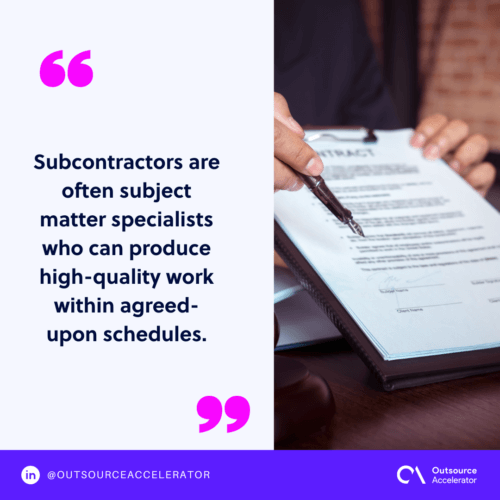
Subcontractors are often subject matter specialists. So they deliver strong work on time. This means faster turnaround, fewer mistakes, and better quality.
How to find the right subcontractor
Finding the right subcontractor takes care and a clear review. Here are some simple steps to help you choose a good partner.
Identify the specific requirements of your firm
First, define the tasks or projects you want to outsource. Next, list the skills, experience, and resources the work needs.
Knowing your needs helps you judge each option well. As a result, it becomes much easier to spot a strong fit. It also helps to know your own core competencies before you hand off any work.
Conduct thorough research and due diligence
Research matters a lot when you pick a subcontractor. So try these simple steps:
- Ask colleagues or industry contacts for names
- Explore online platforms
- Review case studies or work samples
- Check their skills, track record, and reputation
Suppose you find someone with a strong portfolio. Then ask about their methods and quality checks during hiring. Also look for proof of past wins.
Because of this review, you learn whether the subcontractor fits your project. It saves time and money later.
Establishing effective subcontracting relationship
Suppose you have hired the right person. Now you need to build a strong working relationship. Here are the key steps to follow.
Clearly define the scope of work and deliverables
First, make sure the subcontractor knows the exact scope of work. Be clear about deliverables and the results you want.
Next, put it all in a full agreement to avoid later disputes. Review and update the document often as the project shifts.
Set realistic expectations and deadlines
Set fair goals for timelines, milestones, and deliverables. Work with the subcontractor to agree on dates that match your aims.
Clear talk and regular updates keep things on track. As a result, both sides stay aligned through the project.
Adopt updated collaboration strategies
Use good tools to keep talk and project work smooth. For example, set up platforms like these:
- Project management software
- Cloud-based document sharing
- Video conferencing
These tools speed up chats and help your team and the subcontractor work well together.
Monitor and manage the subcontractor’s performance
Check the subcontractor’s progress often. Use clear KPIs to keep quality and timelines on track.
Also give helpful feedback and fix issues fast. As a result, you keep a positive working relationship.
Frequently asked questions about subcontracting
What is the difference between subcontracting and outsourcing?
Outsourcing is a broad term for hiring an outside party to do work. Subcontracting is one form of it. In subcontracting, a main contractor passes part of a project to another firm. So all subcontracting is outsourcing, but not all outsourcing is subcontracting.
What industries use subcontracting the most?
Construction and IT rely on it heavily. Both handle complex projects with many moving parts. Other fields also use it, such as marketing, manufacturing, and outsourcing to the Philippines for support roles.
Is subcontracting cost-effective for small businesses?
Yes, it often is. Small firms skip the cost of full-time hires and extra overhead. So they get expert work only when they need it. This keeps fixed costs low during slow spells.
How do you manage a subcontractor well?
Start with a clear scope and a written agreement. Then set fair deadlines and check progress with KPIs. Regular updates and quick feedback keep the work on track.
Key takeaways
- Subcontracting hands non-core work to outside experts, so your team can focus on core tasks.
- It lowers costs, adds skills, and lets you scale fast.
- The right partner takes research, clear needs, and due diligence.
- A written scope, fair deadlines, and KPIs keep the relationship strong.
Maximize your firm’s efficiency by subcontracting
Your company can reach strong efficiency through subcontracting. It builds smart partnerships that can spark new ideas and a real edge.
By handing off non-core work, you turn your firm into a nimble business. As a result, you adapt to changing demands with ease.






 Independent





