
A brief overview of a process executive role


What is a process executive?
A process executive is the person who oversees and improves the core workflows that keep a company running.
- They map current processes and find where work slows down.
- They build simple fixes and track the results with clear metrics.
- Many firms now hire an offshore process executive to cut costs.
In business, efficiency and smooth operations help you stay ahead. So the process executive role matters more each year. This person brings the skills to streamline work and lift daily performance.
This article explains what a process executive does. Next, we cover the main duties, the key skills, and the perks of hiring offshore.
What does a process executive do?
A process executive oversees an organization’s processes and workflows. In short, they keep operations running and fix the parts that waste time or money. They also make sure the work stays compliant.
To do this, they work closely with many teams. As a result, they learn how each workflow really runs. Then they spot the areas that need a fix.
In the end, a process executive helps a business boost efficiency and lower costs.
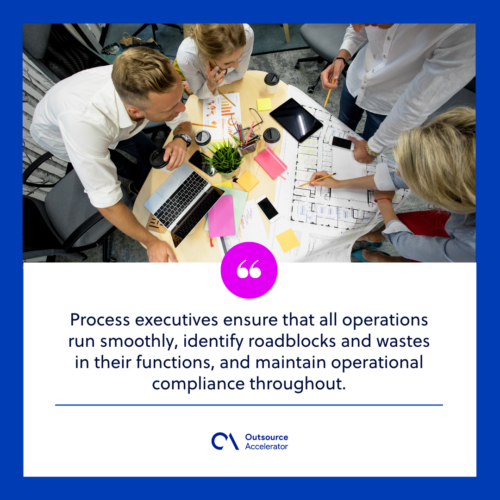
Industries where process executives work
Process executives are in demand across many industries. For example, these sectors often rely on their skills.
- Manufacturing. Here, process executives improve supply chain management, apply lean methods, and keep quality high across the production cycle.
- Logistics. In this sector, they plan transport routes and shipments. As a result, they cut order delays and reduce shipping costs.
- Banking. Here, accuracy and compliance matter most. So they speed up tasks like loan processing and keep data secure.
- Healthcare. Meanwhile, they improve patient care through better scheduling, clinic workflows, and electronic health record (EHR) systems.
- Information technology (IT). In IT, they refine development work, project management, and service delivery. They also look for tasks they can automate.
Responsibilities of a process executive
Duties change by industry. Still, most process executives share a few core tasks. Here are the main ones.
Analyzing processes
First, a process executive studies the current workflows. They look for bottlenecks, repeat steps, and gaps. Then they share these findings with stakeholders.
Developing process improvements
Next, they build and roll out the fixes. This may mean a new process or a small change to an old one. As a result, the workflow adapts to the change.
Above all, the fixes must be practical. So they also need to match the company’s goals.
Monitoring process performance
After a change, they watch how the new process performs. Because of this, they can catch issues early.
They set key performance indicators (KPIs) to track progress. Then they adjust the process when the data says so.
Training staff
They also train teams on the new steps. As a result, every team member understands the process. This helps the whole group use it well.
Collaborating with teams
Finally, teamwork sits at the heart of this role. So they talk with managers and staff often. In this way, they learn the real challenges and gather useful insights.
Skills needed in a process executive role
To do well, a process executive needs a mix of skills. Here are the most important ones.
Problem-solving skills
First, they need strong problem-solving skills. So they can study a complex issue and find a fix. Then they put a clear plan into action.
Expertise in project management methodologies
Next, they need solid project management skills. This is because they handle company workflows every day.
For example, these common project management methodologies are worth knowing:
- Six Sigma
- Lean management
- Agile
- Scrum
- Waterfall
Interpersonal skills
They also work with senior leaders and frontline staff. So they need good people skills to connect with both.
Effective communication, negotiation, and leadership all help here. As a result, they build trust and get teams to work together.
Proficiency in relevant software and tools
Finally, they should know business process management platforms well. They also use other tools to manage and improve workflows.
With these tools, they can use technology to make each process better.
Hiring an offshore process executive
A process executive plays a key role in most firms today. However, each business must decide whether to keep the role in-house or hire offshore.
An offshore process executive can bring several clear benefits.
- Cost-effectiveness. Offshore talent often costs far less than local hires. So small and new firms can scale with the savings.
- Fresh perspectives. An outside expert can spot issues an in-house team may miss. As a result, you get new ideas fast.
- Specialized knowledge. Offshoring also opens access to skills that may be hard to find nearby.
In short, hiring offshore can bring cost savings, fresh ideas, and rare expertise.
Frequently asked questions about the process executive role
What does a process executive do day to day?
They study workflows, find waste, and build fixes. Next, they train the team on the new steps. As a result, work runs faster and costs drop.
What skills does a process executive need?
They need problem-solving, project management, and people skills. In addition, they should know process management tools well. So they can plan and track each change.
Which industries hire process executives?
Many sectors do. For example, manufacturing, logistics, banking, healthcare, and IT all use this role. In each one, the goal is smoother operations.
Why hire an offshore process executive?
Offshore hires can cost far less than local ones. In addition, they bring fresh ideas and rare skills. So firms can grow while they save.
Key takeaways
- A process executive oversees and improves the workflows that keep a business running.
- Their core tasks are analysis, process fixes, tracking, training, and teamwork.
- Strong problem-solving, project management, and people skills all matter in this role.
- The role adds value in manufacturing, logistics, banking, healthcare, and IT.
- Hiring offshore can cut costs while it brings fresh ideas and rare expertise.






 Independent





