
Marketing & Discoverability in the Age of AI Search with Andrew Kokes of Pivot AI Global

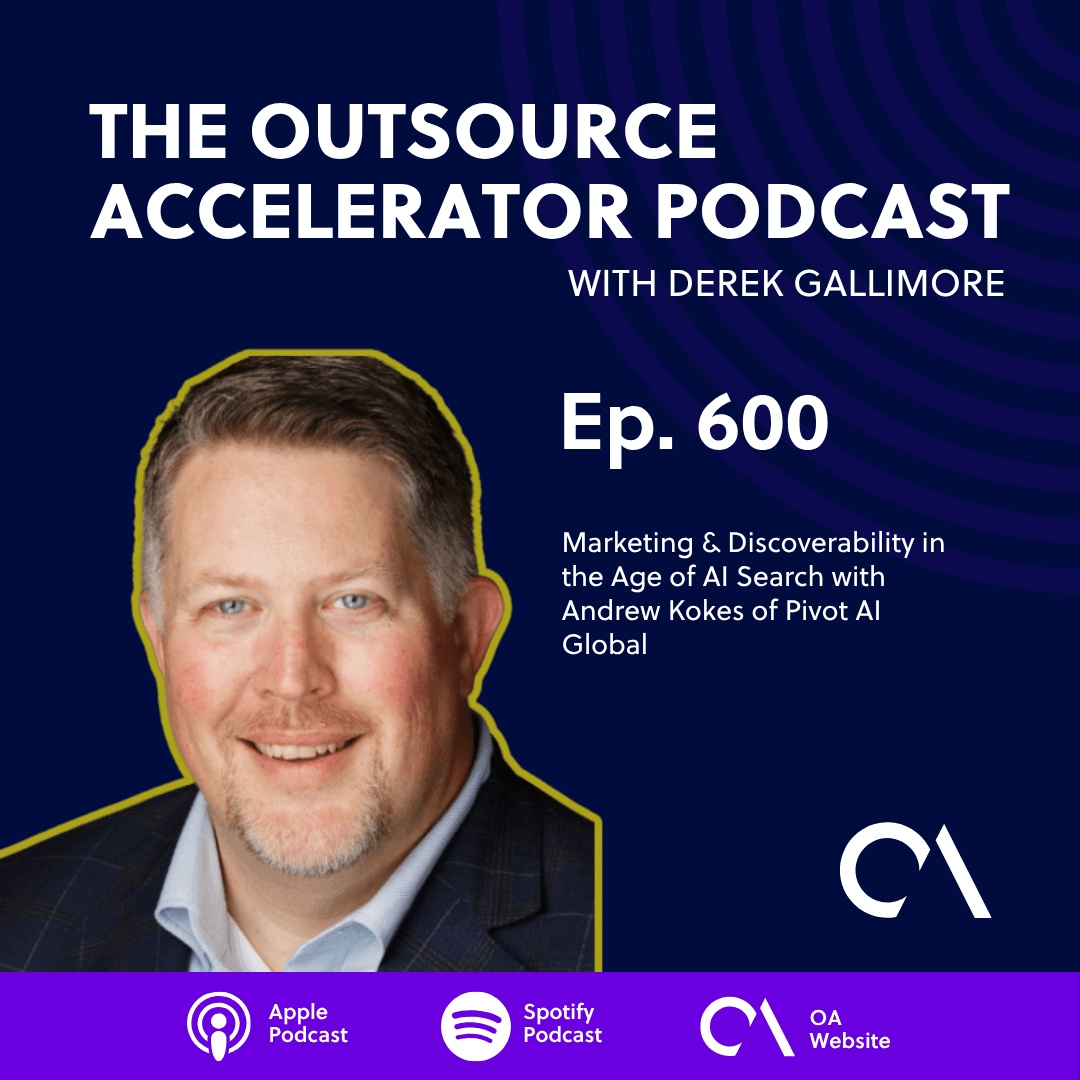
Andrew Kokes joins the Outsource Accelerator Podcast after nearly three decades in outsourcing marketing, most of it in senior in-house roles including chief marketing officer. He has now launched Pivot AI Global to help mid-market BPOs solve a fast-growing problem: how to get discovered when buyers ask AI instead of Google.
The conversation is a practical look at how search is changing, how AI answer engines actually pick who to recommend, and what outsourcing firms should do about it.
Pivot AI Global
Andrew built Pivot AI Global around a pattern he kept hearing from founders of mid-market BPOs, the $20 million to $200 million firms that the big analyst houses tend to ignore. Their marketing was getting harder and more expensive at the same time.
“Every time I talk to them, we’re kind of saying some version of the same thing. We’ve never spent more on sales and marketing and produced less.”
Search is breaking down
The core shift, Andrew says, is that buyers have changed how they look for answers. People increasingly skip the search box entirely.
“Most people I talk to, they’re like, ‘What do you Google?’ ‘Well, I just go on ChatGPT and ask it, and it gives me the answer.'”
This is not a fringe effect, and he points to a stark example from a company that mastered the old game.
“The best search engine marketers in the world, HubSpot, saw 70-plus percent of their volume go away.”
Clarity beats clutter
Because AI reads everything, a patchy website now works against you. Andrew compares most sites to a hotel that only ever refreshes its lobby while the rooms get a coat of paint. AI, he warns, checks the rooms.
“AI goes into all of it. It goes into the dusty closet. It sees the cobwebs… It sees the inconsistencies from the top page to the deeper pages, and when it sees that stuff, it starts to discount.”
His fix is to get clear and focused, and he insists that focus is not the same as staying small.
“Focusing on your niche doesn’t mean you have to be small. It just means you’re really good and you understand what you do and you understand the value you offer.”
How AI answer engines actually choose
The shift is not cosmetic. Where old search rankings could be influenced by budget, AI weighs something different.
“That [search] algorithm was biased by ad spend, ad dollars… What’s very different in the way the AI answer engines are working is that it is biased by what the engine believes is the best answer to the question that you’re asking.”
And most of what it weighs is outside your direct control.
“10% to 20% of how it forms that answer is what you say about your company… the other 70% or 80% of where the answer is being formed is through the third-party customer reviews.
What does your customer say about what you do? And does it validate what you’re saying about yourself?”
That gap explains why a few firms dominate while others stay invisible. External validation from reviews on Clutch, G2, and Gartner Peer Insights, plus recognised industry publishers, is what tips the balance.
“The best of the best companies we’re seeing are getting 70%, 80% of the inclusion… a lot of smaller companies who haven’t pulled it all together, they’re lucky if they’re seeing 1% or 2% of the mentions.”
The metrics change too. As firms get better at answer-engine optimisation, clicks can fall even as direct traffic rises, because the AI builds awareness before anyone visits. And unlike the slow climb of SEO, AI visibility has to be watched constantly.
“It’s not like the SEO game where I just keep creeping up from page four to two to eventually getting on page one… It’s constantly changing.”
The content noise problem
Andrew is clear-eyed that AI cuts both ways. The same tools that help you can flood the market with filler.
“What AI has done is industrialized the content problem, because it’s made it so much easier to blast out content that doesn’t necessarily answer a question.”
His answer is not more content, but clearer content that genuinely answers a specific buyer’s question, which is exactly what the answer engines reward.
Why nimble BPOs win
Andrew does not think contact centres are going away, but he does think the advantage is shifting to smaller, faster providers who blend technology and people well.
“You’re almost always gonna want to have that ability to lead with technology, but integrate a human when it adds value.”
He is backing that view with his own rankings, designed to surface capable smaller firms that the big analysts overlook.
“We created what we call the Pivot Path… The first list we published in July was the IPO 25, the top 25 intelligent process outsourcing companies who are really leading with technology, but have the staff then that they can bring in at the moment when it helps to solve the problem.”
For Andrew, the firms that win the next few years will be the ones that get genuinely clear about who they serve, earn real third-party validation, and stay nimble enough to blend AI and human work as each situation demands.
To learn more, visit pivotaiglobal.com. He is also offering a free first discoverability report for anyone who mentions the Outsource Accelerator Podcast.
If you’d like to learn more about what we do in the outsourcing space, send us an email at [email protected].






 Independent





