
Leading AI Implementation within BPO with Scott Stavretis of Acquire Intelligence

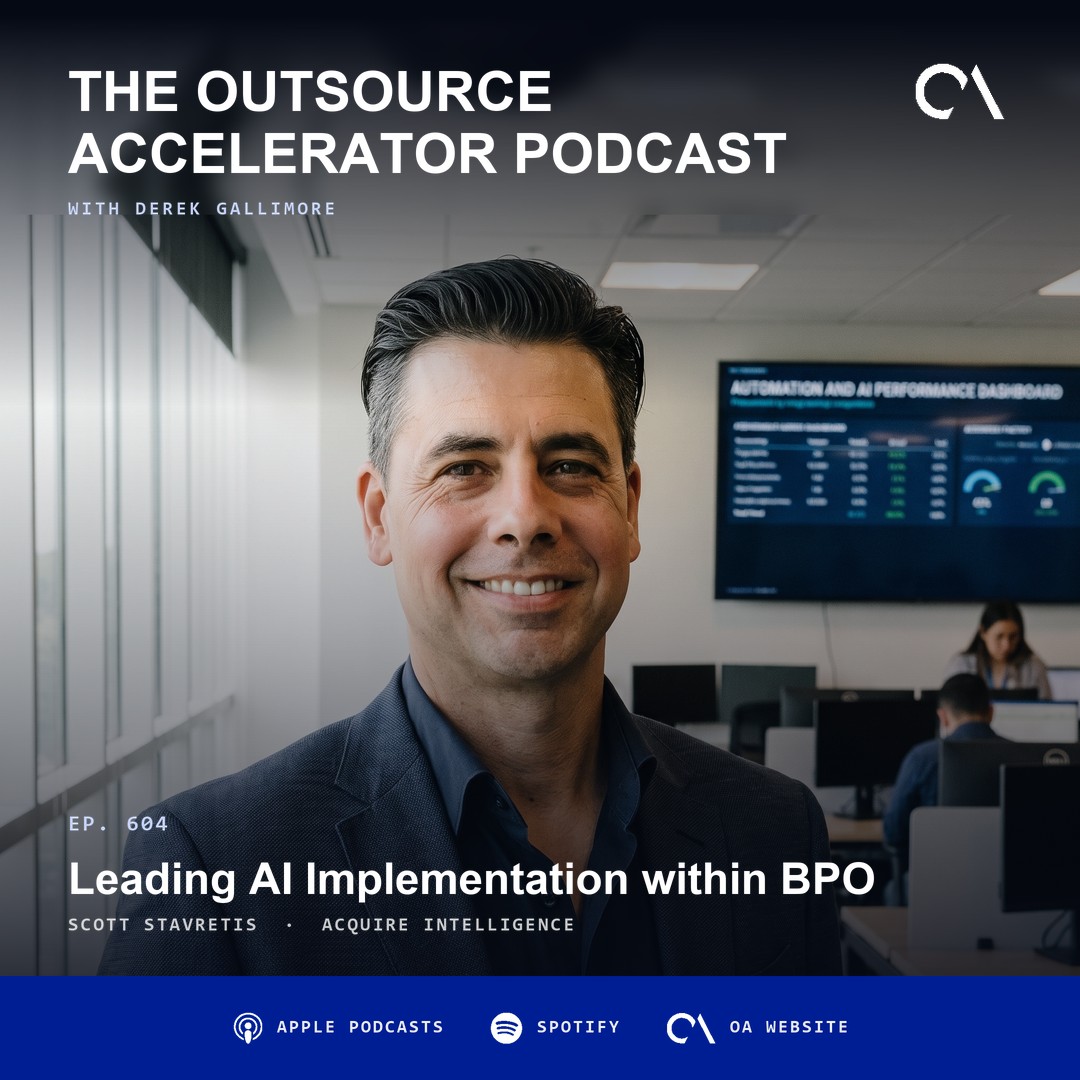
Few people are better placed to explain what AI is doing to outsourcing than someone with 10,000 staff riding on the answer.
Scott Stavretis is the CEO and co-founder of Acquire Intelligence, a firm of around 9,500 people across the Philippines, Australia, the Dominican Republic, and the United States. He returns to the Outsource Accelerator Podcast for a direct, operator’s view of where the industry is heading.
The conversation is a masterclass in leading AI implementation the right way round, and why the label “BPO” no longer fits.
From Acquire BPO to Acquire Intelligence
The company name is the tell. For the best part of 20 years this was Acquire BPO. Scott and his team had started a separate AI consultancy, Acquire AI, back in 2020, well ahead of the current wave.
In June last year they merged the two and rebranded the whole business Acquire Intelligence, deliberately taking the letters BPO out of the name. In May this year they acquired Applied AI Australia and now run an AI readiness assessment before every engagement, backed by a guarantee: if they cannot find value worth chasing, the consulting fees are returned.
Start with the business, not the software
Scott’s core argument is that most companies approach AI backwards. They start with a tool instead of a problem.
“Companies are still looking at, ‘Here’s a piece of software. How do we put it in our business?’ Which is just the totally wrong way to go about it… It’s really fundamentals. What does the business need?”
His fix is to reason from first principles, asking what the business actually needs to achieve before choosing anything. He also warns against being seduced by whatever tool is fashionable.
“People are focusing on a solution because that’s sexy, but it’s not actually the one that’s gonna move the needle in their business the most.”
Eliminate, automate, reallocate
That thinking becomes a three-step framework, and Scott is firm that the order is the whole point. The first step, eliminate, is the one most companies skip.
“Is there some software out there that can do this? Can we just automate it? Do we need to actually do it at all? Is there a whole different way to do it?”
Only after that cull does technology, and eventually outsourcing, come into play.
“Once you sort of eliminate all the wasted processes, then automate them, and then only then can you reallocate the humans that were doing the work to do the right thing.”
Rather than a one-off exercise, Scott now runs this as a continuous loop, working through a client’s departments one after another and then round again.
Where boards go wrong
Much of the pressure to “do something with AI” comes from the top, and Scott’s view is that boards should be focused on governance and data, not picking software. He points to incoming Australian privacy rules on AI decision-making as exactly the kind of issue they should own.
His test for responsible data use is refreshingly plain.
“A lot of it is just that good faith test. What do they actually think you’re doing with it? And are you doing something much different with it that they wouldn’t like?”
AI and the call center
Scott is candid that AI will hollow out routine call center work, and that well-funded newcomers will drive it.
“Will it impact the traditional call center level one people? Absolutely… Will the volume of calls to call centers go down? Yes, absolutely. And I think companies [will] absolutely dominate in that space.”
For outsourcers, that makes standing still dangerous.
“It’s more about moving jobs and changing jobs around and solving different problems. If you’re hanging your hat on still solving problems on having a whole bunch of team there answering a phone that somebody never wanted to call to start with, it’s not a good place to be.”
He is equally blunt on why some large contact centers have been punished by the markets, including their attempts to build proprietary AI.
“You can’t compete with these trillion-dollar businesses and create your own software in that regard, which a lot of them tried to do.”
The trouble with outcome-based pricing
Asked whether the industry will shift from per-hour pricing to outcome-based deals, Scott sees a place for it, but a narrow one.
“Some of that outcome-based is great, but it’s also very short term… We have an ROI guarantee that if we can achieve that ROI over a certain time, you don’t pay us for our AI solutions.”
He walks through why it tends to unravel over time.
“Let’s tear up that contract and go with outcome base and we’re gonna pay you $200 a customer for acquisition on a sales program. And to start with, it sounds great… But after a while, that’s going to fade out because somebody is gonna win and somebody’s gonna lose.”
The maths, he argues, always reverts to margin, which is why he sees per-hour pricing as the more durable, transparent basis for a long-term partnership.
A bullish long view
For all the disruption, Scott is emphatically optimistic, and he thinks perspective is everything.
“I love business, I love innovation, I love capitalism, I love growth, and AI just amplifies all that.”
He suspects the current moment will look smaller in hindsight than it feels now.
“If you zoom out on anything over a long period, I don’t think it is that dramatic… It is software. Software’s speeding up a lot of things that we’re doing already.”
For Scott, the outsourcers that thrive will be the ones that stop selling seats and start optimizing processes, using AI to eliminate and automate work first, and only then reallocating the people who remain.
To learn more about Acquire Intelligence, visit acquire.ai or connect with Scott Stavretis on LinkedIn. And if you would like to learn more about what we do in the outsourcing space, send us an email at [email protected].






 Independent





