
Creating African Opportunity – 4,500 Jobs in 8 Years with Simone Bartlett of Hugo

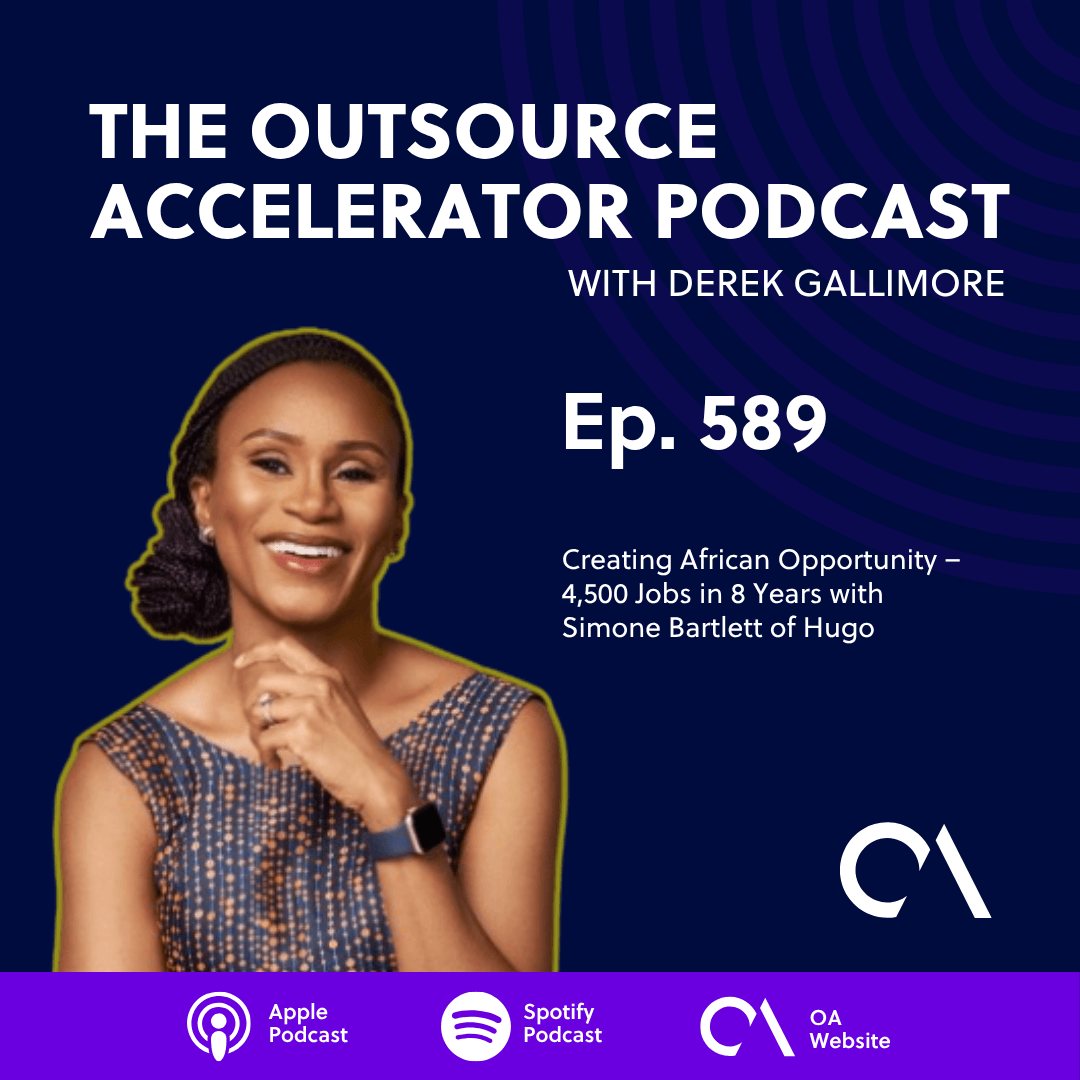
Simone Bartlett, co-founder and CEO of Africa Operations at Hugo, joined the Outsource Accelerator Podcast to share how a finance-and-business-school outsider built a 4,500-person outsourcing firm across Nigeria, South Africa, and the US in just eight years.
From the realities of operating in emerging markets to where AI is reshaping the industry, Bartlett delivered a frank conversation about the work behind the growth — and why job creation drives everything she does.
Hugo was also the overall champion of the 2025 Outsourcing Impact Report.
From Barbados banking to building in Africa
Simone grew up in Barbados, studied in the US, and went into finance before business school and a first entrepreneurial venture that didn’t reach the scale she’d hoped for. Outsourcing came up as her next move — and she didn’t take to it instantly.
“Outsourcing [was] an opportunity that was presented to me, and I remember at the time thinking, ‘Oh, I don’t know if that is the right thing.'”
What sold her was a combination of fit and mission: she’d grown up in client services, loved teaching people to deliver consistent outcomes, and wanted to build something that mattered in Africa.
“I wanted to impact communities in Africa. I wanted a business that I could run in Africa and I could be successful in Africa, and outsourcing just made a lot of sense. It creates a lot of jobs.”
Hugo’s onshore quality at offshore prices
When Hugo launched in 2018, Simone saw an industry where offshore was viewed as the bottom of the hierarchy — used out of necessity, not preference. Hugo set out to invert that.
“We are gonna compete against your in-house team. So we are gonna give you onshore quality at offshore prices, and we are gonna think about what would need to be true for us to do that.”
That meant hiring senior operating managers and giving each engagement the same ownership a client’s internal lead would bring.
“There’s this idea that when the manager is internal, they just have a lot more ownership, they care a lot more. And we wanted to bring that energy to our clients as well.”
AI across the board
Hugo operates across three areas: data annotation, CX and back office, and sales. The first was unplanned.
“We didn’t even know about data annotation. What we knew is we had a lot of university-educated people that didn’t have jobs.
So we were willing to do any work, quite frankly, where that required a team. So that’s how we got into data annotation.”
The timing was fortunate as the AI boom drove explosive demand in that space. Meanwhile, CX and back office remained the original focus, and sales is Hugo’s newest push.
“In the end, people always spend on sales. That’s the engine. We always spend on sales and our clients will always spend on sales. So we’re really excited about that side of the business.”
How Hugo thinks about AI: Supervise, don’t hide
Simone is direct about the threat and the opportunity AI presents to outsourcing. Her stance is to lean in rather than protect legacy.
“We are no longer saying, ‘Where can AI supplement?’ We are saying, ‘Where can we supplement your AI? Where can we do that?'”
Hugo is investing in model evaluation, supervising AI outputs, and pushing into the higher-complexity work automation isn’t ready to handle. The bigger risk, she argued, is sitting out.
“If I am afraid, if I don’t show courage in confronting it, the door is open for others that are willing to just come and exist in that paradigm.”
She also doesn’t think the replace-everything-with-AI thesis plays out as fast as Silicon Valley’s funding suggests.
“Anyone that comes in saying, ‘I can get rid of humans, I can take out a human element in the next year,’ I would bet against that.”
Why job creation is the real point
Hugo took the overall champion title and the Silver Award for Health and Wellness at the 2025 Outsourcing Impact Report. For Simone, the impact case is also the response to common ethics critiques of the industry.
“People just want to work. And working is not just about making money. Working is just about knowing you can do something really good and get really good at something, and you can be competitive at something.”
She frames outsourcing not as a destination but as a stepping stone — a way for young workers in emerging markets to learn, earn, and build options.
“For me, working with an outsourcing company is not a destination. You come here to learn how to work. You come here to learn how to present yourself, and then you can go into a bigger economy.”
To learn more about Hugo’s outsourcing services, visit hugoinc.com or reach Simone Bartlett directly at simone@hugotech.co.
If you’d like to learn more about what we do in the outsourcing space, send us an email at ask@outsourceaccelerator.com.






 Independent





