
Tiered support model

Definition
Tiered support model
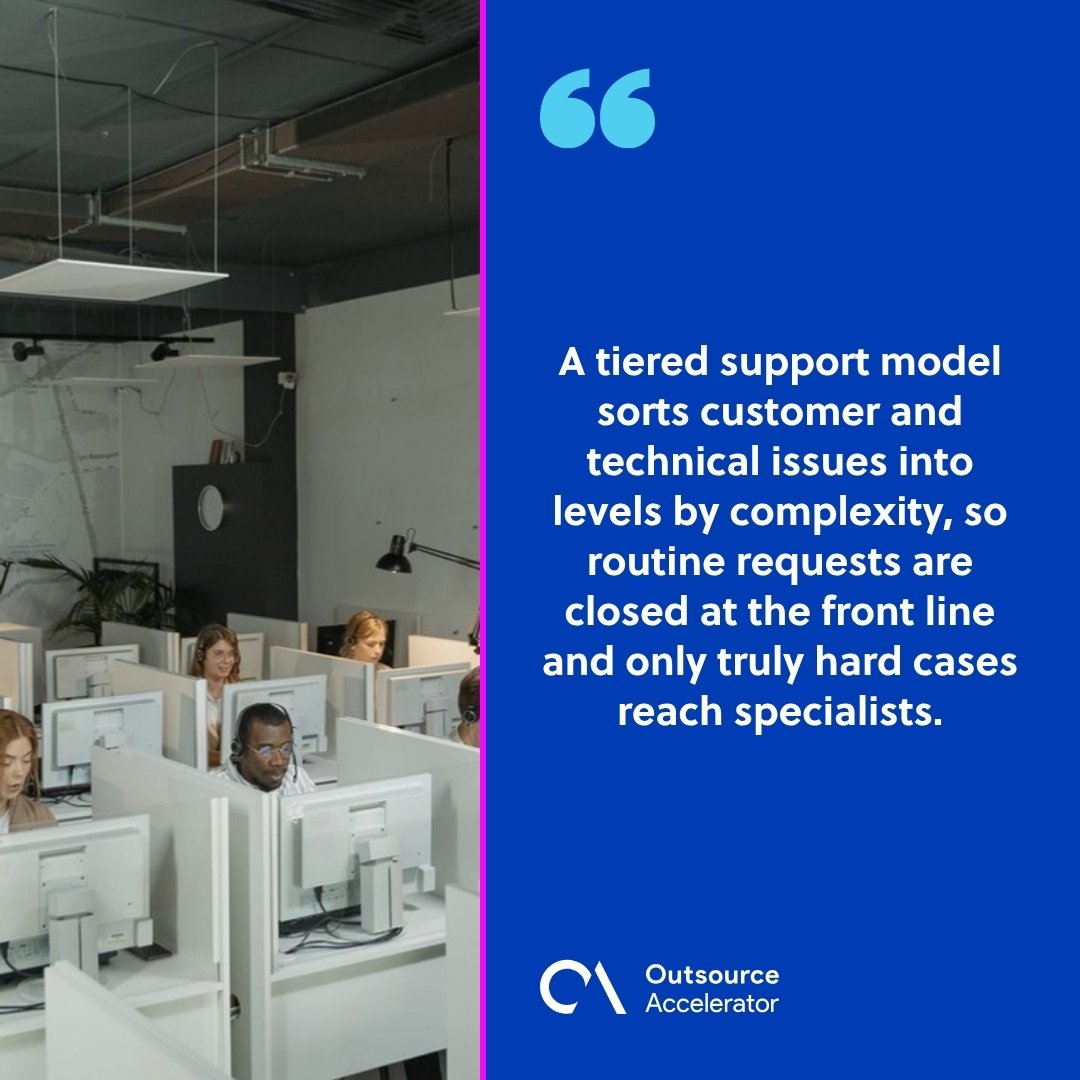
A tiered support model sorts customer and technical issues into levels by complexity, so routine requests are closed at the front line and only truly hard cases reach specialists. It protects expensive expertise from cheap questions, and it governs how escalation flows.
Most operations run three tiers plus a self-service layer. The tiers differ by skill, system access and the time each case is allowed to take.
The design question is never how many tiers to have. It is what each tier is permitted to resolve, and what triggers a hand-off to the next one.
Get that boundary wrong and the model fails in one of two directions — tier one becomes a switchboard that solves nothing, or it holds cases it cannot fix while the customer waits.
Key takeaways
- Tiers are defined by issue complexity and system access, not by seniority or job title.
- Tier 0 is self-service, tier 1 is first contact, tier 2 is deeper technical work, tier 3 is specialist.
- First-contact resolution and escalation rate are the two numbers that show whether the boundaries are right.
- Every tier needs a written trigger for passing a case up, and a rule for passing it back down.
How it works
A tiered support model works by matching each issue to the cheapest level that can resolve it. Contact arrives, tier one diagnoses against a known-issue list, resolves what it can, and escalates the rest against documented criteria.
University service desks publish unusually clear versions of this. UC Santa Barbara defines tier 1 as the first point of contact for IT issues, with tier 2 taking what tier 1 cannot resolve and tier 3 staffed by subject matter experts.
Routing works on two inputs: the issue type and the resolution path. Account resets, how-to questions and known faults belong in tier one. Anything requiring code, database access or a vendor ticket does not.
The hand-off is where most models leak. A case passed up without diagnosis notes forces tier two to start again, which doubles handling time and annoys the customer twice.
Permissions matter as much as training. A tier one agent who cannot issue a refund or reset a licence will escalate cases that were never complex — the boundary there is administrative, not technical.
| Tier | Scope | Who handles it | Target |
|---|---|---|---|
| 0 | Self-service, help centre, chatbot | Customer | Deflection rate |
| 1 | First contact, known issues, account tasks | Customer support agent | First-contact resolution |
| 2 | Technical diagnosis, configuration, deeper access | Specialist support | Resolution within SLA |
| 3 | Engineering, infrastructure, vendor escalation | Product or platform team | Root cause closed |
Design the tiers around your actual contact mix, then measure. A rising escalation rate usually means tier one is under-trained or under-permissioned rather than overworked.
Write the rules down. A documented escalation plan removes the judgement call — one that otherwise happens forty times a shift.
Examples
Published models make the pattern concrete. Two university systems document their tiers openly, and outsourced customer support operations in Manila and Bengaluru run the same shape against commercial service levels.
The University System of Georgia runs an explicit three-tier structure. Its published model places tier one as the frontline helpdesk, tier two with functional analysts and subject matter experts, and tier three with developers and database administrators.
UC Santa Barbara’s breakdown is narrower but identical in logic: basic troubleshooting first, deeper system knowledge second, named specialists third. Both treat escalation as a defined route rather than an informal favour.
Commercial outsourcing adds a billing dimension. Tier one seats are priced lower than tier two, so customer support tiering decisions change the blended rate on a contract directly.
Software vendors often add a tier 0 that carries real volume. A searchable help centre and a chatbot can deflect a large share of password and how-to contacts before any agent sees them.
Shift coverage breaks the model more often than skill does. A tier two queue staffed in one time zone only turns a two-hour fix into an overnight wait for customers on the other side of the planet.
Smaller teams compress the model. A customer support virtual assistant may cover tiers 0 and 1 alone, escalating straight to the product owner — workable at low volume, fragile as soon as volume climbs.
Related terms
A tiered support model is surrounded by terms describing its parts and its failure points. The distinctions below matter most when you are writing the contract, because each one maps to a different service level.
- Escalation: the act of passing a case to a higher tier or authority.
- Escalation manager: the owner of high-severity cases that cross several teams.
- Escalation rate: share of contacts that leave tier one, and the core health check on the model.
- Customer support tiering: the design work of defining what each level handles.
- Customer support agent: the front-line role that resolves or routes the first contact.
FAQ
Five questions come up when teams design or renegotiate a tiered support model: how many tiers, what tier 0 is, what to target for first-contact resolution, when to skip tiers, and how it affects cost.
How many tiers should we run?
Three plus self-service suits most operations. Add a fourth only when a genuinely distinct skill set exists, because every extra boundary adds a hand-off and a delay.
What is tier 0?
Tier 0 is everything the customer resolves without contacting you: help centre articles, status pages, chatbots and in-product guidance. It is measured on deflection, not on handle time.
What first-contact resolution target is realistic?
It depends entirely on contact mix, and published service-desk goals vary widely. Set yours from your own baseline, then move it deliberately rather than copying another operation’s number.
Can a case skip a tier?
Yes, and it should when severity demands it. Outages, security incidents and regulated complaints are routed straight to the tier that owns them, under a documented exception.
How does tiering change support cost?
It lowers cost per contact by matching work to the cheapest capable level. The saving disappears if tier one escalates everything, which is why escalation rate is tracked alongside resolution.
To compare providers who can staff all three tiers, shortlist them in the Outsource Accelerator directory.






 Independent






