
Talent pipeline strategy

Definition
Talent pipeline strategy
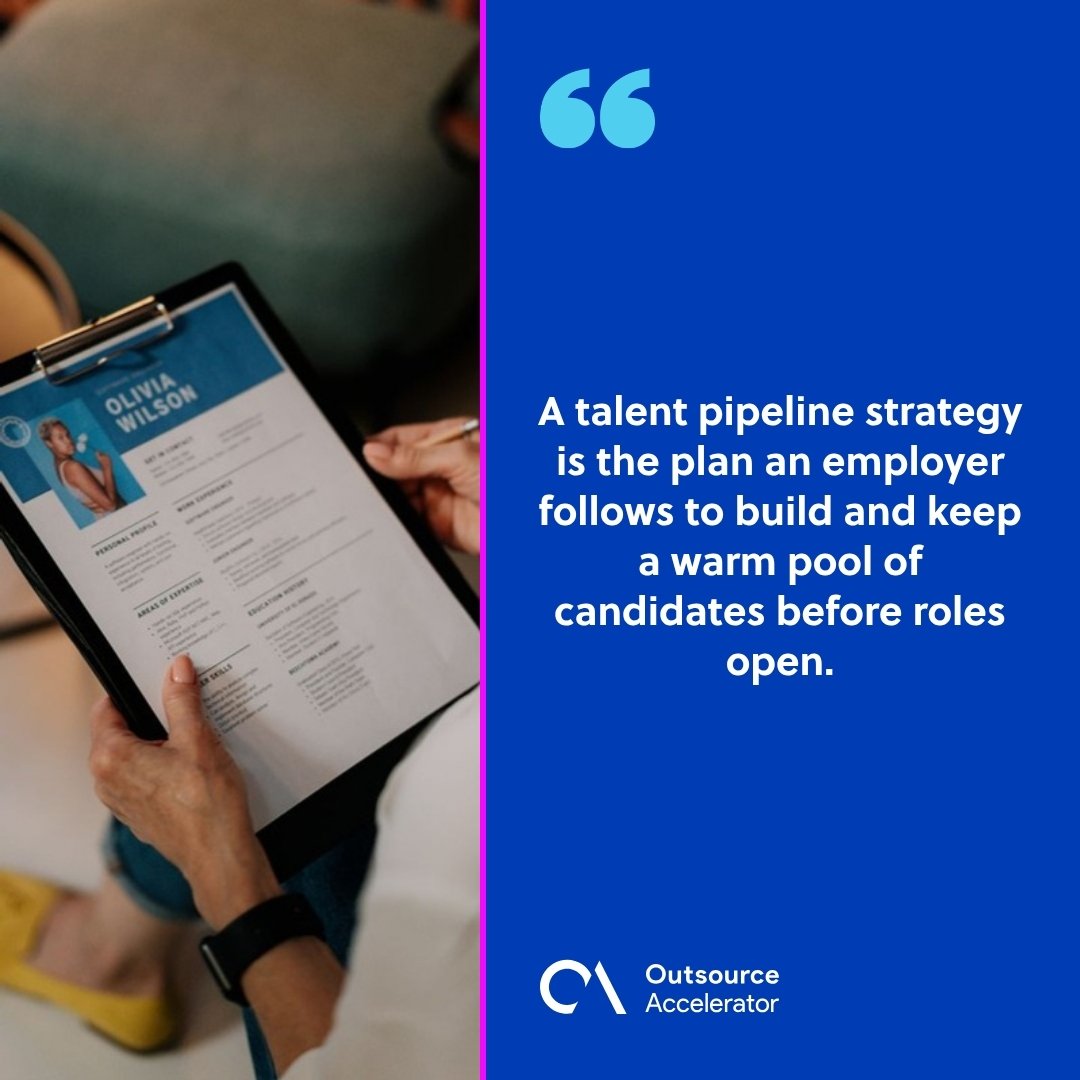
A talent pipeline strategy is the plan an employer follows to build and keep a warm pool of candidates before roles open. It sets which roles to pre-source, where to find those people, and how often to stay in touch with them.
The distinction matters. A talent pipeline is the pool itself, a list of people who could join. The strategy is the set of decisions that fills that pool, keeps it current and decides when to stop.
Without one, sourcing restarts at zero every time somebody resigns. With one, the first three conversations happen before the vacancy exists — which is where the time saving comes from.
It is a planning document, not a campaign. Most of the work is choosing which roles deserve a standing pool, because warming candidates for everything is how recruiting teams burn out.
The strategy also says what happens once a pool exists, which is the point at which pipeline management takes over the day-to-day.
Key takeaways
- A talent pipeline strategy decides which roles get a pre-built candidate pool, and why.
- It defines sourcing channels, contact cadence and the owner for each pool.
- Pools decay, so refresh rules matter more than initial pool size.
- Success is measured in time-to-offer and offer acceptance, not in contact counts.
How it works
Building a pipeline strategy takes five steps: forecast demand by role, rank roles by scarcity and cost of delay, pick sourcing channels for each, set a contact cadence, then assign an owner. Everything after that is maintenance.
Demand forecasting is where most plans wobble. Hiring managers tend to describe last year’s shape, so pair their input with attrition data and the operating plan.
Scarcity ranking does the hard filtering. A role that takes 70 days to fill and stops revenue when vacant earns a standing pool; a role you can fill in a fortnight does not.
Channels follow the ranking. Critical pools get worked by name through referrals, alumni and direct approach, and an honest employer brand strategy decides whether those approaches get answered.
| Pool tier | Who sits in it | Contact cadence | Target time-to-offer |
|---|---|---|---|
| Critical | Silver-medal candidates, named targets | Every 4–6 weeks | Under 14 days |
| Scarce | Niche skills, slow local supply | Quarterly | Under 30 days |
| Volume | Repeatable frontline roles | Campaign-driven | Under 21 days |
Cadence is the part teams skip. A pool nobody contacts is a stale list, which is why pipeline hygiene rules belong in the strategy document rather than in somebody’s head.
Two numbers keep the plan honest. Pipeline velocity shows how fast warm candidates convert, and pipeline forecast accuracy shows whether the demand maths held up — both belong in the monthly review.
The market sets the stakes. According to the Bureau of Labor Statistics, job openings stood at 7.1 million in August 2026 against 5.2 million hires, so competition for the same shortlists is constant.
Examples
Pipeline strategies look different by hiring volume. A professional services firm pre-sources a dozen named people; a contact centre pre-sources a thousand profiles a quarter. Both plan ahead, but their cadence and channels diverge sharply.
Healthcare employers have the clearest case. Nursing pipelines run years ahead of vacancies, because training lead times are fixed and an uncovered rota line has to be filled by agency staff at a premium.
UK employers feel the same squeeze from the other side. The Office for National Statistics counted 702,000 job vacancies in June to August 2026, at 2.5 unemployed people per vacancy, so pre-built pools decide speed.
Philippine contact centres build standing pools against known attrition. A site losing 4% of agents a month knows its monthly intake before January starts, so sourcing runs as a continuous programme rather than a reaction.
Technology teams run named-target pipelines. A platform engineering lead keeps 20–30 people warm through meetups and alumni contact, with notes on who is due a move elsewhere.
Their recruitment outsourcing partners get briefed on relationships rather than requisitions, and are measured on pool depth — not on CVs sent.
A provider under a recruitment process outsourcing (RPO) contract will usually own the cadence itself, reporting pool depth monthly against the tiers the client signed off.
Related terms
Pipeline vocabulary gets muddled because sales teams use the same words for deals. These neighbouring terms each cover one slice of the work, and keeping them separate makes the strategy document far easier to argue for.
- Talent pipeline: the pool of potential candidates itself, which the strategy exists to fill.
- Pipeline management: the day-to-day running of a pipeline once the strategy sets its shape.
- Pipeline velocity: how fast candidates move from first contact to signed offer.
- Pipeline forecast accuracy: how closely predicted hires match actual hires over a period.
- Employer brand strategy: the positioning work that makes warm candidates answer your messages.
- Recruitment Process Outsourcing Association (RPOA): the industry body for providers running outsourced recruitment.
FAQ
Most questions about pipeline strategy come down to cost and proof. Hiring leaders want to know what the pools cost to keep warm and what evidence shows they shorten hiring, so start there.
How many roles should have a standing pipeline?
Start with three to five. Pick roles that are slow to fill, expensive when vacant, or both. Adding pools faster than you can contact them produces a stale database.
How often should candidates be contacted?
Every four to six weeks for critical pools, quarterly for scarce ones. The message has to carry something useful, such as a market update or an invitation, not a status check.
What metrics prove it is working?
Time-to-offer, offer acceptance rate, and the share of hires that came from the pool rather than a fresh search. Track pool source share monthly.
Can a provider run the strategy for us?
Yes. An RPO provider can own forecasting, sourcing and cadence end to end, though the role-ranking decision should stay with the client because it reflects commercial priorities.
Is this the same as succession planning?
No. Succession planning maps internal people to future internal roles, while a pipeline strategy is mostly outward-facing — it builds relationships with people who do not work for you yet.
Find recruitment partners who can run these pools for you in the Outsource Accelerator directory.






 Independent






