
Budget Analyst

Definition
Budget Analyst
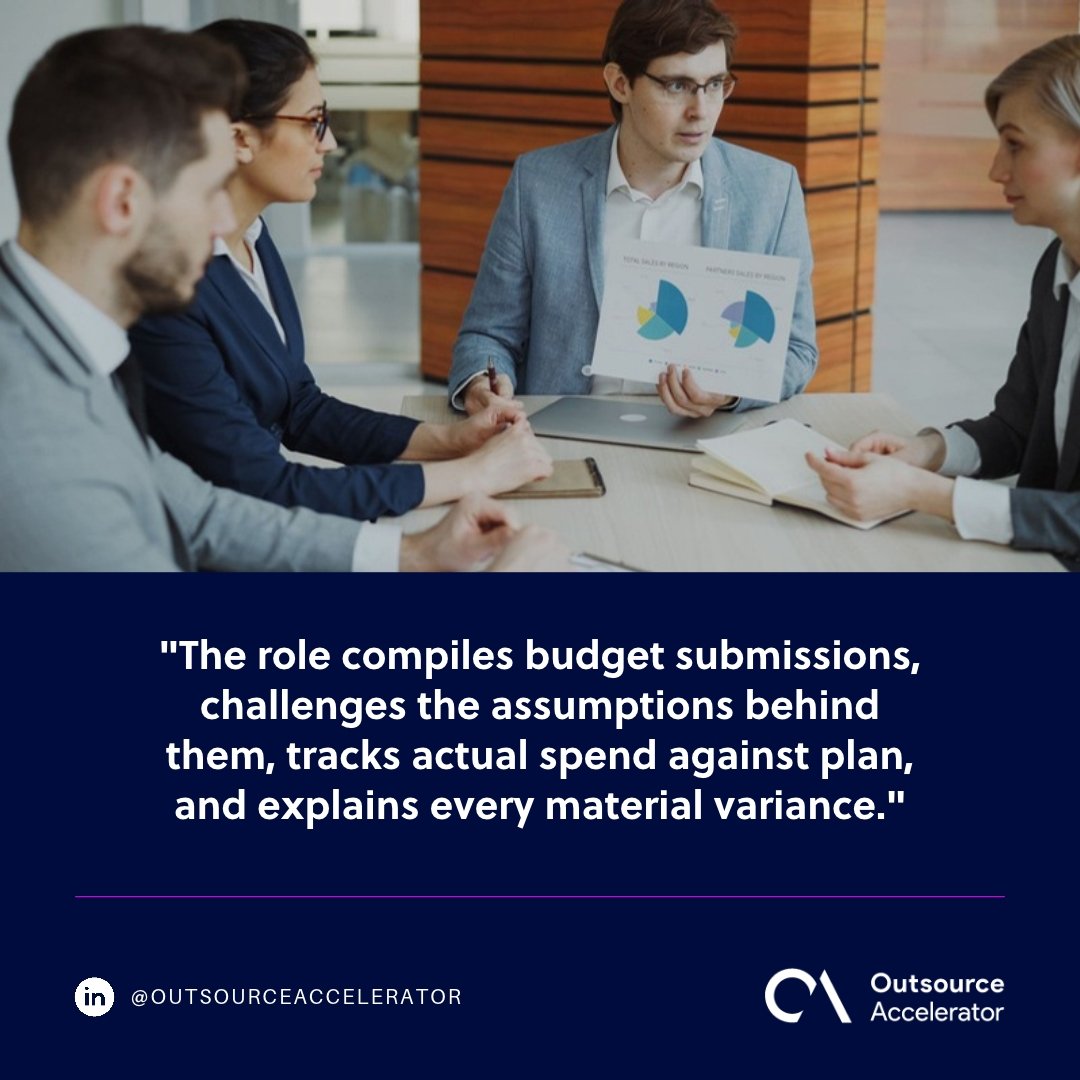
A budget analyst builds the spending plan and then polices it through the year. The role compiles budget submissions, challenges the assumptions behind them, tracks actual spend against plan, and explains every material variance. The budget is a control, not a forecast.
That distinction decides how the job is done. A forecast tries to predict what will happen, and it is judged on accuracy.
A budget states what the organisation has agreed to allow. It is judged on whether spending stayed inside it — which is why the analyst spends more time on variance than on prediction.
The role is also the only one in finance whose job is to say no with evidence. Everyone else’s budget request is sincere, and most of them cannot all be funded.
Key takeaways
- The role compiles, challenges and then monitors the organisation’s spending plan.
- Variance explanation is the recurring deliverable, not an occasional exercise.
- The budget is an authorisation limit rather than a prediction of outcomes.
- Public sector budgeting is rule-bound; corporate budgeting is negotiation-bound.
How it works
The cycle repeats annually with a monthly heartbeat inside it. Departments submit requests, the analyst standardises and challenges them, finance consolidates an affordable plan, and from then on every month compares actual spend against that agreed line.
Challenge is the stage that creates the value, and the stage most often skipped. Without it the budget simply records what each department hoped for, and the first serious variance arrives in month two.
| Cycle stage | What the analyst does | Where it goes wrong |
|---|---|---|
| Submission | collects and standardises departmental requests | every team budgets for its best case |
| Challenge | tests assumptions against prior actuals | the loudest manager wins, not the best argument |
| Consolidation | rolls up into one affordable plan | cuts applied evenly rather than by priority |
| Variance review | explains actual against plan each month | the explanation stops at the word “timing” |
The occupation is small and specialised. The US Bureau of Labor Statistics counts just 50,400 budget analyst jobs in 2025 at median pay of $91,640, with 2 percent growth projected to 2035.
Concentration in government explains the shape of the role. The US Government Accountability Office maintains standard definitions for terms used in the federal budget process, a level of formal vocabulary corporate budgeting never developed.
Monthly reporting usually lands alongside the close, so the analyst depends on whatever the staff accountant has posted — a late accrual turns a clean variance into an argument about whether the cost is even real.
Examples
Budgeting looks different depending on whether the limit is legal or merely agreed. In government the budget is an authority to spend; in a company it is a management commitment that can be revisited when conditions change.
A government agency budgets to appropriations. The analyst tracks obligations against authorised amounts, and overspending is not a performance issue but a compliance breach.
A manufacturer budgets to capacity and demand. Here the analyst’s hardest work is separating volume-driven variance from genuine cost inflation, because the two look identical on a summary report.
A fast-growing technology company barely budgets in the traditional sense. It reforecasts quarterly, so the analyst runs a rolling plan and spends most of the time explaining why the last version is already out of date.
The sharpest analysts in all three settings do the same thing — they investigate favourable variances as carefully as adverse ones, because underspend usually means a project has silently stalled.
Underspend also tends to be punished a year later. A department that returns money is frequently given less next cycle, which quietly teaches every budget holder to spend the remainder rather than report it.
Related terms
Planning roles are separated by what they are accountable for rather than by the tools they use. The distinctions below clarify which part of the planning cycle each one owns.
- Budget: the agreed allocation of money across a fixed period that this role administers.
- Financial Planning Analyst: the forecasting counterpart focused on likely outcomes rather than authorised limits.
- Financial Analyst: the broader analytical role covering performance, investment and profitability.
- Finance Manager: the supervising role that owns the consolidated plan and defends it upward.
- Key Performance Indicator (KPI): the measures a budget is monitored against alongside pure spend.
FAQ
What does a budget analyst do?
They collect and challenge departmental budget submissions, consolidate them into an affordable plan, then track actual spending against that plan and explain the variances each month.
How is a budget analyst different from an FP&A analyst?
A budget analyst administers an agreed spending limit, while a financial planning analyst forecasts likely outcomes. Budgeting is about control and authorisation; planning is about prediction.
What is variance analysis?
It is the monthly comparison of actual spending against the budgeted amount, with an explanation for each material difference. A useful explanation names a cause and a corrective action.
Is the role more common in government or business?
Both employ it, but the title is most formalised in the public sector, where budgets are legal spending authorities rather than internal management targets.
What skills matter most?
Strong analytical work, plus the confidence to challenge a senior manager’s assumptions without turning the conversation into a confrontation.
See how finance functions are structured and delivered across the Outsource Accelerator network.






 Independent






