
What is robotic process automation in finance?

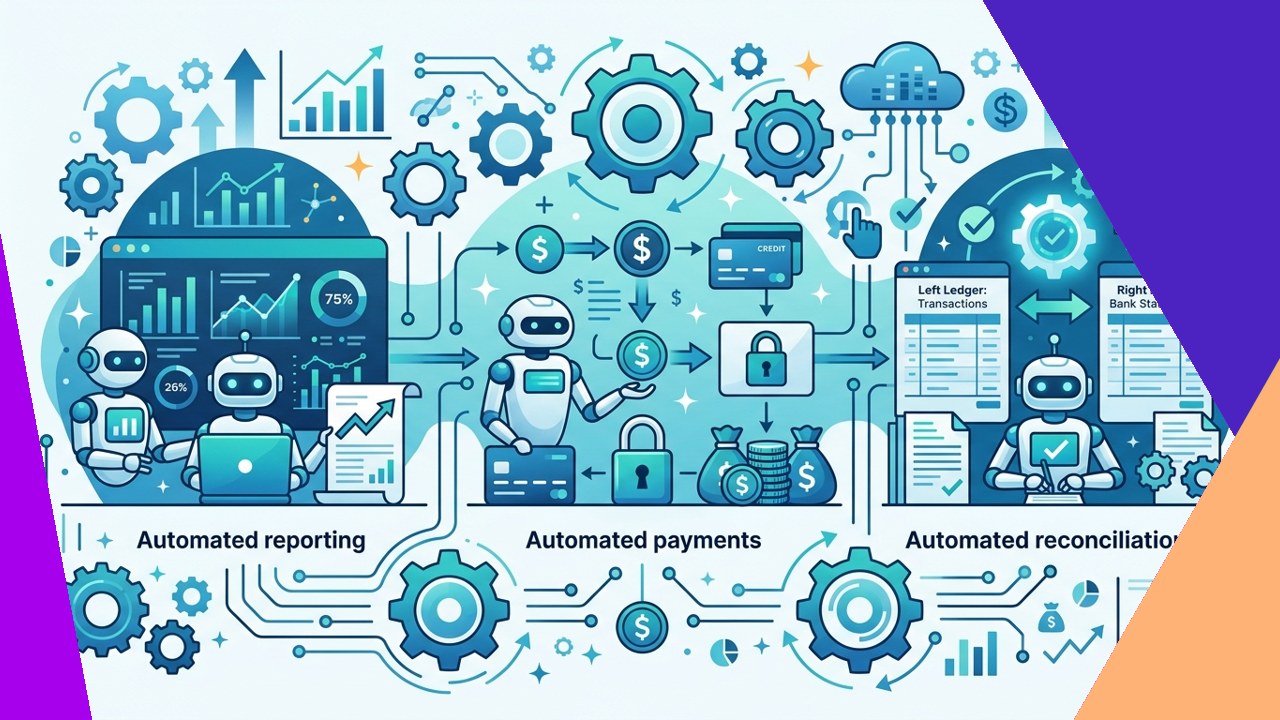
- Robotic process automation in finance uses software bots to run repetitive, rule-based tasks like invoice matching and reconciliations.
- The best candidates are high-volume processes with structured data and stable rules; judgment-heavy work is a poor fit.
- Bots cut cycle times and errors and leave a clean audit trail, but they need strong governance and human oversight.
Robotic process automation in finance uses software bots to handle the repetitive, rule-based work that finance teams once did by hand. Think invoice matching, account reconciliations, and monthly report preparation. The bots log into your systems, read structured data, and follow set rules, just as a person would.
This guide explains what RPA is and where it fits inside a finance function. It also shows how RPA differs from broader finance automation. Finally, it covers the highest-value use cases, the benefits, and the risks you must manage.
What is robotic process automation in finance?
RPA is a type of software that mimics how a person works inside an application. According to Harvard Business Review, “RPA is a category of software tools that enable complex digital processes to be automated by performing them in the same way a human user might perform them.” In finance, that means the bot clicks, types, copies, and pastes across your ERP, banking portal, and spreadsheets.
Because the bot works on the screen surface, you do not need to rebuild your systems. The bot follows a script and a set of if-then rules. It handles structured data, such as an invoice number or a ledger amount. However, it cannot reason or make judgment calls on its own.
How RPA differs from broader finance automation
People often confuse RPA with finance automation in general, but the two are not the same. RPA is one narrow tool inside a much wider toolkit. It automates specific tasks, not whole decisions.
Broader finance automation can include artificial intelligence, machine learning, and process mining. These tools read unstructured data, spot patterns, and even predict outcomes. RPA does none of that. It simply repeats a fixed, rule-based task quickly and without error. As a result, many teams pair RPA with AI to cover both routine work and judgment work. Outsource Accelerator explains this pairing in its overview of how AI supports finance and accounting outsourcing.
High-value RPA use cases in finance
RPA shines in the back office, where work is high in volume and low in variation. Here are the most common use cases.
Accounts payable and accounts receivable
Bots capture invoice data, match it to purchase orders, and flag mismatches for review. On the receivable side, they post payments and send reminder emails on schedule.
Reconciliations
Bots pull balances from two systems and compare them line by line. They mark exceptions and route them to an analyst, so people only touch the items that need a human eye.
Financial close and reporting
During close, bots gather data, run journal entries, and build recurring reports. Because the steps repeat every period, the process suits automation well.
Compliance checks and payments
Bots screen transactions against rules and watchlists, then log every step. For payments, they prepare batches and check details before release. Every action leaves a timestamped record for auditors.
Good versus poor RPA candidates
Not every task deserves a bot. The table below shows what to automate first and what to leave alone.
| Good RPA candidate | Poor RPA candidate |
|---|---|
| High volume, done many times a day | Rare or one-off task |
| Clear, stable rules | Rules that change often |
| Structured, digital input | Handwritten notes or scanned images |
| Few exceptions | Heavy judgment or negotiation |
| Stable underlying systems | Systems that change screens often |
The benefits of RPA in finance
The benefits fall into four clear buckets: speed, accuracy, audit trail, and cost.
First, bots work fast and never tire. Public-sector results show the scale of the time saved. One U.S. General Services Administration bot “reviewed over 4,000 new MAS offers and saved over 5,000 hours,” per the agency’s own report on RPA in federal acquisition.
Second, bots follow the same steps every time. Because they do not slip on tired afternoons, error rates fall. Third, bots log every action, so you gain a complete audit trail. That record makes compliance reviews faster and cleaner. Fourth, teams free up hours for analysis and planning instead of data entry.
Risks and governance
RPA is powerful, but it can go wrong without controls. A bot copies a bad process just as fast as a good one. So you should fix the process before you automate it. HBR makes this point plainly in its guidance on why teams should improve processes before automating them, not just bolt automation onto broken steps.
You also need clear ownership and change control. When a system screen changes, the bot can break silently. For that reason, someone must monitor bots and test them after updates. Access rights matter too, because a bot holds real credentials. In short, treat every bot like a member of staff with defined duties, limits, and oversight.
How outsourcing partners deploy RPA
Many companies bring in an outsourcing provider to run RPA at scale. The partner first maps your finance processes and finds the best candidates. Then it builds, tests, and maintains the bots inside your systems.
A good offshore partner also blends bots with skilled people. The bots handle volume, while analysts own exceptions and judgment calls. This model reduces cost and keeps quality high. To see where these functions fit, review the common types of outsourced finance and accounting services a provider can support.
Frequently asked questions
Is RPA the same as artificial intelligence?
No. RPA follows fixed rules and structured data, while AI learns from patterns and handles judgment. Many finance teams use both together, so bots do the routine work and AI supports harder decisions.
Which finance task should I automate first?
Start with a high-volume, rule-based task that has few exceptions. Invoice processing and reconciliations are common first choices. Because the payback is quick, these projects build early momentum and trust.
Will RPA replace finance staff?
Usually not. Bots take over dull, repetitive steps, so people shift to analysis, controls, and planning. As a result, roles change rather than disappear.
How long does an RPA project take?
A simple bot can go live in a few weeks. More complex, multi-system processes take longer. The timeline depends on how stable and well-documented your current process is.
Key takeaways
- RPA in finance runs repetitive, rule-based tasks with software bots that mimic human clicks and keystrokes.
- It differs from broader automation because it follows fixed rules and does not reason or predict.
- Automate high-volume, structured, low-exception work first, and fix the process before you build the bot.
- Strong governance and human oversight keep bots safe, accurate, and audit-ready.






 Independent





