
Remote employee vs Contractor: How to decide for your team

Table of Contents
- Remote employee vs Contactor: Which is better for your team?
- What is a remote employee?
- What is a contractor?
- Remote employee vs Contractor: Key similarities and differences
- When to hire a remote employee vs contractor
- FAQ
- Key takeaways
Remote employee vs Contractor: Which is better for your team?
- A remote employee is officially employed by your company but works outside a traditional office.
- A contractor is an independent professional hired under a service agreement for specific deliverables.
- Remote employees offer stability and integration, while contractors provide flexibility and specialized expertise.
- The right choice depends on your goals, budget, compliance requirements, and long-term growth plans.
- Companies like Remote Employee help businesses scale efficiently by providing vetted remote talent and administrative support.
Choosing between a remote employee and an independent contractor is one of the most important workforce decisions a growing business can make.
While both offer flexibility and access to global talent, the legal structures, levels of control, and long-term impacts on your organization differ significantly.
What is a remote employee?
A remote employee is a worker who is legally employed by your company but performs their job outside a centralized office environment. They may work from home, in a coworking space, or in another geographic location, either full-time or in a hybrid setup.
Remote employees play an important role in building a sustainable remote workforce structure. They allow organizations to maintain operational consistency while accessing talent beyond traditional office boundaries.
Remote employees:
- Are on your company’s payroll
- Work under company policies and supervision
- Typically receive benefits (depending on local regulations)
- Are integrated into your team structure and culture
| Pros of hiring a remote employee | Cons of hiring a remote employee |
| Long-term stability | Less short-term flexibility |
| Cultural alignment | Time zone differences |
| Greater control | Long-term financial commitment |
| Stronger team cohesion |
Remote work is no longer a temporary shift; it’s a structural change in the workforce. In the United States alone, over 32.6 million people were working remotely in 2025, making up 22% of the national workforce.
As companies adapt to distributed operations, developing the right remote workforce structure has become a strategic priority.
What is a contractor?
A contractor is a self-employed individual or business entity that provides services to a company under a contract. Contractors are not employees and typically operate independently.
Contractors:
- Control how and when they complete work
- Use their own tools and equipment
- Manage their own taxes and benefits
- Are engaged for defined scopes of work
| Pros of hiring a contractor | Cons of hiring a contractor |
| Flexibility | Limited control |
| Specialized expertise | Less integration |
| Lower administrative burden | Knowledge continuity risk |
| Scalable on demand |
Contractors are often attractive for project-based work, but businesses must carefully evaluate worker classification rules to ensure that an independent contractor is not being treated like a full-time employee.
Remote employee vs Contractor: Key similarities and differences
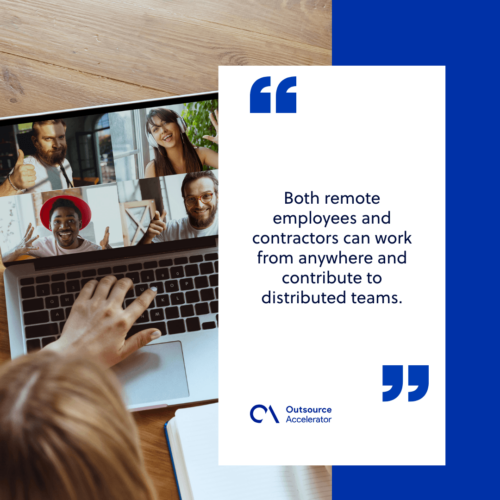
Both remote employees and contractors can work from anywhere and contribute to distributed teams.
However, their legal classification and long-term impact differ.
| Criteria | Remote Employee | Contractor |
| Legal status | Official employee | Independent service provider |
| Payroll & taxes | Employer withholds taxes | Contractor handles own taxes |
| Benefits | Often eligible | Not eligible |
| Work control | Employer sets expectations and schedule | Greater autonomy |
| Duration | Ongoing, long-term | Project-based or fixed-term |
| Integration | Embedded in team culture | External collaborator |
| Compliance risk | Standard employment compliance | Higher compliance risk if worker classification rules are violated |
Making the right decision also requires understanding worker classification and employment classification. Misidentifying a worker’s status can create legal complications and financial liabilities for your business.
Understanding these distinctions is critical to avoiding compliance issues and building the right remote workforce structure.
Key takeaway: Remote employees support sustainable, culture-driven growth strategies. On the other hand, contractors offer agility and specialized skill access without long-term commitment.
When to hire a remote employee vs. contractor
Your decision should align with your company’s growth strategy and operational needs.
Hire a remote employee when:
| Situation | Why it makes sense |
| The role is core to your business | Ensures stability and long-term ownership |
| You need daily collaboration | Enables consistent oversight and teamwork |
| You’re building a scalable team | Supports sustainable growth |
| You want strong cultural alignment | Employees embody your mission and values |
| You require structured management | Employees operate under defined policies |
Hire a contractor when:
| Situation | Why it makes sense |
| The work is short-term | No need for permanent headcount |
| You need specialized expertise | Access niche skills quickly |
| Budget flexibility is important | Pay for defined deliverables |
| The scope is clearly defined | Easier contract structuring |
Remote Employee CEO Ruffy Galang advised for outsourcing, saying, “Outsourcing is about making smarter decisions for your business. When you delegate non-core tasks to a reliable partner like Remote Employee, you free up your key leaders to focus on what truly drives growth.”
FAQs
Is a remote employee more expensive than a contractor?
Not necessarily. While remote employees may include benefits and payroll obligations, they often provide stronger long-term ROI through loyalty, productivity, and institutional knowledge.
Are remote employees always full-time?
No. Remote employees can be full-time or part-time, depending on business needs and employment agreements.
Which option is better for startups?
Startups often begin with contractors for flexibility, then transition to remote employees as roles become core to operations and long-term growth.
How Remote Employee supports scaling teams
Scaling a team, especially across borders, can quickly become complex. From sourcing qualified talent to managing payroll, compliance, and HR processes, international hiring requires time, expertise, and infrastructure.
This is where Remote Employee provides strategic support.
Rather than simply filling positions, Remote Employee enables companies to create structured, scalable workforce solutions.
How Remote Employee helps businesses scale:
- Talent sourcing and vetting. They identify qualified professionals aligned with your role requirements.
- Administrative support. Hiring internationally often involves payroll logistics, compliance considerations, and workforce documentation. Remote Employee assists with these processes, reducing your internal administrative burden.
- Cost efficiency. Businesses can expand headcount without investing in additional office infrastructure.
- Scalability. As demand grows, companies can expand teams in a controlled and structured manner.
- Operational focus. Leadership can concentrate on revenue and strategy rather than recruitment processes.
For organizations aiming to scale sustainably, partnering with Remote Employee streamlines workforce expansion while maintaining quality and compliance awareness.
Get in touch with the team to learn how you can grow your remote workforce.
Pro tip: Strategic workforce planning, potentially supported by providers like Remote Employee, enables businesses to grow efficiently in a distributed work environment.






 Independent





