
How to build a remote employee handbook your distributed team will actually use

- Most remote employee handbooks fail not because they’re missing content, but because they’re written to satisfy legal requirements rather than to actually help the people reading them.
- A handbook your distributed team uses is short, plain, written around how work actually happens, and given to staff at onboarding — not buried in a shared drive.
- The sections that get read are the practical ones: communication expectations, working hours, performance standards, and what happens when something goes wrong.
- Remote Employee provides structured offshore staffing for businesses that need their distributed teams built on clear, operational frameworks from the start.
There’s no shortage of templates online for remote employee handbooks. Most of them produce documents that sit unopened in a shared drive, referenced once at onboarding and never again.
The problem isn’t the content — it’s that the handbook was written to cover the company’s bases rather than to serve the person reading it.
A handbook your distributed team actually uses looks different. It’s written like an operating guide, not a legal document. It tells people what to do, not just what not to do. That’s what a genuinely useful employee handbook template produces in practice.
For a broader look at how to manage a remote team effectively, that foundation matters as much as the documentation itself.
Why most remote handbooks don’t get used
Ruffy Galang, CEO of Remote Employee, puts it plainly: “Remote work only fails when leadership ignores the structure and systems it demands.”
A handbook that nobody reads isn’t providing structure. It’s just documenting that structure was considered.
The most common reasons handbooks go unused:
- They’re too long
- Written in HR-speak
- Don’t reflect how the team actually operates
- Are handed over as a PDF attachment rather than walked through at onboarding
Fix those four things and utilization changes dramatically.
Research cited by SHRM found that employees who go through a structured onboarding process are 69% more likely to remain with their organization after three years. That figure underscores how much delivery method matters, not just content.
Pro Tip: Before writing a single word of your handbook, audit your last three months of onboarding questions. Every question a new hire asks is a gap in your current documentation. Start there — it’s faster than starting from a template.
What to include in a remote employee handbook — and how to write it
A good remote employee handbook isn’t a legal document — it’s an operating manual. The sections below cover what to include and how to write each one so it actually gets used.
1. Communication expectations
This is the section remote staff consult most often and most handbooks handle the worst.
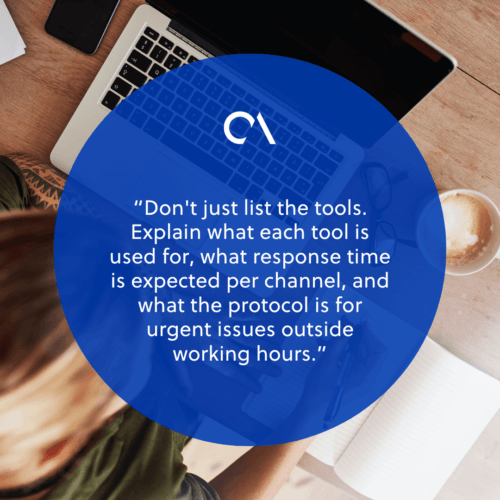
Don’t just list the tools. Explain what each tool is used for, what response time is expected per channel, and what the protocol is for urgent issues outside working hours.
Write it as a set of clear defaults — not a policy paragraph about communication culture. Company policies that explain the why behind each rule get read; policies that just state the rule do not.
2. Working hours and availability
Many offshore roles operate on a defined schedule aligned to the client’s timezone. State core hours explicitly, define the overlap window with the onshore team, and explain how schedule changes are requested and approved.
According to Remote Employee’s guide on time zone management, establishing clear overlap hours is one of the single most effective steps a distributed workforce can take to maintain cohesion.
3. Performance expectations
Remote performance management is output-based. The handbook should state how work is measured, what review cycles look like, and how a staff member knows they’re meeting their remote work expectations — before they get to a formal review.
Ambiguity here drives more anxiety and turnover than any other factor.
Pro Tip: Include a sample performance review template as an appendix. When staff can see exactly how they’ll be evaluated before their first review, ambiguity drops and performance conversations become significantly less stressful for both sides.
4. Equipment and workspace requirements
Who provides hardware? What’s the minimum internet speed? Is a private workspace required for calls handling sensitive information?
Spell it out. The questions seem minor until a staff member takes a client call from a café with no understanding that this was a problem.
5. What happens when things go wrong
Technical failures, family emergencies, performance issues — the handbook should tell staff exactly what to do and who to contact in each scenario. This is the section people reach for in a moment of stress, so it needs to be findable and readable fast.
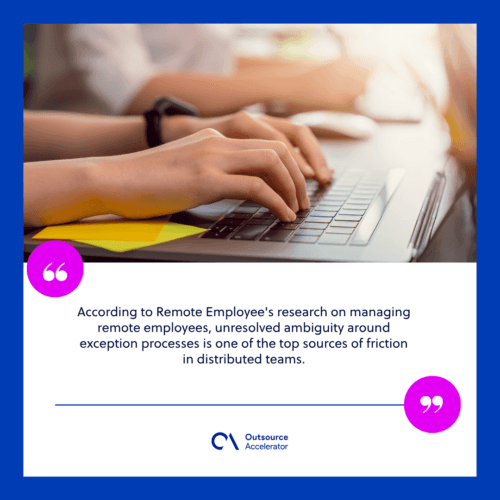
According to Remote Employee’s research on managing remote employees, unresolved ambiguity around exception processes is one of the top sources of friction in distributed teams.
Format and delivery: The part most companies get wrong
| What doesn’t work | What does |
|---|---|
| 50-page PDF attached to an onboarding email | A short, structured document (under 20 pages) shared during a live onboarding session |
| Dense policy paragraphs | Short sections with clear headings and bullet-point defaults |
| Updated annually if at all | Reviewed and updated whenever a tool, process, or expectation changes |
| Covers everything in legal language | Covers what staff actually need to know in plain language |
The length question is worth addressing directly: a remote employee handbook doesn’t need to be comprehensive. It needs to be useful.
If a section can be summarized in two sentences, write two sentences. Staff will read it. They won’t read the paragraph version.
The same principle applies to building a strong remote work culture — clarity on expectations is more valuable than volume of documentation.
Pro Tip: Run a 20-minute handbook walkthrough in the first week of onboarding — not a presentation, just a guided read-through with the new hire. Ask them to flag anything unclear. Those flags become your next revision, and the exercise itself signals that the handbook is a living document, not a compliance checkbox.
How Remote Employee supports a distributed team
Remote Employee provides offshore staffing solutions that place full-time dedicated staff in the Philippines for businesses across the US, Australia, and globally. Their model includes the onboarding support and operational frameworks that help distributed teams function reliably from day one — not just filling roles, but ensuring those roles are set up to work.
- Full-time dedicated offshore staff based in the Philippines
- HR, compliance, and payroll handled locally by Remote Employee
- Onboarding support aligned with the client’s existing processes and tools
- Roles across customer service, administration, finance, and specialist functions
For businesses building distributed teams that need to operate with clarity and accountability, explore remoteemployee.com.
FAQs
What is the purpose of a remote employee handbook?
A remote employee handbook helps distributed teams understand company expectations, communication standards, performance requirements, and operational procedures. It serves as a practical guide that supports consistency, accountability, and successful onboarding.
How long should a remote employee handbook be?
Long enough to answer the questions staff actually have; short enough to be read in one sitting. For most remote teams, that’s 10 to 20 pages.
If your handbook is running longer than that, it’s probably covering material that belongs in separate process documents rather than the handbook itself.
Should offshore staff have the same handbook as local staff?
One handbook is simpler and avoids creating a two-tier culture. But it needs to address remote-specific realities: time zone expectations, equipment provisions across borders, and data privacy requirements in the employee’s location.
A single handbook with role-specific or location-specific sections handles this cleanly.
How often should a remote employee handbook be updated?
Whenever something material changes: a tool is replaced, a process is updated, a compliance requirement shifts. Building a quarterly review into someone’s responsibilities prevents the handbook from drifting out of sync with how the team actually operates.
Key takeaways
- A remote employee handbook that gets used is short, practical, written in plain language, and walked through at onboarding rather than emailed as an attachment.
- The sections staff consult most are communication expectations, working hours, performance standards, and what to do when something goes wrong.
- Format and delivery matter as much as content: comprehensiveness is less important than clarity and findability.
- Remote Employee provides structured offshore staffing for businesses that need their distributed teams built on clear operational foundations from the start.






 Independent





