
7 reasons why your ML company should outsource data annotation


This article is a submission by Mobilunity BPO. Mobilunity BPO is among the leaders in sourcing, hiring, and retaining top Ukrainian talents for businesses worldwide.
There are many reasons to outsource data annotation, and the biggest one is speed to high quality AI training data. As AI and ML grow, data annotation (also called data labeling) has become a core tool. It turns raw data into useful, labeled datasets.
Labeled data trains machine learning models. So it drives digital transformation, process automation, and other new projects. Do not let your business fall behind. You can adopt AI and ML with strong data annotation services.
Here are some eye-opening stats that show why this matters:
- Statista predicts that the global AI market will grow from $208 billion in 2023 to nearly $2 trillion in 2030.
- Fortune Business Insights expects the global ML market to surpass $209 billion in 2029, up from $21 billion in 2022.
- MarketsandMarkets states that the digital transformation industry, driven by AI and ML, will grow from $594 billion in 2022 to over $1.5 trillion in 2027.

But how do you streamline data annotation for AI and machine learning? In general, you have two options:
- Hire in-house data labelers
- Outsource data annotation services
Today, we will focus on the second option. We will also explain why it often beats the in-house route.
What are the main reasons to outsource data annotation?
The main reasons to outsource data annotation are higher quality datasets, easy scaling, better data security, wider talent access, less internal bias, lower cost, and more time for core work.
- Outsourcing taps expert labelers who deliver accurate, consistent data.
- You scale up or down fast without hiring or buying tools.
- Your team stays focused on product, marketing, and growth.
Types of ML data annotation
Data annotation is a must when you adopt AI and ML. It prepares high quality, labeled, and sorted datasets for machine learning. So here are the most common types you may need.
Image annotation
This labels images with boxes, polygons, or points. So it can flag objects, shapes, or regions. Common uses include object detection, facial recognition, and self-driving cars.
Video annotation
Similarly, this labels video with tags to flag objects, actions, or events. Many firms choose video annotation outsourcing for surveillance, activity tracking, and autonomous vehicles.
Text annotation
In addition, this labels text to pull out meaning. The top use is natural language processing. For example, it powers sentiment analysis, text sorting, and named entity recognition.
Audio annotation
Also, this labels audio to flag speech or other sounds. So it drives virtual assistants, voice commands, and transcription tools.
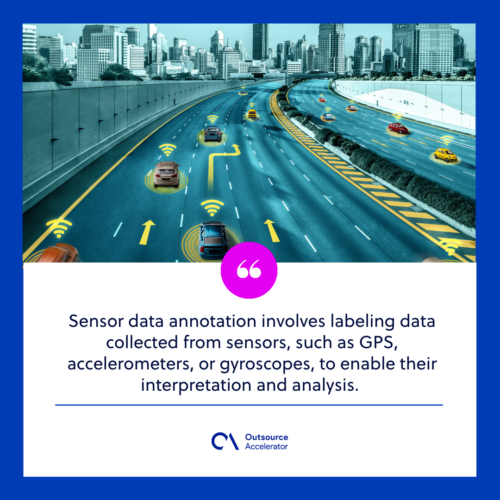
Sensor data annotation
Finally, this labels data from sensors like GPS or gyroscopes. As a result, teams can read and analyze it. It is common in health and environmental monitoring.
Those are the most common types of data annotation. Knowing each one helps you build effective machine learning models for your tasks. For non-English projects, teams often add multilingual data annotation to the mix.
Top 7 reasons to outsource data annotation
Now let us cover the core topic. Why should you outsource data tagging? You can count on at least these seven reasons.
1. High-quality datasets
Outsourcing data labeling lets you tap skilled experts. As a result, you get high quality datasets. These experts also handle quality checks and validation. So the labeled data stays accurate and consistent. This links closely to data labeling best practices.
2. Scalability and timely delivery
In addition, data annotation can eat up time and resources. So outsourcing lets you scale up or down with ease. As a result, projects finish on time with the right partner.
3. Data security
Also, security can be a big concern with sensitive data. This includes personal details or trade secrets. A trusted partner adds security steps and confidentiality terms. So your datasets stay safe from theft or misuse.
4. Talent availability
When you outsource data labeling for machine learning, you reach a large talent pool. These workers have the skills your niche needs. So you can find talent fast and meet deadlines. Growing demand also fuels wider AI outsourcing across many fields.
5. Internal bias mitigation
In-house annotation can carry bias. Your team may know the data too well. So they may expect a certain model behavior and mislabel data. Outsourcing brings a fresh view. As a result, you reduce this risk.
6. Cost savings
Outsourcing data annotation is cost-effective. It removes the need to hire and train in-house labelers. It also cuts spending on tools and infrastructure. On top of that, you can pick partners in regions that fit your budget. For a balanced view, weigh the pros and cons of offshore outsourcing.
7. Focus on core business
Last but not least, a remote data annotator frees up your time. So you can focus on product, marketing, and other key work. Meanwhile, the outsourcing partner labels the data for you.
How to choose a trustworthy data annotation service provider
Now you know the reasons to outsource data annotation. Next, you may wonder how to find a reliable data labeling partner. So here are some tips to help.
- Look for a provider with expertise in your domain and data type. Check their experience, credentials, and reviews first.
- Make sure they offer a clear quality assurance process. So ask for work samples and review the data quality.
- Confirm they have the tools and workforce for large volumes. This shows they can meet your scaling needs.
- Choose a partner with strong security. Look for encryption, secure transfer, and access controls.
- Compare pricing and services across providers. So you find the best value for your money.
- Check their communication channels. Good tools and support keep you updated on progress.
- Look for flexible solutions they can tailor to your needs.
- Prefer a partner who uses smart techniques, like active learning, to cut the data needed for training.
- Give preference to a vendor with end-to-end services, such as data preprocessing, validation, and model training.
Keep these tips in mind, and you will find a strong data annotation vendor. If you also handle high volumes of records, data entry outsourcing can support the same team.
Frequently asked questions about outsourcing data annotation
What is data annotation?
Data annotation is the work of labeling raw data for AI. It tags images, text, audio, video, or sensor data. As a result, machine learning models can learn from it.
Why should ML companies outsource data annotation?
Outsourcing brings expert labelers, fast scaling, and lower cost. It also improves data security and reduces bias. So your team can focus on core work.
Is outsourced data annotation secure?
Yes, trusted partners use strong security. They add encryption, secure transfer, and access controls. They also sign confidentiality terms to protect your data.
How much does it cost to outsource data annotation?
In general, cost depends on data type, volume, and provider location. Outsourcing still tends to cost less than an in-house team. So compare a few vendors to find the best value.
What types of data can be annotated?
Overall, you can annotate images, video, text, audio, and sensor data. Each type suits a different AI use case. So the right mix depends on your project.
Key takeaways
- The top reasons to outsource data annotation are quality, scale, and cost.
- Outsourcing also improves security, talent access, and bias control.
- Common data types include image, video, text, audio, and sensor data.
- Choose a partner with domain skills, strong QA, and solid security.
- Outsourcing frees your team to focus on core growth work.
Outsource data annotation: In conclusion
Outsourcing data annotation can help businesses of all sizes. It is a smart way to stay ahead and drive your AI and ML adoption. So we hope these top reasons have convinced you to outsource data annotation. Use the tips above to find a partner. As a result, you can get high quality datasets and save time, money, and resources.






 Independent





