
5 key traits of impactful quiet leading


You often hear the world celebrating the charismatic leader, the one who commands the room, delivers the motivational speech, and captures all the attention. This “loud” leadership style dominates media narratives, but does it truly drive the best results in your organization?
Some impactful leaders today often operate not from the spotlight, but from a powerful place of reserved focus. They practice quiet leading.
Research by Hogan Assessments indicated that less dominant, more agreeable leaders were perceived as more effective, with their teams showing lower turnover rates and higher engagement and productivity.
Quiet leading may not grab attention at first, but it develops strong loyalty and sustainable performance. It helps you lead without burnout and build teams that function with confidence rather than fear.
If you want to strengthen your leadership identity without relying on theatrics, this article discusses what it’s all about.
What is quiet leadership?
Quiet leadership is a leadership style based on calm authority, strategic communication, and steady influence.
Rather than using force, urgency, or intimidation, you guide people through clarity and example. You stay composed under pressure. You communicate to solve problems, not to overwhelm your team. You make decisions based on data, long-term thinking, and grounded judgment.
Think about the difference between a crisis manager who publicly blames others and a manager who quietly reinforces protocols and defends their team’s working space. The quiet leader is effective because they are predictable, reliable, and focused on systemic improvement, not momentary drama.
This mindset changes how you deploy your most valuable resources:
- Energy. You conserve personal energy by avoiding unnecessary public appearances and internal debates, channeling it into critical strategic planning.
- Attention. You grant your full, undivided attention to high-leverage problems, rather than scattering it across a hundred low-priority pings.
- Authority. You leverage your authority to empower others, making the team the hero, which builds deeper loyalty and ownership.
The brain science behind subtle influence
Quiet leading works because it aligns with how the human brain processes information, builds trust, and handles stress.
The human brain, particularly the prefrontal cortex, has a finite capacity for attention and decision-making. Loud, chaotic, and overly aggressive leadership styles can trigger the stress response (fight, flight, freeze, or fawn).
That then diverts cognitive resources away from critical thinking and towards survival. This is why high-pressure environments often lead to simple errors and poor decisions.
Quiet leading, however, triggers a different reaction. By demonstrating calm consistency, deep listening, and non-reactive decision-making, the quiet leader builds psychological safety.
Google’s own re:Work team analyzed data from 180 teams and found that psychological safety was the most critical factor in determining a team’s overall effectiveness. And when it’s high, employees are more likely to take calculated risks, share new ideas, and admit mistakes. Those are behaviors essential for innovation.
Furthermore, subtle influence works through the principle of modeling. When you demonstrate focused calm, your team subconsciously mirrors that behavior.
Benefits of quiet leadership
Adopting quiet leadership is a strategic move that delivers tangible benefits directly to your company’s bottom line and long-term stability, by:
Systemic resilience
Loud, charismatic leadership often creates a single point of failure: the leader. Quiet leadership distributes ownership and expertise across the team, building resilience.
When the structure, not the personality, drives results, your organization becomes inherently more stable and crisis-resistant.
Better decision-making
Quiet leaders are better listeners. They intentionally seek out dissenting opinions and gather complete data before acting.
This disciplined approach drastically reduces the incidence of reactive, expensive errors. You lead from a position of data-backed clarity, not gut instinct.
Superior talent retention
When you practice quiet leadership, you honor your employees’ expertise and defend their focus time. This respect is a powerful motivator.
Plus, quiet leaders set the tone for sustainable work. Instead of glorifying overwork, you model balance and clarity, leading to better performance and higher loyalty.
5 characteristics of effective quiet leading and leaders
Quiet leadership is a skill set you can cultivate. Here are five characteristics that define the most effective quiet leaders:
1. They champion asynchronous communication
Effective quiet leaders understand that real-time communication is the enemy of focused work. They implement a default standard of asynchronous first, requiring written, clear memos and documents for all non-urgent communication.
You respect your team’s focus blocks and ensure meetings only occur when they absolutely require real-time debate to resolve a specific, critical decision.
2. They practice deep listening over speaking
Loud leaders often dominate conversations; quiet leaders facilitate them. You actively seek out the quietest voices in the room, understanding that the best ideas often come from those who do not aggressively self-promote.
When you listen deeply, you absorb context and nuance, allowing you to ask the precise, clarifying question that unlocks the team’s next step. You confirm that all voices feel heard and valued.
3. They make the process the hero
Silent leaders focus on building repeatable, documented processes that guarantee quality. They understand that a reliable system is infinitely more valuable than a heroic, last-minute effort. That means usually, they obsess over standardizing workflows and clarifying expectations.
When you focus on the process, you remove the reliance on individual genius, making success predictable and scalable.
4. They possess calibrated confidence
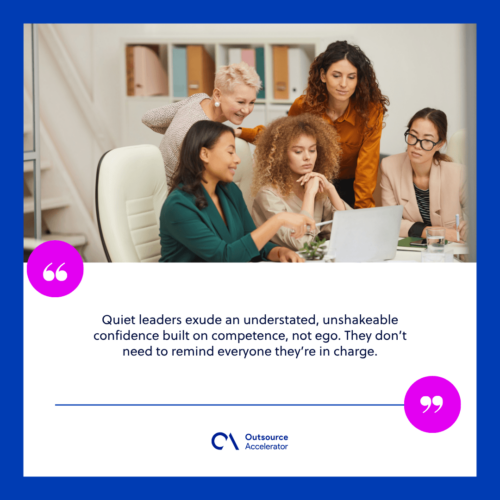
Quiet leaders exude an understated, unshakeable confidence built on competence, not ego. They don’t need to remind everyone they’re in charge. Their strategic clarity and reliable presence have already achieved that.
When problems arise, you remain visibly calm. This calibrated confidence acts as a powerful stabilizer for the organization, reassuring the team that the person at the top has the situation under control.
5. They measure value, not volume
You intentionally ignore the noise and evaluate performance purely by measurable impact. You reward team members who deliver high-quality, sustainable results (even if they work quietly) over those who merely look busy.
This focus on outcomes over activity is the key to maintaining a high-performance, low-burnout culture.
Quiet leading as a powerful force
You have the opportunity to redefine what impactful leadership looks like within your organization.
Quiet leading is not a retreat from responsibility, but an escalation of strategic influence. You replace the exhaustion of performance with the deep satisfaction of sustainable contribution. You create a culture where ambition is rooted in competence and impact.
By adopting these quiet traits, you can build a resilient team that knows exactly where to focus its energy. Trust that your intentional calm will cascade throughout your entire organization, making your company more strategic, more productive, and fundamentally stronger.
FAQs
How can a quiet leader manage highly visible change or crisis?
A quiet leader manages visible change or crisis by prioritizing communication structure over speed.
During a crisis, you remain visibly calm, providing concise, predictable updates at fixed times. You focus on the factual information and the actionable steps the team must take. You delegate tactical execution while you maintain strategic oversight.
This approach provides a psychological anchor for the team, reducing panic and ensuring decisions remain data-driven rather than emotionally reactive.
Does quiet leadership hinder networking and external influence?
Quiet leadership actually enhances long-term external influence. While loud leaders may get initial attention, true influence with stakeholders, investors, and partners is built on trust and proven competence.
A quiet leader cultivates relationships through reliable follow-through, deep subject matter expertise, and honest communication. Your reputation for delivering on commitments becomes your most powerful networking asset. This results in you earning deep respect that lasts far longer than any flashy public presence.
What is the biggest mistake a leader makes when trying to become a quiet leader?
The biggest mistake is confusing quiet leading with passivity. Some leaders mistakenly step back entirely, hoping the team will self-manage, which results in a leadership vacuum.
Quiet leading is not hands-off, but rather it’s hands-on-the-system. You must remain actively engaged in defining strategy, removing roadblocks, and coaching your personnel.
Your presence remains critical, but you express it through clear strategic directives and operational support. Not through constant micromanagement or unnecessary public visibility.






 Independent





