
A guide to overtime pay computation around the world


How does overtime pay computation work around the world?
Overtime pay computation changes by country, but the core idea is the same: you pay a higher hourly rate for hours worked beyond the normal limit.
- Most countries set a standard workweek, then add a premium for extra hours.
- Common rates run from 125% to 200% of the normal hourly wage.
- Rules on caps, rest days, and exempt workers differ a lot by place.
Sometimes, you cannot finish all your work within the week. For example, you can move some tasks to the next week. Or, if you want it all done now, you can instead choose to work overtime.
Overtime pay computation is a complex process, and it differs for many countries. So read on to learn how the main rules work around the world.
Overtime pay computation around the world
What is overtime pay?
In simple terms, overtime pay is the money staff earn for working beyond the normal workday. How much you get depends on the:
- Weekly earnings
- Actual working hours
- Company’s overtime rate
Overtime pay computation depends on many factors. As a result, every country (and sometimes each province or territory) has its own method.
The term “overtime pay” can also mean the employer’s total cost for those extra hours. So it works as both a worker’s reward and a business expense.
A normal workday exists to balance workers’ health and productivity. For this reason, overtime pay offsets the strain that extra hours can bring. It also helps firms plan their true labor cost before they approve extra shifts.

Calculating overtime pay
While overtime pay computation varies by place, a few general steps still apply.
First, find the hourly overtime rate. To do this, multiply the normal rate by the company’s overtime rate. Next, multiply the overtime hours by that rate. This gives you the total overtime pay.
Before they pay out, employers should follow these steps:
- Check if the employee is eligible for overtime pay.
- Track the employee’s weekly working hours.
- Confirm the overtime pay rate of the company.
- Calculate the overtime pay.
Clear records also make payroll easier. So many firms now handle this with modern payroll software that tracks hours and rates in one place.
Overtime pay computation around the world
Here is a look at overtime pay computation in selected countries. As you will see, the rates and caps change from place to place.
Philippines
In the Philippines, labor law requires overtime pay for work beyond eight hours a day. Employers add 25% to the hourly rate on regular days. On rest days and holidays, they add 30%.
However, “exempt” staff do not get overtime pay. This group covers the following:
- Government employees
- Managerial employees
- Officers or members of a managerial staff
- Stay-in helpers and persons in the personal service of another
- Workers who are paid by results
- Field personnel
For overtime pay computation in the Philippines:
- Determine the hourly rate.
- Multiply the hourly rate by 125% to get the overtime rate per hour.
- Multiply that overtime rate by the number of overtime hours worked.
Filipino teams are common in outsourcing. So it helps to know local wages in the Philippines before you set overtime budgets.
USA
In the USA, overtime pay for nonexempt staff falls under the Fair Labor Standards Act (FLSA). Special rules also apply to federal workers.
All overtime must be paid, whether it is ordered or simply “suffered or permitted.” So employers cannot skip it just because they did not approve it first.
Under the FLSA, you multiply the “straight time rate of pay” by all overtime hours. Then you add half the regular hourly rate times all overtime hours. In short:
(Straight time rate of pay * overtime hours worked) + ½ (regular hourly rate of pay * overtime hours worked)
Here, straight time rate of pay means the hourly rate of basic pay.
United Kingdom
Besides overtime pay, the UK also uses “time and a half.” This means staff earn 1.5 times their normal rate when they come in on days they are not due to work.
This idea also covers holidays. As a result, it works as an incentive to take on extra shifts.
Still, there is no legal duty to pay for extra hours in the UK. An employer may offer overtime to meet higher demand, but it is a choice.
If they do choose to pay, they follow these steps:
- Find the employee’s standard weekly or monthly pay.
- Multiply the daily pay by the overtime rate and the overtime hours worked.
- Combine the two figures for the full weekly or monthly amount.

India
Labor laws in India set out two methods for overtime pay computation. However, the method can also change by location or job role.
As a rule, overtime workers earn double their regular rate. The employer may accept up to nine hours of work in each 12-hour shift on normal days.
For day workers, the formula is:
2 (Basic pay + DA + RA)/total no. of days in a month) maximum working hours in a day * overtime hours
- Overtime is worked out for each extra hour.
- DA means dearness allowance, paid to government staff to ease the impact of inflation.
- RA or HRA means house rent allowance, paid to help cover the cost of renting a home.
Australia
In Australia, some staff are not covered by a modern award or enterprise agreement. For these workers, the right to overtime pay depends on their contract.
When it applies, overtime is paid at:
- 150% of the ordinary hourly rate for the first two to three hours of overtime
- 200% of the ordinary hourly rate after the first two to three hours
Some agreements also allow time off in lieu (TOIL). This gives paid time off instead of overtime pay.
For overtime pay computation:
- Find the hours worked in a week.
- Calculate the hourly rate.
- Confirm the company’s overtime pay rate.
- Multiply the hourly rate by the overtime pay rate.
Spain
In Spain, any hours beyond the 40-hour week count as overtime. There is also a cap of 80 overtime hours per year. So this limits how long staff can work.
The standard rate adds 75% to the regular hourly pay. To find the overtime hourly rate, divide the monthly gross salary by the regular monthly hours.
This gives you the hourly rate of pay. Finally, multiply that figure by 75% to get the overtime rate.
Brazil
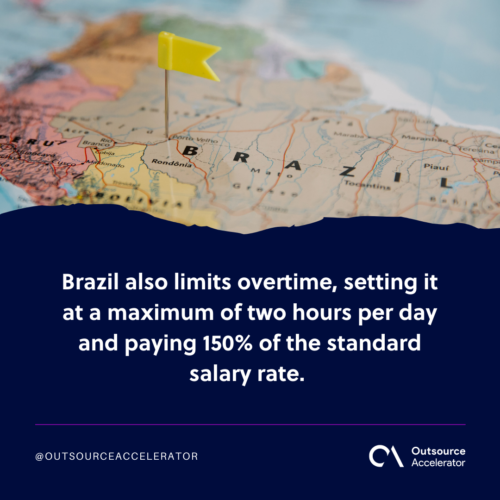
In Brazil, overtime starts when staff work beyond the hours set in their contract. As a base, overtime pay equals 1.5 times the salary.
Meanwhile, work on Sundays or public holidays earns double pay. Brazil also caps overtime at two hours per day, paid at 150% of the standard rate.
This can extend to four hours for work that cannot wait. In that case, the employer must tell the Ministry of Labor to avoid legal issues.
Overtime pay computation is as follows:
- Daily overtime pay: 5 am to 10 pm, paid at a rate of 50%
- Nightly overtime pay: 10 pm to 5 am, paid at least 50%, plus a 20% night bonus
Vietnam
In Vietnam, regular hours cannot pass eight hours a day or 48 hours a week. The limit is lower for heavy-duty or hazardous work, at six hours a day.
Staff who work overtime are paid based on their current hourly wage:
- At least 150% for extra hours on regular workdays
- At least 200% for extra hours on weekends
- At least 300% for extra hours on holidays and paid leave days
- An extra 30% for night shifts
France
In France, overtime is any work beyond the weekly limit of 35 hours. So the bar for extra pay is lower than in many other countries.
With an agreement in place, overtime pay is at least 110% of regular wages. Without one, the rate is 125% for the first eight hours and 150% for later hours.
Staff also have an annual quota of 220 overtime hours. In addition, France requires compensatory rest for hours worked above this yearly quota.
Canada
In Canada, overtime pay is 1.5 times the regular rate, also known as time and a half.
Overtime pay computation is done on a weekly basis. Daily rates do not apply unless a contract or collective agreement says so.
It can also cover a longer period under an averaging agreement. Meanwhile, different provinces and territories set their own methods and standards.
Rules like these matter most when you build cross-border teams. So it pays to compare average wages around the world and local premiums before you hire.
Frequently asked questions about overtime pay computation
What is the basic overtime pay formula?
First, multiply the normal hourly rate by the overtime rate to get the overtime rate per hour. Then multiply that by the overtime hours worked. This gives the total overtime pay.
Why does overtime pay computation differ by country?
Each country sets its own workweek, caps, and premium rates. As a result, the same overtime hours can cost very different amounts by place.
Who is usually exempt from overtime pay?
Many countries exempt managers, field staff, and some paid-by-results workers. Still, the exact list depends on local law.
Is overtime pay the same as a 13th month pay?
No, they are different. Overtime pays for extra hours, while a bonus like the 13th month pay is a set yearly benefit in some countries.
How can businesses manage overtime costs?
Track hours closely and confirm the correct rate for each day. For example, payroll tools and clear policies help keep overtime spending under control.
Key takeaways
- Overtime pay computation rewards work beyond the normal workday at a higher rate.
- Common premiums range from 125% to 200% of the regular hourly wage.
- Rules on caps, rest days, and exempt staff change from country to country.
- Accurate hour tracking and the right rate are the keys to correct pay.
- Compare local wages and premiums before you build a cross-border team.






 Independent





