
Outsourced technical support: Is it for your business?


Is outsourced technical support right for your business?
Outsourced technical support is a strong fit for most businesses that want to cut costs while keeping service quality high.
- It gives you trained technical staff at a fraction of in-house cost.
- It frees your core team to focus on complex, on-site work.
- It scales up or down as your support volume changes.
When your business needs to cut costs, would you consider outsourced technical support? The practice has been around for decades, much like other cost-cutting models. Over time, outsourcing and its partner, offshoring, have delivered strong results.
Just look at the big firms that outsourced their services early on. As a leader, one of your jobs is to keep your audience happy with your products and services. So when cutting back on expenses, some may see it as an either-or choice. In truth, there are ways to lower costs without hurting quality.
For example, partnering with specialized firms like Six Eleven BPO helps businesses keep that balance. In short, they offer high-tier technical support at a fraction of domestic costs. By using their ready infrastructure and trained staff, you keep the customer experience smooth while you trim your budget.
Outsourcing technical support services to external parties
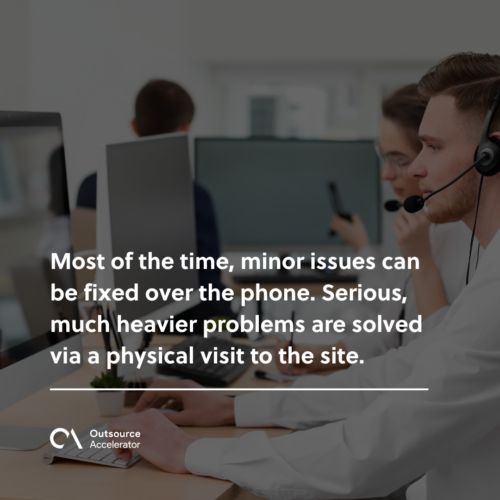
Technical services can cover both software and hardware support. Most of the time, minor issues get fixed over the phone. However, bigger problems may need a site visit.
So it is wise to keep an in-house team for days like that. Meanwhile, you can pass the minor tickets to your outsourced staff. In this way, a hybrid team helps you run the business day to day. More than that, it gives you an edge and lifts your service quality.
There are a couple of ways to outsource your technical support services. Each has its own pros and cons. So weigh them and pick what fits your business best. For a wider view, see our guide to technical support outsourcing.
BPO companies
BPO companies recruit and onboard professionals for specific projects and accounts. They match people to roles based on their skills. Whether career shifters or freshers, these staff are trained to handle many tasks.
BPO firms are known for robust onboarding. In addition, they keep investing in staff growth. For example, it helps to pick a trusted provider like Infinit-O to keep the process smooth.
BPO firms are also the best choice for bulk hiring. They cover overhead, benefits, and pay, then bill you for active seats. So growing your team has never been easier. This model also powers much customer service outsourcing today.
Freelancers and independent contractors
On the other hand, you may only need to outsource a small part of your team. In that case, you could turn to freelancers.
Independent contractors and freelancers work from their own home offices as solo providers. Often, they bill by the hour or by the project. So their pay depends on output and the contract terms.
Many online write-ups call freelancers digital nomads, since they work remotely. All they need is a good device and a strong connection. For this reason, some employers choose contractors, as they can cost less than salaried staff. For a deeper look, see our guide to help desk outsourcing.
Independent contractors: Technical support outsourced hourly rate
In most cases, independent contractors set their own rates per hour or project. As a general rule, rates should not fall below $3 USD per hour. Anything lower is not fair, especially if you hire freelancers outside your country.
That said, adding team members is a big investment in any business. Whether hourly or salaried, people keep the company running. From the smallest tasks to senior roles, staff are what bring revenue in.

US
The federal minimum wage in the US is $7.25 per hour. Some states set higher rates than this. So when you hire in the States, your offer should sit above the minimum. In addition, each applicant’s credentials, history, and skills shape their pay.
Philippines
The Philippines sets its minimum wage by the day and by region. So rates vary across the country. Most of the time, however, freelancing Filipinos turn down very low offers. Like any contractor, they must still declare their work on their tax forms. For context, see why firms keep outsourcing to the Philippines.
India
India sets some of the lowest daily minimum wages, and each state fixes its own. So Indian contractors still tend to seek fair project rates. As an employer, part of your job is to help your team earn a livable wage.
Today, workers keep building their skills to stay ahead in a fast-changing market. So assess each person’s ability and pay them fairly for their work. Anything beyond that comes down to personal preference.
To wrap up, outsourcing technical support opens doors to many skilled people. In short, you expand your team. At the same time, you give capable individuals a chance to help your business grow. For the full case, review the benefits of outsourcing.
Frequently asked questions about outsourced technical support
What tasks can you outsource to a technical support team?
You can outsource help desk tickets, troubleshooting, and basic software or hardware fixes. Many teams also handle live chat and email support. So you can offload routine work and keep complex jobs in-house.
How much does outsourced technical support cost?
Costs depend on location, skill level, and hours covered. Offshore rates often run far below domestic ones. So many firms save a lot while keeping service quality high.
Is outsourced technical support secure?
It can be, with the right safeguards. Use clear contracts, access controls, and data rules from the start. In addition, pick a provider with a proven security track record.
Should I outsource or hire an in-house support team?
Many firms do both. A hybrid team keeps in-house staff for complex, on-site work. Meanwhile, outsourced agents handle routine tickets. So you get coverage and control at a lower cost.
How do I choose a technical support provider?
Check their experience, training, and client reviews first. Next, confirm their tools and security match your needs. Then start with a small pilot before you scale up.






 Independent






