
10 best learning management systems (LMS) companies in 2026


List of the leading LMS companies
- Adobe Learning Manager
- Docebo
- LearnUpon
- Litmos
- Absorb LMS
- Moodle
- TalentLMS
- 360Learning
- Blackboard
- CYPHER Learning
Somewhere between the launch of the internet and the global shift to remote work, learning became everyone’s business… literally.
Once confined to dusty training manuals and awkward conference room seminars, workplace education has been completely reshaped by Learning Management Systems, or LMS platforms.
In 2024, Grand View Research reported that the global e-learning market was valued at around USD 299.67 billion, and LMS is at the heart of this growth. These tools don’t just help companies teach things; they help them prove that learning happened. And in a world where skills are the new currency, that matters more than ever.
But there are a lot of LMS companies out there. They all promise to be the most intuitive, the most scalable, the most AI-enhanced platform your team has ever seen.
This guide is here to help you explore what LMS companies actually do, why businesses can’t afford to ignore them anymore, and which companies are building tools that actually help people learn.
Whether you’re a seasoned HR lead or someone who just Googled “LMS meaning” five minutes ago, you’ll find something useful here.
What are learning management systems (LMS)?
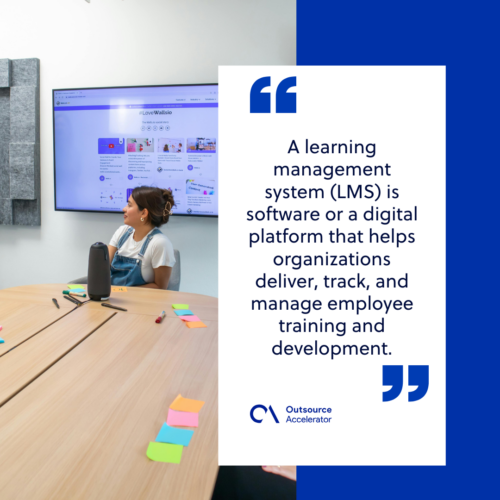
A learning management system (LMS) is software or a digital platform that helps organizations deliver, track, and manage employee training and development.
Whether it’s onboarding, compliance training, upskilling, or leadership development, an LMS centralizes content and enables flexible learning paths.
LMS companies typically include features like course creation, learner analytics, mobile access, and integration with HR systems. They make training more structured, measurable, and adaptable to individual or team needs.
Why companies should use learning management systems
Firms that invest in LMS companies improve not just training efficiency, but also business outcomes.
According to LinkedIn’s Workplace Learning Report, 94% of employees say they would stay longer at a company that invests in their learning.
LMS companies help businesses retain talent, close skills gaps, and ensure regulatory compliance. They also save time and resources by automating manual training processes and tracking learner progress.
In remote or hybrid work environments, LMS solutions enable consistent training regardless of geography. They also make it easier to scale learning across departments or regions, ensuring every employee gets access to the same high-quality content.
Key features to look for in LMS companies
When choosing an LMS, the right features depend on your organization’s needs, but some core capabilities are non-negotiable:
- User-friendly interface for both learners and administrators
- Mobile accessibility
- Customizable learning paths
- Real-time reporting and analytics
- Integration with HR, CRM, and communication tools
- Scalability and multi-language support
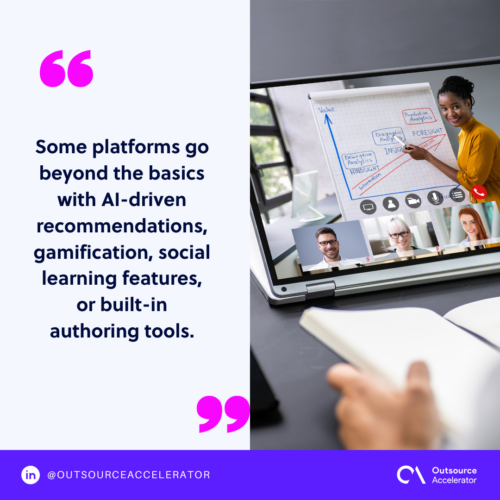
Some platforms go beyond the basics with AI-driven recommendations, gamification, social learning features, or built-in authoring tools. The best LMS is the one that aligns with your goals, workforce, and existing tech stack.
Top 10 LMS companies for effective training and development
We’ve compiled a list of what the best LMS companies have to offer, ranked in no particular order:
1. Adobe Learning Manager
Adobe Learning Manager, formerly Adobe Captivate Prime, continues to be a top contender in the LMS space. It offers a sleek, user-focused design and tight integration with other Adobe products.
The system supports multiple learning formats and automates many tedious administrative tasks. Adobe’s strong focus on engagement and skill mapping makes it popular among large enterprises and creative teams.
Notable features
- Skill-based learning recommendations powered by AI
- Seamless integration with Adobe Creative Cloud and Salesforce
- Gamification and leaderboards
- Custom learner portals for branding
- Offline and mobile learning support
2. Docebo
Docebo has established itself as a flexible, enterprise-grade LMS with a focus on AI and automation. Its strength lies in scalability and the ability to cater to both internal and external learners.
LMS companies love its ability to segment audiences and personalize the experience at scale. Docebo is particularly strong in data-driven learning and ROI tracking.
Notable features
- AI-based content suggestions
- Social learning through forums and user contributions
- White-label and multi-domain support
- Advanced analytics and dashboards
- Marketplace integration for content sourcing
3. LearnUpon
LearnUpon delivers a clean, intuitive experience that works well for small to mid-sized businesses. It focuses on simplicity without sacrificing power.
Clients appreciate how fast they can get it up and running. Its customer support consistently ranks among the best in the LMS space.
Notable features
- Built-in e-commerce and certification management
- SCORM and xAPI compliance
- Branded portals for clients or partners
- API and Zapier integrations
- Streamlined user onboarding
4. Litmos
Litmos is known for its speed and simplicity. The platform works especially well for fast-growing companies that need to train teams across different regions. It also has a large content library and strong compliance training features.
This LMS company has traction in industries like retail, manufacturing, and healthcare.
Notable features
- Global content library of ready-made courses
- Real-time compliance tracking
- Multi-language and localization tools
- Automated training assignments
- Built-in quizzes and assessments
5. Absorb LMS
Absorb LMS strikes a balance between enterprise capability and user-friendly design. It supports diverse learning needs, from employee onboarding to customer education. Its reporting features and custom dashboards are especially helpful for tracking training ROI.
Absorb also offers strong security and privacy features, a key requirement for global businesses.
Notable features
- Smart administration automation tools
- Personalized learning paths
- eCommerce capabilities for selling courses
- Flexible course import/export options
- Extensive third-party integrations
6. Moodle
Moodle remains a strong open-source option for organizations that need full control and customization. While it requires more technical know-how, it offers unmatched flexibility.
Universities and NGOs often choose Moodle, but more enterprises are adopting it thanks to cloud-hosted options like MoodleCloud.
Notable features
- Completely open-source and self-hostable
- Strong plugin ecosystem
- Advanced grading and assessment tools
- Customizable user roles and permissions
- SCORM and LTI compatibility
7. TalentLMS
TalentLMS is built for businesses that want a fast, cost-effective solution without sacrificing quality. It works well for remote teams and external training.
Its minimal learning curve and affordable pricing make it a top choice for startups and SMBs.
Notable features
- Pre-built course library
- Branching logic for assessments
- Video and webinar integration
- Role-based access controls
- Gamification elements to boost engagement
8. 360Learning
360Learning brings a collaborative twist to the LMS model. Its emphasis on peer learning and content co-creation sets it apart.
Rather than top-down course delivery, 360Learning encourages employees to share knowledge organically. It’s a favorite among agile teams and modern workplaces.
Notable features
- Collaborative course creation
- Real-time feedback and reactions
- Social learning feed
- In-app messaging and discussion boards
- Built-in authoring tool with templates
9. Blackboard
Though rooted in academia, Anthology’s Blackboard continues to evolve its corporate offerings. It’s particularly suited for organizations focused on deep skill development and credentialing.
Its strong analytics and content structuring tools make it ideal for complex training paths. Blackboard Learn Ultra enhances mobile usability and cloud performance.
Notable features
- Adaptive learning paths
- Virtual classroom with breakout sessions
- Accessibility compliance tools
- Comprehensive content management
- Enhanced mobile-first design
10. CYPHER Learning
CYPHER Learning offers three distinct LMS platforms: NEO (for schools), MATRIX (for businesses), and INDIE (for entrepreneurs). It offers one of the most customizable and learner-centric LMS experiences available.
Its use of gamification and automation helps increase engagement across age groups and learning styles. CYPHER is widely used in both corporate and academic sectors.
Notable features
- Intuitive drag-and-drop course builder
- AI-driven automation of tasks and notifications
- Gamification with points, badges, and leaderboards
- Integration with 40+ third-party platforms
- Detailed learner analytics and tracking
How to calculate the ROI of corporate LMS strategies and efforts
To determine whether your LMS investment is paying off, you need to:
Step 1: Add up all your costs
Start by calculating what the LMS will cost your company, both now and in the future:
- Software subscription or licensing fees
- Setup and implementation costs
- Data migration from your previous system
- Administrator and user training
- Course content development or third-party licensing
- Integration with your existing HR or CRM systems
- Ongoing technical support and updates
Step 2: Track training impact on performance
Once your LMS is running, monitor how it affects employee development and operations:
- Course completion rates
- Time spent on learning
- Test or assessment results
- Compliance training participation
- New hire ramp-up speed
- Feedback or satisfaction scores
Compare data from trained and untrained teams for clearer attribution.
Step 3: Estimate time and cost savings
Then, translate those improvements into cost savings or productivity gains:
- Lower delivery costs by switching from in-person to digital training
- Time saved by automating admin tasks
- Reduced turnover through better engagement
- Increased output or efficiency from better-skilled staff
To calculate ROI:
ROI (%) = (Total Gains ÷ Total LMS Costs) x 100
For instance, if your LMS costs $40,000 annually but saves you $60,000 and boosts output by $20,000, your ROI would be (($60,000 + $20,000) ÷ $40,000) x 100 = 200%.
Clear numbers like these make it easier to secure executive buy-in and justify your investment in learning tech.
Guide your organization through its learning journey
The right LMS doesn’t just deliver training, it transforms how your company learns. Think beyond checklists and compliance. Invest in platforms that support growth, curiosity, and performance.
Start by identifying your unique goals, then choose an LMS that empowers your people to reach them.
Whether you lead HR, L&D, or IT, your role in shaping this journey matters. With the right tools and mindset, your learning strategy can evolve from reactive to proactive, and from functional to transformative.






 Independent





