
Outsourcing live answering service: Benefits and best practices


What is a live answering service, and should you outsource it?
A live answering service is a trained person who answers calls on behalf of your company, and outsourcing it gives you round-the-clock, professional call handling for far less than an in-house hire.
In short, it replaces frustrating voice prompts with a real person. Here is why businesses outsource it:
- Lower cost, because you skip salaries, benefits, and office space.
- 24/7 cover, so no call goes unanswered after hours.
- Easy scaling, since you flex up or down as call volume changes.
Some businesses still choose voice prompts over a live answering service. However, most customers find an automated voice-over annoying when they need help. If the system is not user-friendly, it can reflect poorly on the company. So companies must make sure customers have a positive experience. Offering live assistance is one simple way to make the system easier to use. As a result, outsourcing a live answering service becomes a solid option.
Live answering service explained
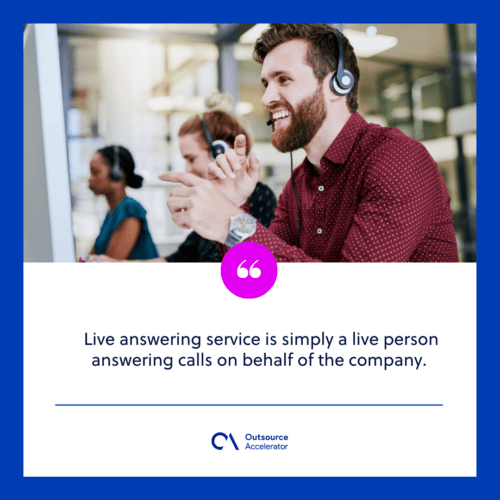
In short, a live answering service is simply a live person answering calls on behalf of the company. Often, it is used as an alternative to an automated voice-over system. When a customer calls, a trained representative answers and handles the inquiry or request.
Outsourcing this service helps businesses that want high-quality support but lack the resources to field every call. So they can be sure customers are greeted by a friendly, knowledgeable representative who can assist with their needs.
These services are usually staffed by trained professionals skilled in customer service and communication. As a result, they handle a wide range of inquiries and adapt to different businesses and industries. In addition, some providers offer bilingual representatives to assist customers who speak languages other than English. This is where a provider with strong 24/7 multilingual support can help you reach more callers.
Benefits of outsourcing live answering service
Business owners know how important it is to provide exceptional customer service. One part of this is making sure customers can always reach you, no matter the time of day. So this is where a live answering service comes in. Here are the main benefits, and how it can help grow a business.
Cost savings
Compared with hiring an in-house receptionist, outsourcing can be far more cost-effective. With internal staff, you must cover salaries, benefits, training, and office space. However, outsourcing removes these costs. As a result, you save money while still providing excellent customer service.
24/7 availability and flexibility
In-house receptionists may only cover regular business hours. Outsourcing, on the other hand, lets you provide support around the clock. So this matters most for businesses with customers in different time zones. It also helps any industry where customers may call at any time. For urgent cases, pairing this with after-hours customer support keeps service seamless.
Access to trained and experienced operators
By outsourcing, businesses gain access to skilled, knowledgeable operators. So you can be sure customers get top-notch service, because these experts handle many kinds of concerns and requests. In addition, you can reach professionals with experience in your specific niche or industry. As a result, callers often feel they are talking to an in-house expert.
Improved scalability and efficiency
Outsourcing also raises scalability and efficiency. As firms grow, they must handle more client requests and inquiries. However, outsourcing lets you scale up or down quickly, without the stress of recruiting and training new staff. Furthermore, it can boost productivity, because your own team can focus on sales, marketing, or product development. Many firms extend this model into full inbound call center outsourcing as call volume climbs.
Things to consider when outsourcing live answering service
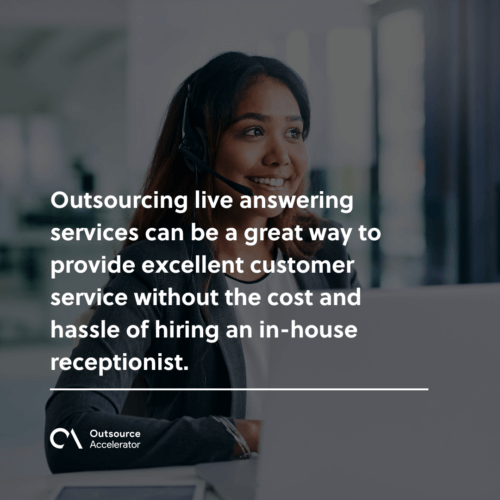
Outsourcing live answering can deliver great customer service without the cost and hassle of an in-house hire. However, not all providers are the same. So here are the key factors to weigh before you outsource this service.
Criteria for evaluating potential providers
There are several factors to assess when you compare providers. Here are the main ones.
Experience
First, look for providers with knowledge of your business or niche. As a result, the representatives will know the terms, problems, and customer needs specific to your industry.
Quality
Next, ask about the quality control steps the outsourcing company uses. For example, do they monitor calls for quality? Also, how do they respond to client complaints? For wider options, it helps to compare full call center outsourcing providers too.
Availability
Then, make sure the service is available around the clock. This can be a major selling point for customers who need help after typical work hours.
Cost
After that, compare prices to confirm you get a good deal. However, you often get what you pay for, so cost should not be the only factor.
Technology
Finally, ask about the provider’s technology stack. For instance, do they use up-to-date equipment and software? Also, can they integrate with your existing systems?
Deciding between in-house and outsourcing live answering service
If there are factors to weigh in outsourcing, there are also things to weigh when choosing between internal staff and a provider.
Cost
Compare the price of an on-site receptionist with outsourcing to a third party. In particular, look at benefits, office space, training, and pay.
Availability
Next, decide whether you truly need 24/7 cover, and whether an internal receptionist can deliver it.
Scalability
Then, assess how often you must scale up or down, and whether an internal receptionist can handle swings in call volume.
Knowledge
After that, check if you have the resources to hire, train, and manage an internal receptionist. Otherwise, a provider with skilled operators may be the better choice.
Focus
Finally, weigh your ability to focus on other duties, such as sales, marketing, or product development. So check whether doing live answering in-house would get in the way. For high call volumes, dedicated telephone answering services are often worth comparing.
Outsource live answering service to improve daily operations
Businesses can gain a lot from outsourcing a live answering service. In practice, it can improve everyday operations by letting the company:
- Concentrate on core tasks
- Lower overhead expenses
- Boost productivity
- Improve customer satisfaction
- Offer round-the-clock support
As a result, companies can streamline operations and make sure customers get excellent service. All of this is possible once you delegate live answering to a reputable provider. So if you want to take your business to the next level, outsourcing a live answering service is well worth the thought.
Frequently asked questions about live answering services
What is the difference between a live answering service and an automated system?
An automated system uses recorded prompts and menus. A live answering service uses a real, trained person instead. So callers get human help right away, which usually feels faster and more personal.
How much does a live answering service cost?
Costs vary by call volume, hours, and the tasks you need covered. However, outsourcing is usually far cheaper than a full-time in-house receptionist, because you skip salary, benefits, and office space.
Can a live answering service handle calls after business hours?
Yes. In fact, 24/7 cover is one of the main reasons firms outsource. So customers in other time zones, or with urgent needs, can reach a person at any hour.
What types of businesses benefit most from a live answering service?
Any business with steady or spiky inbound calls can benefit. For example, medical offices, law firms, home services, and e-commerce brands all use them to avoid missed calls and keep customers happy.






 Independent






