
List of voice assistants you can use in 2026

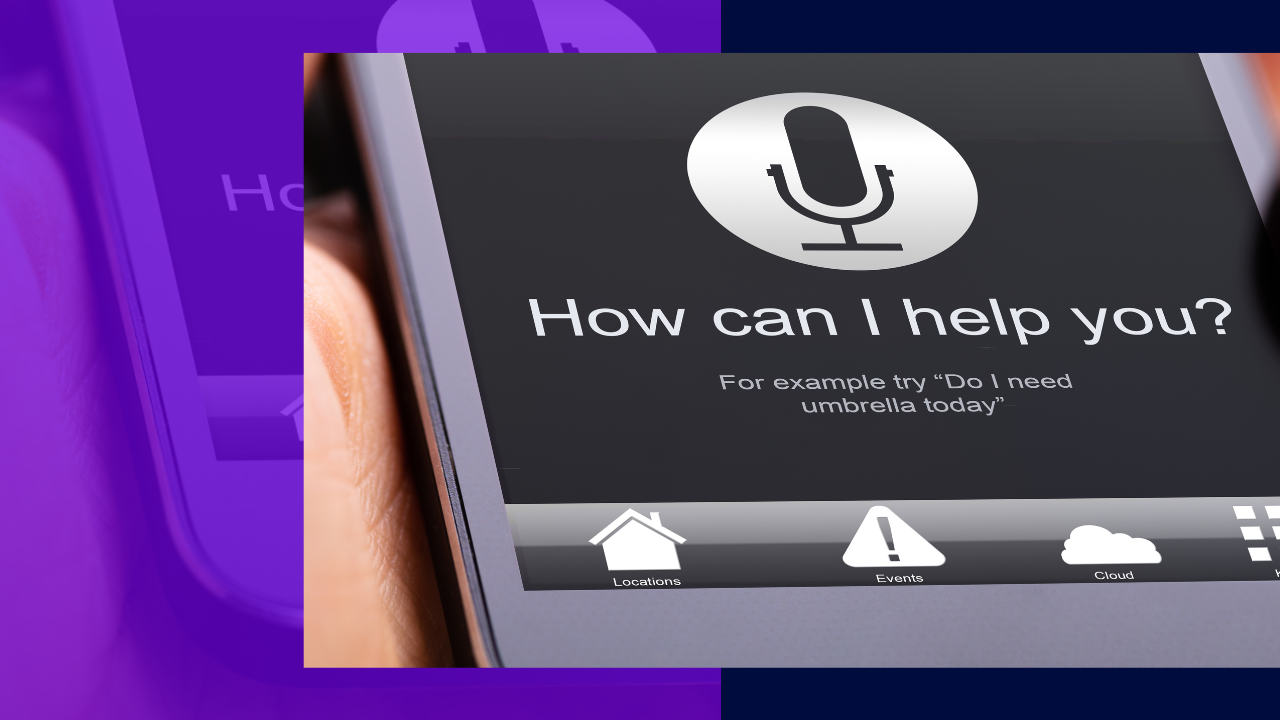
What are the best voice assistants you can use in 2026?
The best voice assistants in 2026 are AI-powered tools like Otter, Google Assistant, Alexa, and Siri that respond to your voice and save you time.
- They answer questions, manage tasks, and control smart devices.
- Some focus on work, such as meeting notes and transcripts.
- Others handle daily life, from music to reminders.
List of voice assistants
- Otter
- Fireflies
- Murf
- Google Assistant
- Amazon’s Alexa
- Apple’s Siri
- Microsoft’s Cortana
- ELSA Speak
- Youper
- Hound
Technology moves fast, and voice assistants are now everywhere. These AI-powered tools have become a helpful part of daily life for many people.
Even busy executives can gain from them. For example, they help manage packed schedules and move from one task to the next.
As voice assistants grow in demand, more products keep flooding the market. So it can be hard to know which one is best for you.
To help with that, we built a handy list of voice assistants you should not miss in 2026.
Check out the list of voice assistants below.
What is a voice assistant?
A voice assistant is also called a virtual or AI assistant. In short, it is AI-powered software that understands and answers voice commands.
These tools use natural language processing (NLP) to read human speech. As a result, they can act on what you ask them to do.
Because they respond to your voice, they offer a hands-free way to use tech. So you can get things done without lifting a finger.
They also improve access for people with limited mobility or sight. In addition, they make many tools feel simple and smooth to use.
Functions of voice assistants
Voice assistants have many uses that can simplify daily life. Whether for work or home, they make things easier.
Below are some common functions of voice assistants.
Information retrieval
Voice assistants can search the web and answer questions. For example, they can make recommendations or pull up facts. They also give weather, news, and sports updates on command.
Task management
Many voice assistants handle a range of tasks. So they can manage calendars, set reminders, make to-do lists, and even book reservations.
Navigation and direction
With internet and live data, voice assistants can guide you around new cities. As a result, they help you find the best route fast.
They can also suggest nearby places, such as hotels and restaurants. For example, ride-hailing apps like Uber use this feature often.
Voice calling and messaging
Many voice assistants support calls and messages. So users can make calls, send texts, and even dictate emails by voice.
This hands-free option is handy while driving or juggling tasks.
Smart home control
Big names like Google Assistant and Amazon’s Alexa work with smart devices. As a result, users can control home appliances from afar for more convenience.
List of voice assistants for 2026
Here are the leading voice assistants on the market today.
1. Otter
Otter is an AI meeting assistant. For example, it can record audio, take notes, capture slides, and write up minutes. So it is great for teamwork and sharing tasks.
Users can link Otter to their Google or Microsoft calendar. Then it joins and records meetings on Zoom, Microsoft Teams, or Google Meet. They can also watch the meeting live on the web or the app.
Its summary feature is a favorite. After each meeting, Otter emails a short recap. As a result, users skip the full transcript and save time.
2. Fireflies
Fireflies is another AI meeting assistant. It uses NLP, so users do not have to take notes during meetings. They can simply record, transcribe, and search their calls.
It also transcribes audio files that users upload. In addition, users can add comments and mark call highlights to work better with teammates.
Its search tool is a crowd favorite. For example, users can review an hour-long call in about five minutes.
3. Murf
Murf is a text-to-speech voice assistant. In fact, it is so strong that other tools use it to build their own voices.
It offers text-to-speech, voice-over, and dictation. So it is very useful for:
- Educators
- Podcast hosts
- Product developers
- Business leaders
Murf also has many options for natural-sounding voices. For example, users can pick from a wide range of voices and dialects.
It offers over 100 voices in 15 languages. In addition, users can set the accent, speaker, and tone.
It even has a voice-changer, so users can record without their own voice.
4. Google Assistant
Google Assistant comes from the world’s largest search engine. As a result, it is a strong and reliable voice assistant.
Users can ask it almost anything, much like a search. For example, weather, traffic, or the latest news are one “Hey Google” away. Google is also folding many of these features into its newer Gemini assistant.
Google Assistant offers a wide range of features, such as:
- Translating text into over 100 languages
- Making reservations
- Setting reminders
- Playing a specific playlist
- Calling someone on your contact list
5. Amazon’s Alexa
Amazon’s Alexa is one of the most popular voice assistants. Like Google Assistant, it can answer questions. However, it is not always as accurate.
Still, Alexa leads on smart home support. In fact, it works with more home devices than most rivals.
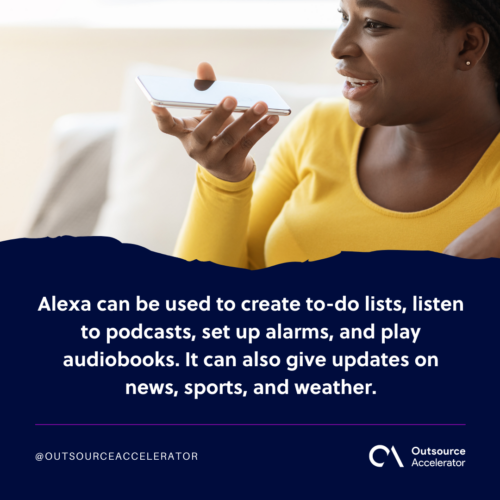
Users can make to-do lists, play podcasts, set alarms, and hear audiobooks. It also gives news, sports, and weather updates.
Its “follow-up command” feature is handy too. So users can give a second command without waking it again.
6. Apple’s Siri
Apple’s Siri is another major player, thanks to its parent brand. So it is a familiar name for many users.
It works best for people who use other Apple products. For example, iPads and HomeKit devices pair with it smoothly.
Siri comes pre-installed on all Apple devices. It has user-friendly and effective features and supports over 21 languages.
However, its strength is also a drawback. Because Apple keeps a tight ecosystem, Siri has limited access to third-party services.
7. Microsoft’s Cortana
Cortana is Microsoft’s voice assistant. Like Google Assistant, it once had access to a search engine, Microsoft’s Bing.
It worked with many platforms, most notably Windows. It used device data to carry out tasks such as:
- Answering queries
- Giving reminders
- Managing calendars
- Taking notes
However, Microsoft has since retired the standalone Cortana app. Instead, it now points users to Copilot, its newer AI assistant. So most of Cortana’s old jobs live on in Copilot today.
8. ELSA Speak
ELSA Speak is not backed by a mainstream brand. Still, it is one of the better voice assistant choices.
This AI tool helps people improve their English. For example, its instant feedback feature helps users learn faster.
ELSA Speak has more than four million downloads and over three million users across 101 countries.
It is available on both Apple and Android devices.
9. Youper
Mental health matters more than ever, even at work. As a result, apps that support emotional health have grown fast.
Youper is an emotional health assistant for Android and Apple devices. It helps users manage their mood through conversation. It also uses guided meditations to reach their goals.
Youper helps people track their moods and understand their feelings. Because of this, it often ranks among the best mental health apps.
10. Hound
Hound earns praise for being fast, detailed, and effective. So many users rate it among the top voice assistants.
It stands out for handling detail and context. For example, its speech-to-meaning tech reads language in real time, not just single words.
As a result, Hound can talk with users in a more natural way than many rivals.
Both small firms and large ones can use Hound. It offers a subscription plan on request.
What are AI voice assistants?
AI voice assistants are voice tools powered by artificial intelligence. In short, they use natural language processing to understand speech and machine learning to improve over time.
This is what lets them answer questions, follow context, and handle new requests. For example, AI-powered voice assistants like Siri, Alexa, and Google Assistant can now hold longer, more natural conversations.
Newer tools go further with generative AI. As a result, they can draft text, summarize notes, and complete tasks, not just set timers or play music.
Frequently asked questions about voice assistants
What is the most accurate voice assistant?
Google Assistant is often rated the most accurate for general questions. However, Alexa leads on smart home control. So the best pick depends on your needs.
Which voice assistants are best for work?
Otter and Fireflies are strong choices for work. For example, both record and transcribe meetings. As a result, teams save time on notes.
Are voice assistants free to use?
Many voice assistants are free, such as Siri and Google Assistant. Still, some tools charge for extra features. So check the plan before you commit.
Do voice assistants keep my data private?
Most let you review and delete stored data. However, settings differ by brand. Because of this, it is smart to check each app’s privacy controls.
Can I use a voice assistant on any device?
Many voice assistants work across phones, laptops, and smart speakers. For example, Alexa and Google Assistant run on many devices. So you can use them almost anywhere.
What are AI-powered voice assistants?
They are voice assistants that run on artificial intelligence. For example, Siri, Alexa, and Google Assistant use AI to understand speech and learn from use. So they get better and more natural over time.
What are the names of popular voice assistants?
The best-known names are Siri, Alexa, Google Assistant, and Cortana. Work-focused tools like Otter and Fireflies are also popular. So the right one depends on whether you want home, phone, or office help.
Key takeaways
- Voice assistants use AI to answer questions and handle tasks by voice.
- Work tools like Otter and Fireflies record and transcribe meetings.
- Everyday helpers like Alexa, Siri, and Google Assistant fit home use.
- Microsoft has retired Cortana and now points users to Copilot.
- The best voice assistant depends on your device and your goals.






 Independent





