
Helpdesk outsourcing services: How they work and when to use them


- Helpdesk outsourcing services allow businesses to scale support efficiently, reduce response times, and access skilled remote staff.
- Different outsourcing options, including Tier 1 and Tier 2 support, 24/7 coverage, and dedicated teams, help companies match resources to operational needs.
- Working with a trusted provider like SixEleven delivers reliable, industry-tailored support that improves service quality and supports global growth.
Reliable helpdesk support is crucial to daily business operations, as it serves as the first line of support for customers and internal teams.
It keeps systems running smoothly, resolves issues quickly, and protects productivity. Thus, inefficient helpdesk processes can trigger longer resolution times, frustrated users, lost revenue, and reputational damage.
As organizations scale across regions and time zones, maintaining consistent, high-quality support becomes more complex and resource-intensive.
Many global companies turn to external partners to balance cost, expertise, and availability without compromising service quality.
This article explains how helpdesk outsourcing services work by outlining leading solutions firms can take on. We’ll also highlight when businesses should use helpdesk outsourcing services to support growth and operational stability.
Your options for helpdesk outsourcing services
Businesses can choose different outsourcing models based on their support needs, budget, and operational goals.
| Helpdesk outsourcing service | Best for | Benefit |
| Tier 1 helpdesk support | High-volume, routine issues | Faster resolution of basic requests |
| Tier 2 helpdesk support | Complex or escalated issues | Deeper technical expertise |
| 24/7 multilingual support | Global operations | Continuous, region-ready assistance |
| Dedicated helpdesk teams | Businesses needing control | Customized workflows and consistency |
| Shared helpdesk services | Cost-conscious organizations | Professional support at a lower cost |
| Omnichannel helpdesk support | Modern, digital-first users | Improved accessibility across channels |
Each option offers distinct advantages, allowing organizations to build a helpdesk structure that aligns with customer expectations and internal demands:
Tier 1 helpdesk support
This service handles basic and high-volume requests such as password resets, account access issues, and common troubleshooting steps.
Tier 1 agents act as the first point of contact, filtering requests and resolving simple problems quickly to reduce ticket backlogs.
Tier 2 helpdesk support
Tier 2 teams manage more complex technical issues that require deeper system knowledge. These specialists investigate recurring problems, handle escalations, and collaborate closely with internal IT teams to restore normal operations.
24/7 multilingual helpdesk support
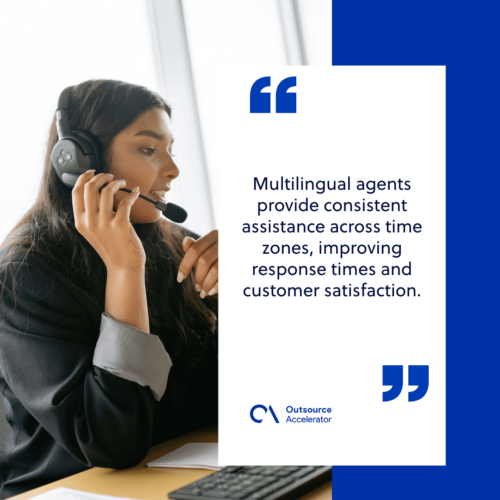
Global businesses often rely on round-the-clock coverage to support users across multiple regions. Multilingual agents provide consistent assistance across time zones, improving response times and customer satisfaction.
Dedicated helpdesk teams
Dedicated helpdesk outsourcing services provide trained staff who work exclusively for one organization. These teams follow company-specific workflows, tools, and service standards, offering greater control and continuity.
Shared helpdesk services
Shared models spread costs across multiple clients while maintaining service quality. This option suits organizations that need professional support but do not require full-time dedicated agents.
Omnichannel helpdesk support
Modern helpdesk outsourcing services cover email, chat, phone, ticketing systems, and self-service portals. This approach meets users on their preferred communication channels and improves overall service accessibility.
When to consider helpdesk outsourcing services
Growing demands on customer support teams and widespread talent gaps make it difficult for many organizations to keep up with user expectations.
According to a Korn Ferry report, by 2030, more than 85 million jobs could remain unfilled due to a shortage of skilled professionals, potentially costing the global economy about $8.5 trillion in unrealized revenue.
In an environment where qualified helpdesk staff are increasingly scarce, many businesses turn to external partners to maintain service quality and responsiveness.
Rapid business growth
When a company expands into new markets or scales operations quickly, internal support teams can struggle to keep up with increased request volumes. Outsourcing helpdesk functions gives access to trained support agents who can absorb demand without straining existing resources.
Difficulty hiring skilled talent
The global shortage of skilled workers affects customer support as much as other functions.
Recruiting and retaining qualified helpdesk professionals can take months and inflate payroll costs. Outsourcing helps organizations tap into a broader talent pool and fill roles faster.
Need for 24/7 availability
Global businesses often need round-the-clock support to serve customers across time zones. Building an internal 24/7 helpdesk team requires significant investment in staffing and infrastructure.
Outsourced helpdesk providers already operate continuous support, allowing companies to keep response times low at any hour.
Cost pressures and efficiency goals
Hiring full-time helpdesk staff can be expensive, especially for specialized roles. Outsourcing allows businesses to convert fixed costs into flexible operating expenses, giving them predictable pricing without sacrificing quality.

Expert and reliable remote helpdesk staff from SixEleven
SixEleven delivers skilled remote helpdesk professionals who support global operations without added complexity. Teams receive consistent, responsive assistance tailored to business workflows and customer expectations.
Get in touch with SixEleven to discuss helpdesk outsourcing services that align with your long-term goals!
Frequently Asked Questions (FAQs)
This section addresses questions businesses often ask when evaluating external support partners and long-term helpdesk strategies:
How does helpdesk outsourcing affect data security and compliance?
Reputable helpdesk providers follow strict security protocols and international compliance standards, using secure systems and clear agreements. Businesses retain data ownership while receiving professional support that meets regulatory requirements across regions.
How long does it take to onboard an outsourced helpdesk team?
Onboarding timelines vary by scope and complexity, but most providers complete it in weeks. The process covers knowledge transfer, tool access, workflow setup, and testing, allowing outsourced agents to deliver accurate support without disrupting daily operations.
Can helpdesk outsourcing services support industry-specific needs?
Experienced providers deliver industry-specific support for SaaS, e-commerce, healthcare, and finance, training agents on terminology, compliance, and customer needs. Custom workflows and reporting maintain consistent, sector-tailored service.
Key takeaways
Helpdesk outsourcing services help businesses scale support, improve response times, and access skilled professionals without overloading internal teams. Choosing the right model depends on operational needs, growth plans, and service complexity.
Partnering with a reliable provider like SixEleven allows companies to maintain consistent, high-quality support across regions.






 Independent





