
How to staff a Global Capability Center without setting up a local entity

- Most multinationals treat a Global Capability Center as an entity-first project, but entity incorporation in the Philippines can take anywhere between six to ten weeks of registration before the first hire.
- An employer of record gives multinationals a fast entry into the Philippines as the legal employer of GCC staff, without SEC, BIR, or LGU registration, while the parent retains full operational control over tasks, priorities, deliverables, and team structure.
- According to Colliers’ September 2026 research, the Philippines is home to approximately 200 GCCs employing around 270,000 professionals, making it the world’s second-largest GCC delivery location after India.
- KMC Solutions provides end-to-end GCC staffing and workplace solutions across 36 Philippines locations, combining EOR, workspace, IT infrastructure, and on-ground HR under one full-stack model.
Most approaches to global capability center staffing begin with the wrong assumption: that a GCC requires entity registration before the first hire.
A Global Capability Center is a dedicated offshore delivery hub owned and operated by the parent company, and the default belief is that building one starts with SEC registration, BIR permitting, and a six-to-ten-week incorporation process before any hiring is legally possible.
That assumption is not necessary. An employer of record already operates as a registered legal employer in the Philippines. GCC staff can be hired through that structure immediately, with the parent retaining full control over tasks, deliverables, IP, and team direction, while the EOR handles payroll, statutory contributions, and compliance.
KMC Solutions combines this entry route with the workspace, IT infrastructure, and on-ground HR support that a functioning capability center requires. Registering a business in the Philippines becomes a later decision, not a precondition for the first hire.
Why the Philippines is the leading GCC destination in Southeast Asia
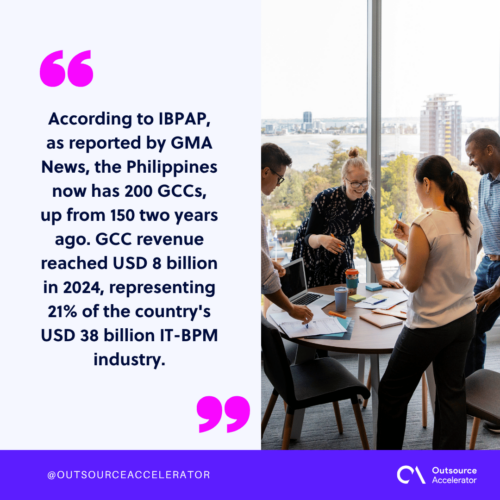
According to IBPAP, as reported by GMA News, the Philippines now has 200 GCCs, up from 150 two years ago. GCC revenue reached USD 8 billion in 2024, representing 21% of the country’s USD 38 billion IT-BPM industry.
IBPAP projects 10% further growth in 2025, with the global GCC market on track to reach USD 155 billion by 2027.
Three factors drive multinational GCC investment to the Philippines over other markets in the region:
- Deep talent pipeline: 800,000+ graduates annually with strong representation in IT, engineering, finance, and healthcare, covering the functions most commonly moved into GCC structures
- PEZA incentives: Companies operating in PEZA-registered locations access income tax holidays and VAT exemptions. GCC clients housed in PEZA-accredited buildings can access those benefits through their workspace provider’s registration, without filing separately.
- English proficiency at scale: The Philippines ranks consistently among the top English-proficient countries in Asia, with a workforce oriented toward Western business processes and management norms
Pro Tip: GCC expansion is moving beyond BGC and Makati. IBPAP reports growth in provincial locations including Cebu and Clark, where operational costs are lower and talent competition is less intense than in Metro Manila’s central business districts. Providers with multi-city portfolios give companies more flexibility as headcount grows.
Using EOR as your GCC entry point
For multinationals that want to move fast, entity incorporation is not the right first step. SEC registration, BIR and LGU permitting, and mandatory employer registrations across SSS, PhilHealth, and Pag-IBIG take six to ten weeks before any hire is legally possible.
An employer of record collapses that timeline to days or two weeks. The EOR is the registered legal employer. The parent manages all operations, controls deliverables, and owns all IP, formalized through a service agreement with an explicit IP assignment clause.
| Entity Incorporation | EOR Entry | |
|---|---|---|
| Time to first hire | 6 to 10 weeks | Days to 2 weeks |
| Registration burden | SEC, BIR, LGU, SSS, PhilHealth, Pag-IBIG | None (handled by EOR) |
| Parent’s operational control | Full | Full |
| IP ownership | Parent company | Parent company (via contract) |
| Upfront capital requirement | Applies for foreign-owned entities | None |
EOR works well as the starting structure for GCC programs still validating the market and the function. As the GCC scales, some multinationals move to entity incorporation. Others run long-term through the EOR structure, adding workspace, IT, and HR services to build a full-function capability center.
Pro Tip: IP ownership is the most common concern from multinationals considering EOR entry for GCC staffing. IP assignment clauses transferring all work product to the parent are standard in EOR contracts and enforceable under Philippine law. Confirm the clause is explicit in the service agreement before signing.
What full GCC staffing requires beyond the EOR
A legal employer wrapper solves the compliance problem. It does not solve the operational one.
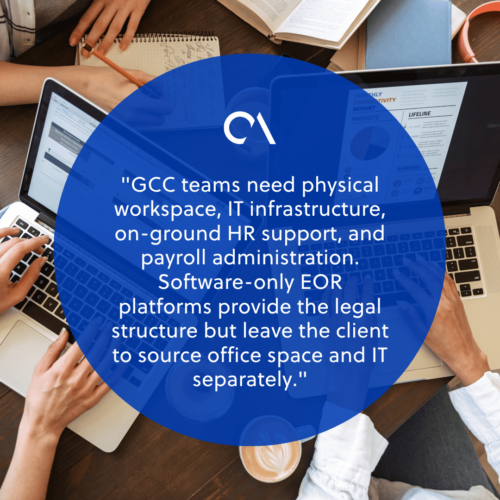
GCC teams need physical workspace, IT infrastructure, on-ground HR support, and payroll administration. Software-only EOR platforms provide the legal structure but leave the client to source office space and IT separately.
That creates a coordination problem: multiple vendors, multiple contracts, no single operational owner.
A full-stack GCC provider integrates all of it. The parent focuses on hiring decisions and team output. The provider handles the rest: workspace, IT, HR, payroll, statutory compliance, and facilities management under one engagement.
Pro Tip: When evaluating full-stack GCC providers, ask which workspace locations carry PEZA accreditation and whether your business activity qualifies for fiscal incentives under that accreditation. Not all PEZA-registered buildings cover the same activity categories, and qualification depends on both the building’s registration and the tenant’s specific function.
How KMC Solutions builds Global Capability Centers
KMC Solutions’ GCC services bring together the talent, employment, infrastructure, and operational support companies need to establish and scale Global Capability Centers in the Philippines. KMC combines recruitment, HR, payroll, compliance, workspace, IT infrastructure, and ongoing operational support under one integrated model.
- Talent acquisition and retention: KMC recruits across the Philippines’ 800,000+ annual graduate pipeline, with an 86% employee retention rate across 7,000+ placed professionals, backed by HR Asia recognition for workplace excellence and B Corp certification for employment standards
- 36 locations and 25,000+ seats: enterprise workspace across major Philippine business hubs, including BGC, Makati, Ortigas, Quezon City, Clark, and Cebu, with additional operations in Bogotá and Medellín
- PEZA-accredited locations: selected KMC offices, including Picadilly Star in BGC and One Ayala East Tower in Makati, are in PEZA-accredited buildings; eligible companies may pursue PEZA registration and applicable incentives depending on their business activity and qualification
- Human-First, Full-Stack EOR: legal employment, payroll, statutory benefits, HR, workspace, and IT infrastructure under one relationship, reducing the need to coordinate multiple providers
- Build-to-Suit GCC environments: enterprise clients can create dedicated, branded workspaces designed around their operational, technology, security, and employee requirements
- Enterprise-grade security and compliance: ISO 27001 and ISO 9001 certified, with processes designed to support data privacy, security, and GDPR- and HIPAA-aligned operations
Companies ready to build a GCC in the Philippines can connect with KMC Solutions to scope a full-stack engagement across staffing, employment, workspace, and operational support.
Key takeaways
- Entity incorporation in the Philippines requires registration across multiple agencies and typically takes six to ten weeks before the first hire; an employer of record provides a legal employment structure in days or two weeks without those requirements
- According to Colliers’ September 2026 research, the Philippines is home to approximately 200 GCCs employing around 270,000 professionals and is now recognized as the world’s second-largest GCC delivery location after India
- Building a full GCC requires more than a legal employer: workspace, IT infrastructure, HR, payroll, compliance, and operational support need to work together under one engagement to avoid fragmented vendor management
- KMC Solutions supports GCC implementation through its Human-First EOR model, combining talent acquisition, employment, payroll, compliance, IT infrastructure, and workspace across its network of 36 office locations, with an 86% employee retention rate and B Corp certification






 Independent





