
A summary of the GDP per capita around the world


What is GDP per capita around the world?
GDP per capita around the world measures a country’s total output divided by its population, and it works as a quick gauge of average income and living standards.
- You find it by dividing a country’s GDP by its population size.
- High figures often point to strong economies and better living standards.
- Small nations can still rank high when their economies perform well.
GDP per capita is a common measure of a country’s wealth. It also hints at the living standards and economic health of its people. Groups like the International Monetary Fund (IMF) and the World Bank prepare these figures. In this article, we explain how GDP per capita is worked out. We also look at the numbers per country around the world.
GDP per capita definition
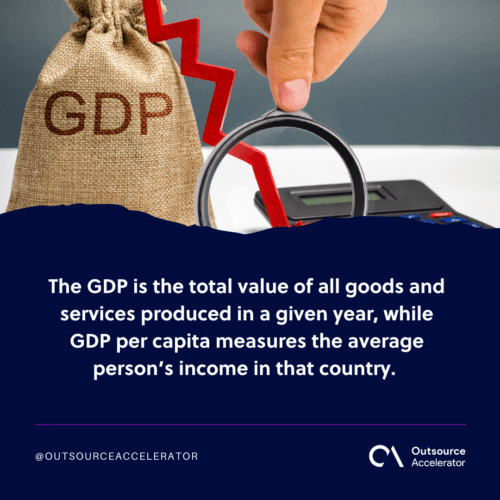
GDP per capita equals a country’s gross domestic product divided by its population. The GDP is the total value of all goods and services made in a year. So GDP per capita shows the average person’s income in that country.
In addition, gross national product (GNP) can add net income from abroad to the total GDP. Analysts then divide that sum by the local population to get GNP per capita.
A country’s GDP per capita depends on both economic output and population size. So a small country can post a high GDP per capita if its economy performs well.
People often use GDP per capita as a sign of living standards. In general, the higher the GDP per capita, the higher the expected quality of life. Still, it is not always accurate. For example, the real cost of living can shift the picture in each country.
The United Nations uses GDP per capita in its Division for Sustainable Development. It sits under the Department of Economic and Social Affairs. So the figure acts as a basic growth indicator. It reflects changes in the total output of goods and services.
The UN also links it to other indicators, such as:
- Population growth
- Net migration
- Land use change
- Arable land per capita
- Forest area
- Other GDP indicators
All of these support the UN’s goal to speed up sustainable development. As a result, GDP per capita rarely stands alone.
Calculating GDP per capita
The most common way to find GDP per capita is simple. You divide the total GDP by the population size:
GDP per capita = Gross domestic product / Population size
Countries with the highest GDP per capita
Below are the top five countries with the highest GDP per capita around the world. Except for Qatar, all sit in Europe.
| Countries with the highest GDP per capita* | ||
| GDP per capita | Population | |
| Luxembourg | 133,590.15 USD | 640,064 |
| Ireland | 100,172.08 USD | 5.033 million |
| Switzerland | 91,991.60 USD | 8.703 million |
| Norway | 89,154.28 USD | 5.408 million |
| Qatar | 66,838.36 USD | 2.688 million |
*All GDP per capita and population figures are taken from the World Bank’s 2021 records.
Luxembourg
Luxembourg sits at the heart of Europe. It borders Belgium, France, and Germany. These three are also its main trading partners.
Its government is stable and efficient. So it offers citizens one of the highest living standards in Europe. A large share of wealth funds top housing, healthcare, and education.
The country is a well-known tax haven. It offers very low tax rates, mostly to foreign businesses. As a result, it hosts major firms like Skype and Amazon. That inflow is one of the clear benefits of globalization. In addition, finance is the biggest driver of its GDP per capita, and it is a hub for private banking.
Ireland
Ireland has long held a high GDP per capita and a strong economy. Its growth has often outpaced its European neighbors by a wide margin.
The 2008 financial crisis hit the country hard. So it made deep reforms to public-sector wages and banking. As a result, it regained fiscal health and lifted employment. Its GDP per capita then nearly doubled.
Ireland is also one of the world’s largest corporate tax havens. So it has become a go-to base for global firms like Apple and Microsoft.
Switzerland
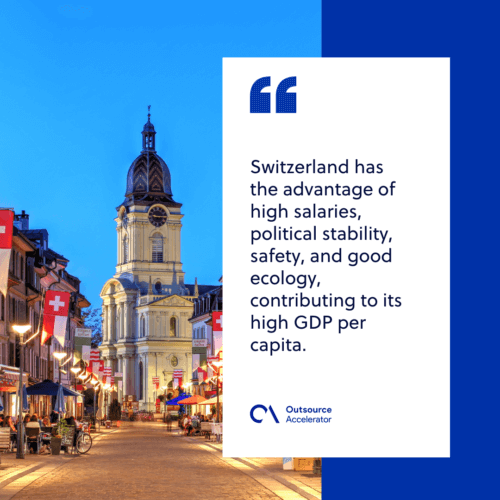
Switzerland enjoys high salaries, political stability, safety, and a clean environment. All of these lift its GDP per capita.
More than 70% of its GDP comes from the service sector. Average Swiss wealth is also very high. However, that average is skewed by a small group that owns billions in assets.
Norway
Norway is Western Europe’s top petroleum producer. Since large offshore reserves were found in the late 1960s, oil has fueled about 30% of the economy.
Norway is also one of the few high-GDP countries that is not a tax haven. Should trouble strike, it can draw on its huge sovereign fund, one of the largest in the world.
Qatar
Qatar holds the highest GDP per capita of any Arab nation. The World Bank has called it one of the fastest-growing economies.
Unlike countries that rely mainly on foreign investment, Qatar has vast natural resources. These include massive reserves of hydrocarbons. In addition, its leaders keep building non-primary sectors like telecom and IT.
Countries with the lowest GDP per capita
Below are the top five countries with the lowest GDP per capita around the world. Most rely on agriculture, and all sit on the African continent.
| Countries with the lowest GDP per capita* | ||
| GDP per capita | Population | |
| Burundi | 221.48 USD | 12.55 million |
| Central African Republic | 461.14 USD | 5.457 million |
| Sierra Leone | 480.04 USD | 8.421 million |
| Madagascar | 500.51 USD | 28.92 million |
| Malawi | 634.84 USD | 19.89 million |
*All GDP per capita and population figures are taken from the World Bank’s 2021 records.
Burundi
Burundi holds the lowest GDP per capita in the world. With 442 people per square kilometer, it is also very densely populated.
About 80% of the population works in farming. The main exports are coffee and tea. However, those earnings swing with weather and world prices.
Several weaknesses keep its GDP per capita low, namely:
- Low governmental capacity
- Corruption
- High poverty rate
- Poor educational levels
- Weak legal system
- Poor transportation network
- Overburdened utilities
Together, these factors have blocked planned economic reforms.
Central African Republic
The Central African Republic has a weak central government. Armed groups operate freely and control large areas of land.
Along with a low GDP per capita, CAR is the only nation the Global Hunger Index lists with “extremely alarming” hunger levels. It is rich in gold, oil, uranium, and diamonds. Still, most citizens remain poor.
Sierra Leone
Sierra Leone suffered a long civil war until 2002. Then an Ebola epidemic in the mid-2010s disrupted jobs and trade.
Its economy relies on a narrow export base of base metals, wood, diamonds, and cocoa. Poor governance and tight fiscal space add more strain. Farming is also very exposed to climate change. So GDP per capita stays low.
Madagascar
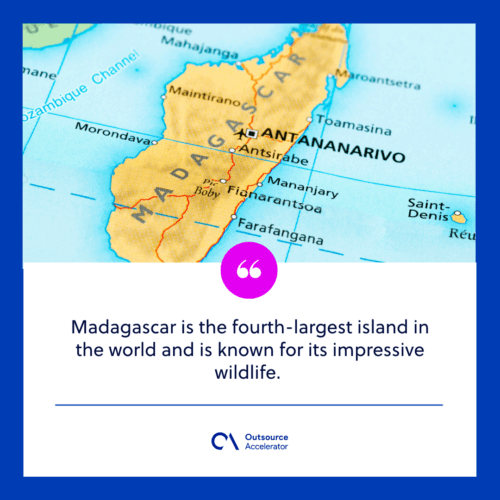
Madagascar is the fourth-largest island in the world. It is famous for its wildlife. Still, a weak tourism sector has not lifted the country out of poverty.
Its heavy reliance on farming brings risk from weather disasters. Economic shocks have also triggered sharp recessions. So to raise its GDP per capita, Madagascar must improve education, healthcare, and the environment.
Malawi
Malawi leans on subsistence farming and one cash crop: tobacco. This narrow base limits its economy and GDP per capita. In fact, 71.9% of total employment is in farming.
Living standards may be improving in cities. However, food insecurity in rural areas stays very high. High public debt also crowds out private investment, and power blackouts disrupt business.
The gap between rich and poor nations is wide. Still, services can help lift developing economies. For example, many countries grow their income through outsourcing to the Philippines. Local pay and the cost of living in top offshoring destinations also shape how far each dollar goes.
Frequently asked questions
What is GDP per capita?
GDP per capita is a country’s total output divided by its population. So it shows the average income per person. People often use it to compare living standards between countries.
How is GDP per capita calculated?
You divide the gross domestic product by the population size. The result is a per-person figure. Because of this, small countries with strong economies can rank very high.
Which country has the highest GDP per capita?
Luxembourg leads the list in the World Bank data above. Ireland, Switzerland, and Norway follow. Qatar is the only non-European nation in the top five.
Is GDP per capita the same as standard of living?
Not exactly. GDP per capita hints at living standards, but it is not a perfect match. For example, high living costs or wide wealth gaps can skew the picture.
Why do some countries have a very low GDP per capita?
Many face weak governance, conflict, or heavy reliance on farming. Poor infrastructure and limited education add more strain. As a result, their per-person output stays low.






 Independent





