
Financial reporting challenges in the US and how to fix them


This article is a submission by Fusion Business Solution (P) Ltd.-FBSPL. Fusion Business Solution (P) Ltd. (FBSPL) is a Udaipur, India-based company providing Business Process Outsourcing, management, consulting, and IT services, with operations in New York, USA.
Financial reporting is the backbone of business transparency, compliance, and decision-making. Yet, for many organizations, especially in the US, the process is far from seamless.
Complex regulations, fragmented data systems, and manual workflows create persistent financial reporting challenges that slow down operations and increase risk.
In today’s fast-moving business environment, finance leaders are not just asking what went wrong; they’re asking how to fix it.
This article explores the most pressing financial reporting challenges in the US and provides practical, technology-driven solutions for overcoming them, including the growing role of AI in financial reporting.
The state of financial reporting in the US
US financial reporting operates under some of the most rigorous and evolving compliance frameworks in the world.
Organizations must align with Generally Accepted Accounting Principles (GAAP), meet Securities and Exchange Commission (SEC) disclosure requirements, adhere to Sarbanes‑Oxley (SOX) internal control mandates, and prepare for emerging regulatory expectations such as climate and ESG reporting.
These regulations are critical for transparency and investor confidence, but they also introduce significant complexity. Beyond compliance, organizations are expected to provide increasingly granular insights into financial performance; something that traditional manual processes struggle to deliver.
At the same time, the pace of business has accelerated. Finance teams are pressured to deliver faster, more dynamic reporting; from monthly closes to real‑time dashboards; without sacrificing accuracy or compliance.
But in many US companies, outdated systems, siloed data, and legacy workflows are blocking progress. Organizational data often resides in disparate platforms (ERP systems, billing, payroll, CRM, and spreadsheets), making consolidation slow and error‑prone.
The gap between what regulators and stakeholders expect and the realities of existing systems and processes has widened. Finance leaders recognize this disconnect and are increasingly investing in technology and process transformation; yet significant challenges remain.
In response, forward‑thinking organizations are modernizing with automation, AI, and integrated reporting platforms to improve speed, accuracy, and compliance.
7 key challenges in the US reporting process
Below are the most persistent barriers that slow down reporting performance, erode trust, and increase operational risk.
1. Manual processes and spreadsheet dependency
Many organizations still rely on spreadsheets and manual workflows to manage reports. While these methods are familiar, they are prone to human error and difficult to scale.
Teams often spend excessive time on data entry and reconciliation, which slows down the reporting process and limits productivity.
2. Data silos and poor data quality
Financial data is often spread across multiple systems that do not integrate well. This creates silos, leading to inconsistent and duplicated data.
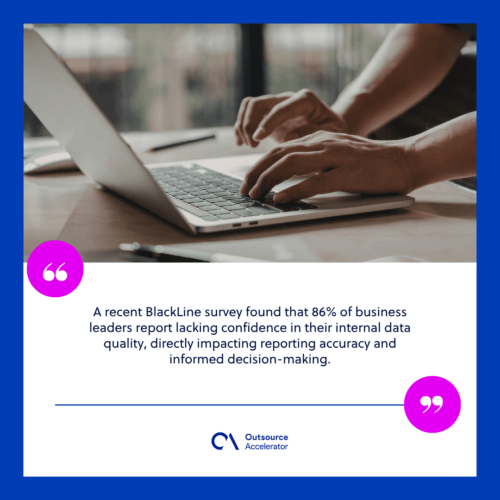
A recent BlackLine survey found that 86% of business leaders report lacking confidence in their internal data quality, directly impacting reporting accuracy and informed decision-making.
As a result, reports become unreliable, making it harder for stakeholders to trust the numbers and make informed decisions.
3. Regulatory complexity in the US
US compliance requirements, including GAAP, SEC regulations, and tax laws, are constantly evolving. Managing these requirements is time-consuming and complex.
For global companies, this challenge expands into overcoming the challenges of global financial reporting, where multiple regulatory frameworks must be handled simultaneously.
4. Lack of real-time visibility
Traditional reporting cycles typically provide insights on a monthly or quarterly basis. This delay prevents organizations from accessing up-to-date information, making it difficult to respond quickly to financial changes or risks.
5. Talent shortage and skill gaps
There is a growing need for professionals who understand both accounting practices and modern technologies.
However, many organizations struggle to find and retain such talent, resulting in slower processes and increased pressure on existing teams.
6. Poor cross-department collaboration
Reporting depends on data from multiple departments, but lack of coordination often leads to delays and inconsistencies. Misaligned inputs can disrupt the Reporting Process and affect overall accuracy.
7. Security and data privacy risks
Handling sensitive financial data comes with significant risks. Weak controls, limited monitoring, or human errors can expose organizations to breaches, penalties, and reputational damage.
How to fix these challenges
Effective solutions should not only eliminate the problem but strengthen reporting accuracy, speed, and strategic value.
1. Automate the reporting process
Automation helps eliminate manual tasks such as data entry and reconciliation. By streamlining workflows, organizations can improve accuracy, speed up reporting cycles, and allow teams to focus on analysis rather than repetitive work.
2. Implement integrated systems
Connecting financial and operational systems into a unified platform removes data silos.
A single source of truth ensures consistency, simplifies data consolidation, and improves the reliability of reports.
3. Strengthen compliance management
Organizations should adopt proactive compliance strategies using tools that provide real-time regulatory updates and automated documentation. This reduces risks and simplifies audits, especially when dealing with complex US requirements.
4. Adopt real-time reporting tools
Implementing real-time dashboards and continuous accounting systems enables access to live financial data.
This improves decision-making speed and allows businesses to respond quickly to changing conditions.
5. Upskill teams and leverage AI
Investing in training helps teams adapt to modern tools, including AI in financial reporting. AI-powered solutions simplify complex tasks, improve accuracy, and enhance efficiency, making it easier to handle increasing workloads.
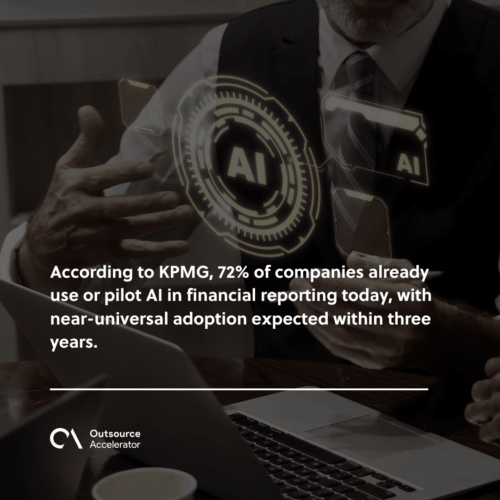
According to KPMG, 72% of companies already use or pilot AI in financial reporting today, with near-universal adoption expected within three years.
6. Improve cross-functional collaboration
Using shared platforms and standardized workflows improves coordination between departments. This ensures timely data collection and more accurate reporting outcomes.
7. Strengthen security measures
Organizations should implement strong access controls, encryption, and continuous monitoring systems. Regular audits and automated alerts help protect sensitive data and ensure compliance with regulations.
Role of AI in overcoming financial reporting challenges
For multinational companies, Overcoming the Challenges of Global Financial Reporting requires advanced capabilities beyond traditional tools.
AI plays a crucial role by:
- Standardizing data across regions
- Automating currency conversions and consolidations
- Ensuring compliance with multiple regulatory frameworks
- Enhancing forecasting accuracy
By integrating AI tools in insurance and finance functions, organizations can streamline global reporting while maintaining compliance and accuracy.
Building a future-ready financial reporting strategy
To succeed in modern US financial reporting, organizations must move beyond reactive processes and adopt a proactive, technology-driven approach.
Key priorities include:
- Embracing insurance automation and financial automation tools
- Investing in scalable systems
- Embedding AI into core financial workflows
- Creating a culture of continuous improvement
Financial Reporting is no longer just a compliance function; it is a strategic driver of business performance.
Turning reporting challenges into a strategic advantage
Financial reporting challenges in the US are complex but not insurmountable. From manual inefficiencies and data silos to regulatory pressures and talent shortages, these issues can significantly impact business performance.
However, by focusing on automation, integration, and AI in financial reporting, organizations can transform their reporting process into a competitive advantage. Overcoming financial reporting challenges is not just about fixing inefficiencies; it’s about building a smarter, faster, and more resilient finance function.
In an era where data drives decisions, mastering financial reporting is no longer optional; it’s essential for sustainable growth and long-term success.






 Independent





