
A practical guide to finance automation outsourcing

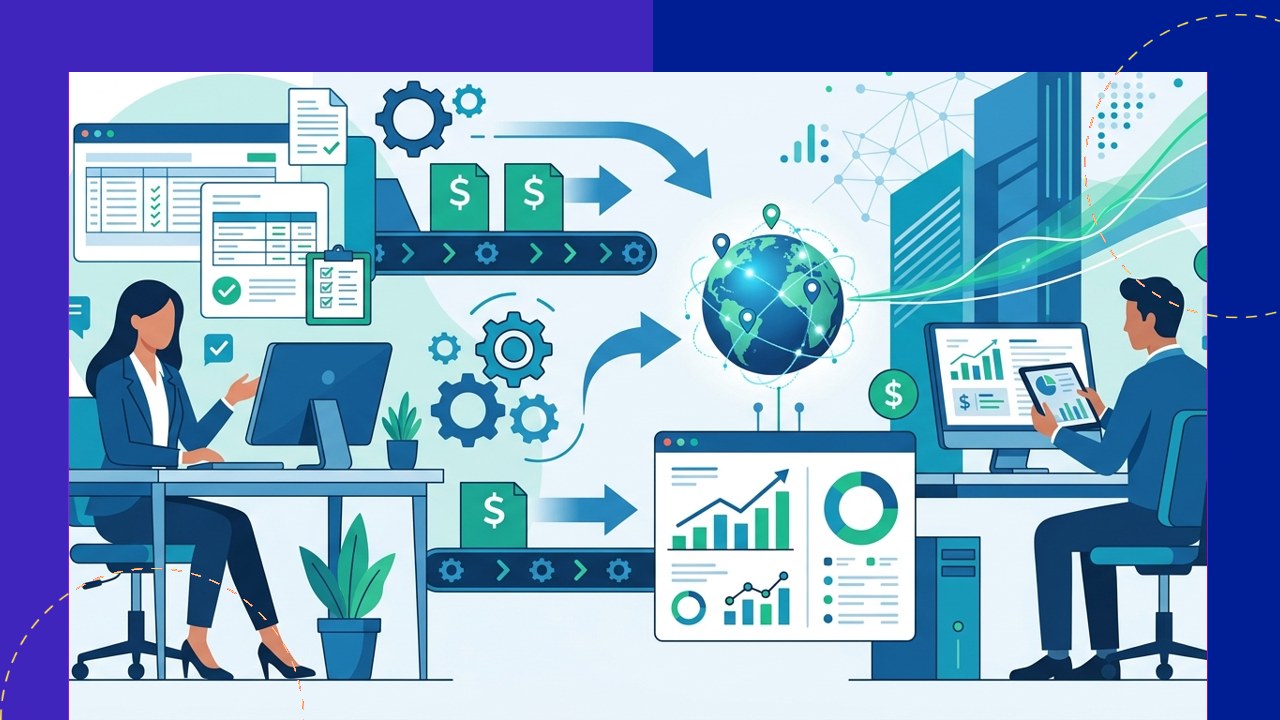
- Finance automation outsourcing pairs automated finance workflows with an offshore or third-party team so routine work runs faster and cheaper.
- Common scope includes accounts payable, accounts receivable, reconciliations, reporting, and payroll, with clear controls kept in-house.
- Choosing a partner comes down to security, system fit, and a staged rollout rather than lifting and shifting everything at once.
Finance automation outsourcing is the practice of combining automated finance workflows with an external team that runs them for you, usually offshore. Instead of only hiring people to do repetitive tasks, you pair software that handles data entry, matching, and routing with specialists who manage the exceptions and the judgment calls.
The result is a finance operation that costs less to run, moves faster at month-end, and scales without a linear increase in headcount. This guide covers what the model includes, where the benefits come from, how to vet a partner, and a practical path to get started without losing control of your books.
What finance automation outsourcing actually means
Two things happen at once. First, standard finance processes are digitized so that invoices, receipts, and transactions flow through software with fewer manual touches. Second, a provider supplies the trained staff who operate, monitor, and correct those workflows day to day.
This differs from simply buying an accounting tool or hiring an offshore bookkeeper. The value comes from doing both together, so automation removes the grind and people handle the cases that need review. For background, see this overview of how finance and accounting outsourcing works.
What gets covered
Most engagements start with high-volume, rules-based work because that is where automation pays off fastest. Higher-judgment tasks can follow once the basics are stable.
Accounts payable and receivable
Invoice capture, three-way matching, approval routing, and payment scheduling on the payable side. On the receivable side, invoicing, payment application, and collections follow-ups. These are the highest-volume flows in most companies.
Reconciliations and reporting
Bank, credit card, and ledger reconciliations run on a schedule, with the team clearing breaks. Reporting covers monthly close packs, management dashboards, and variance notes so leaders get numbers on time.
Payroll and compliance support
Payroll processing, timesheet checks, and statutory filings can be managed alongside the core ledger. For a fuller list, review these types of finance and accounting services you can outsource.
The benefits
The case rests on four practical gains rather than any single silver bullet.
Cost. Offshore labor rates plus automation reduce the cost per transaction, often meaningfully, because you pay less per hour and need fewer hours per task.
Speed. Automated routing and offshore coverage compress close cycles and shorten invoice turnaround, so month-end stops being a scramble.
Accuracy. Machine matching and validation cut manual keying errors, and a second team reviewing exceptions adds a checkpoint that a lone in-house bookkeeper cannot.
Scalability. Volume spikes at year-end or during a growth phase are absorbed by the provider without a hiring cycle on your side. Finance is consistently the most common function moved into shared and outsourced delivery, a pattern reflected in Deloitte’s Global Shared Services and Outsourcing Survey, which tracks how finance teams adopt automation and analytics to cut cost and standardize processes.
In-house automated finance vs outsourced automated finance
Automating in-house and outsourcing an already-automated process both work. The right choice depends on your scale, budget, and appetite to manage the operation directly.
| Factor | In-house automated finance | Outsourced automated finance |
|---|---|---|
| Upfront cost | Software, setup, and hiring paid by you | Bundled into a monthly fee |
| Speed to launch | Slower; you build and staff it | Faster; provider brings tools and people |
| Ongoing cost | Local salaries plus licenses | Offshore rates plus shared tooling |
| Scalability | Limited by your hiring pace | Flexes with the provider’s bench |
| Control | Full and direct | Shared; governed by contract and SLAs |
How to choose a partner
Look past the sales deck at three things that predict whether the engagement holds up.
Security and controls
Ask how they protect financial data, who can approve payments, and how duties are separated. Certifications such as SOC 2 and ISO 27001 are reasonable baselines to request.
System and process fit
Confirm they work fluently in your accounting platform and can integrate with your bank and ERP. A partner that forces a tool switch on day one adds risk you do not need.
Team quality and reporting
Check the qualifications of the people assigned, not just the company. Agree on service levels, error thresholds, and a regular reporting cadence before you sign.
Security and controls to keep in-house
Automation and outsourcing do not remove your accountability for the numbers. Segregation of duties matters more, not less, when a third party touches your ledger. Keep final payment approvals, banking credentials, and access provisioning under your control.
Public companies operate under formal requirements here. Under the Sarbanes-Oxley Act, Section 404 requires management to assess and report on internal control over financial reporting, a standard worth borrowing even if you are private. Document who does what, and keep an audit trail that shows each automated step and each human sign-off.
A practical implementation path
1. Map and standardize
Document your current AP, AR, close, and payroll processes. Fix obvious inefficiencies first, because automating a messy process just makes the mess faster.
2. Start with a pilot
Move one high-volume process, usually accounts payable, into the automated and outsourced model. Run it in parallel until the numbers match your own for a full cycle.
3. Set controls and SLAs
Lock in approval limits, reconciliation deadlines, and error thresholds. Define what gets escalated to your team and how fast.
4. Expand and review
Add receivables, reconciliations, and reporting once the pilot is stable. Review performance quarterly and adjust scope as volumes grow.
Frequently asked questions
Is finance automation outsourcing only for large companies?
No. Small and mid-sized firms often benefit most, because they gain automation and specialist staff they could not justify hiring on their own. The monthly-fee model spreads cost that would otherwise be a large upfront investment.
Will I lose visibility into my finances?
Not if the engagement is set up well. Cloud accounting platforms and shared dashboards give you real-time access, and a good provider reports on agreed metrics. You keep the final approvals and the source-of-truth systems.
What should stay in-house?
Strategic decisions, final payment authorization, banking access, and financial planning generally stay with you. The model is best at running repeatable transactional work, not at replacing your finance leadership.
How long does it take to see results?
A single-process pilot can show cost and speed gains within one to two close cycles. Broader benefits accrue over the first few quarters as more processes move over.
Key takeaways
- Finance automation outsourcing combines automated workflows with an external team, so routine finance work runs faster, cheaper, and more accurately.
- Scope typically covers AP, AR, reconciliations, reporting, and payroll, starting with high-volume transactional tasks.
- Keep payment approvals, banking access, and controls in-house, and hold providers to security standards and clear SLAs.
- Start with one pilot process, prove it in parallel, then expand as confidence and volume grow.






 Independent





