
Department of Trade and Industry (DTI)


What is the Department of Trade and Industry (DTI)?
The Department of Trade and Industry (DTI) is the Philippine government’s main agency for trade, industry, and investment.
- It promotes and regulates business activity across the country.
- It backs the IT-BPM sector, a top driver of the economy.
- It also protects consumer rights and helps create jobs.
Trade once thrived in public markets, then in commercial centers and malls. Today, many of the busiest trade hubs run online. So businesses now range from local to global, and most move at high speed.
The information technology and business process management (IT-BPM) industry was an early winner online. Over the years, Filipino workers built a strong brand for skill, warmth, and quick adaptability. Building the bridges between IT-BPM firms and their Filipino teams is the Department of Trade and Industry.
About DTI
The Department of Trade and Industry, or DTI, is the government’s main arm for trade, industry, and investment. In short, it coordinates, promotes, and regulates these activities.
It is also the parent agency of many offices. For example, these include the Intellectual Property Office of the Philippines (IPOPHL), National Development Company (NDC), Philippine Economic Zone Authority (PEZA), the Philippine International Trading Corporation (PITC), Philippine Pharma Procurement Incorporated (PPPI), and the Construction Industry Authority of the Philippines (CIAP). In addition, the Board of Investments (BOI), Regional Operations Group (ROG), Small Business Corporation (SBC Corp.), Center for International Trade Expositions and Missions (CITEM), Design Center of the Philippines (DCP), and Philippine Trade Training Center (PTTC) are part of it too.

DTI’s pledge to the nation is simple: “enabling business, empowering consumers.” A new spirit came with the digital age and the Electronic Commerce Act (ECA), or Republic Act No. 8792, signed into law on June 14, 2000.
R.A. 8792 gave legal weight to electronic data, documents, signatures, and transactions. It also set penalties for piracy, hacking, and access without consent.
Section 29 of the law gave DTI the power to promote e-commerce in the Philippines. So it works with other agencies to guide this growth. As a result, this law helped spark the rise of the business process outsourcing (BPO) sector, now known as IT-BPM.
What does DTI Philippines do?
The Department of Trade and Industry builds an innovative and competitive industry and services sector. In turn, this creates jobs and drives inclusive growth. It also advances consumer rights and duties.
Continuing trends of growth
The IT-BPM sector is a key part of the country’s edge in both voice and non-voice work. So DTI has long backed the industry with full support.
In 2017, then-DTI Secretary Ramon Lopez pledged that support in a keynote to the IT and Business Process Association of the Philippines (IBPAP). At the time, he noted the Philippines was growing at more than twice the global rate.
That momentum has held up well. According to IBPAP, the IT-BPM industry earned about USD 38 billion and employed 1.82 million people in 2024. By 2025, revenue reached roughly USD 40 billion with 1.9 million jobs. As a result, the sector now accounts for more than 8 percent of the country’s GDP.
The goals keep rising too. Under the IBPAP roadmap, the industry aims for USD 59 billion in revenue and 2.5 million jobs by 2028. So DTI continues to push for new investment and more skilled roles.
Wide opportunities in the industry
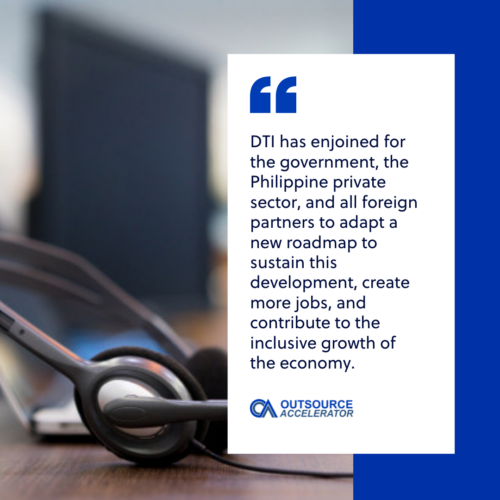
DTI has always worked closely with IBPAP on the IT-BPM’s industry initiatives. These initiatives focus on a few clear action areas.
- First, they widen and deepen human capital through public-private partnerships.
- Next, they promote the Philippines as a strong investment destination.
- Then they lead cross-sector efforts to hit industry roadmap goals.
- Finally, they build the Philippine IT-BPM brand around the world.
DTI has also raised IT-BPM in future regional business plans across ASEAN. For example, it once chaired the ASEAN Economic Ministers and the Committee on Business and Investment Promotion.
The agency has also backed young entrepreneurs in the region. So it has supported networks in IT, outsourcing, fintech, food, agriculture, logistics, and startups. In this way, DTI helps new regional talent grow.
A future we can keep up with
DTI keeps doing its part for the IT-BPM industry and its stakeholders. Its roadmaps aim to expand the country’s market share. They also push for more complex, higher-value IT-BPM work.
While DTI and Filipino workers unite to improve trade, this is your chance to invest. The country’s homegrown talent is ready to fill the gaps that foreign firms face.
Filipino workers are also in the right setting to keep up with fast tech change. So it is a good time to enter the Philippine market for IT-BPM.
Recent years have seen strong growth in the sector. More importantly, new pathways keep opening to trade hubs and global firms. As a result, the industry looks set to prosper in the years to come.
Frequently asked questions about the Department of Trade and Industry
What is the role of the Department of Trade and Industry?
DTI is the government’s main body for trade, industry, and investment. So it promotes and regulates business across the country. It also protects consumers and helps create jobs.
How does DTI support the IT-BPM sector?
DTI works with IBPAP to grow the industry. For example, it backs skills training, investment drives, and global branding. As a result, the sector keeps expanding.
What agencies fall under DTI?
Many offices sit under DTI. For example, these include PEZA, the Board of Investments, and IPOPHL. Each one supports a part of trade and industry.
How big is the Philippine IT-BPM industry today?
The sector earned about USD 40 billion in 2025, per IBPAP. It also employed around 1.9 million people. So it remains a top driver of the economy.
Key takeaways
- The Department of Trade and Industry leads Philippine trade, industry, and investment.
- It oversees many agencies, including PEZA, the BOI, and IPOPHL.
- R.A. 8792 gave DTI the power to promote e-commerce and helped launch the BPO boom.
- The IT-BPM sector earned about USD 40 billion in 2025 and employed 1.9 million people.
- DTI keeps backing the industry toward its USD 59 billion goal by 2028.






 Independent





