
Track & measure service excellence: Top 20 customer service KPI


What is a customer service KPI?
A customer service KPI is a measure that shows how well a team serves its customers, such as response time, resolution rate, and satisfaction. In short, these numbers tell you if your support is working. So businesses use them to track, compare, and improve service.
- KPIs measure the speed and quality of each customer interaction.
- They cover inbound support, outbound sales, and staff engagement.
- They help firms spot gaps and fix them fast.
What is KPI in customer service?
Key performance indicators (KPIs) help you measure how well a business performs. So they cover many areas, such as finance, product quality, and marketing.
Business process outsourcing firms also use them to gauge service quality. In short, they track how well they serve customers in support roles.
Call centers use standard customer service KPIs on every call. So they measure the quality of each one.
However, businesses should know these numbers too. So here are a few reasons why.
Performance monitoring
One reason to outsource customer service is to improve support. So businesses should watch their call center‘s performance through the customer service KPI. Firms weighing outsourcing customer service should track these numbers closely.
Leading providers like SupportYourApp value this level of transparency. They offer dedicated teams and technical skills. As a result, businesses can track and beat their service goals with ease.
Budget tracking
Budget tracking matters too. This is true whether you hire call centers on-demand or by the month.
KPIs help agents measure service by tracking the average call time for each customer. In addition, they flag any extra charges you incur.
Process improvement
Tracking the customer service KPI helps agents improve their team’s process. So the whole support flow gets better over time.
Streamline calls, simplify steps, and define the product well. As a result, your team solves customer issues in less time.
Call centers use many KPIs across industries and settings. Still, businesses should pick only what fits their operations.
The role of customer service teams
Customer service teams play a key role in any business. So they shape how customers see the brand.
They are the face of the company. In short, they give customers the support they need to decide and to trust the brand.
They offer timely replies and accurate details. As a result, they resolve issues and build a positive image.
Good teams are vital for solid support and loyalty. So they help keep customers coming back.
A dedicated team can lift a company’s reputation. In addition, it creates loyal customers who return for future purchases.
They give the first response to complaints and questions across many channels. As a result, they help keep a strong customer satisfaction score. They can also spot weak spots and share feedback with the company.
Customer service metrics
Customer service metrics are vital to any business. So they offer clear insight into satisfaction, loyalty, and the customer experience.
By tracking these metrics, companies can find weak areas. As a result, they can make changes that keep customers happy.
- Average resolution time. This shows where to improve. So it helps you resolve issues quickly and well.
- Customer effort score. Firms can make changes so customers spend less effort to fix an issue.
- Customer satisfaction KPI. This measures how happy customers are with the service. So you can track it through surveys, feedback, and ratings.
20 important customer service KPIs
Below are some of the most important customer service KPIs your business should measure.
Inbound customer service KPIs
Firms measure how well inbound customer and technical support teams perform. So they use the following indicators to gauge the length and quality of calls.
1. First response time
Quality service should be quick. So call centers measure first response time to see how fast an agent replies.
An issue need not be solved right away to count here. According to a study, customers want a fast first reply, even before a fix.
In short, customers just need to know an agent is on it. So a quick reply helps them feel cared for.
2. Average speed of answer
Calls are also measured by how fast an agent picks up. So this is a key speed metric.
The average speed of answer (ASA) shows the team’s efficiency and access. However, it can be hard to read.
You compute ASA as total wait time over total answered calls. Per industry norms, ASA should be about 28 seconds. So an agent should not be too quick or too slow.
3. First call resolution
First call resolution shows how well an agent solves an issue on the first call. So it aims to stop repeat calls, transfers, and escalations.
When customers call, a note reminds them that calls are recorded for quality. As a result, teams can review and learn.
You measure it as the share of issues solved on the first call over all resolved issues in a period.
4. Average handling time
Average handling time (AHT) measures the work an agent does during and after a call. So it captures the full effort per call.
A call may include answer speed, transfers, hold, and escalation. Unlike average call duration, AHT leaves out ring and queue time. However, abandoned calls and wrap time still affect it.
5. Escalation rate
Sometimes an agent cannot solve an issue at first. So the call moves to a team that can help.
Escalation rate measures escalated calls over total calls in a period.
Escalation happens when an agent lacks the knowledge or when a customer asks for it. So measuring it helps cut these cases and lift service.
6. Inbound abandon rate
Abandon rate refers to calls a customer drops before the task is done. So it points to friction in the flow.
For inbound service, a customer may hang up while on hold or mid-task. Waiting times largely affect a call. The longer they wait, the less satisfied they feel. As a result, they drop the call.
7. Average call transfer rate
The average call transfer rate tracks how often an agent transfers a call to fix an issue.
In some cases, transfers are fine. For example, they help when the team acts as a virtual reception. Meanwhile, some calls need a different department. For instance, invoice questions should go to finance.
8. Customer satisfaction rate
Customer satisfaction rate (CSAT) is the most popular way to measure service. So many teams start here.
It shows how happy customers are, if agents helped well, and if issues got solved. In short, CSAT directly affects retention.
When you meet or beat expectations, scores rise. As a result, you build loyalty and positive word of mouth. Call centers use scaled ratings and simple yes-or-no forms. Nowadays, many also ask for feedback on what to improve. To go deeper, learn how to measure customer satisfaction.
9. Net promoter score
The net promoter score (NPS) is often tied to CSAT. So it shows how likely a customer is to refer their agent to others.
NPS reflects the agent’s attitude, professionalism, and courtesy. An agent’s score runs from 1 to 10, split into three groups:
- Promoters (9-10)
- Passives (7-8)
- Detractors (0-6)
Most firms add this to a staff file. As a result, it counts toward a performance review. To compare the two, read this guide on CSAT vs NPS.
10. SERVQUAL (service + quality)
A moniker of “service” and “quality,” SERVQUAL measures overall quality against customer expectations. So it gives a broad view. SERVQUAL rests on five elements:
- Reliability. How consistent the team was in keeping its promise. So it checks if they met or beat the service given.
- Assurance. How the team builds trust through its knowledge and quick replies.
- Tangibles. The look of the company. For example, its office, staff, and equipment.
- Empathy. How agents reach out to each customer’s needs.
- Responsiveness. How willing the team is to help and to solve concerns.
Outbound customer service KPIs
Outbound KPIs work much like their inbound peers. However, some rely on unique factors tied to sales and lead generation quotas. So here are the key outbound KPIs to measure.
11. Customer retention rate
New customers cost more than keeping current ones. So businesses should watch how many customers stay over time.
Customer retention rate tracks how many customers stay loyal. As a result, it strengthens the bond between customer and company. Now, the questions are:
- Do customers sign up for updates?
- Do they keep subscribing to the company’s services?
- How many are happy with what they get?
These are a few traits this indicator checks. In short, it highlights the value of great service. A high rate points to happy, loyal customers. So it reflects the skill and care of your reps. For more ideas, see these customer retention strategies.
12. Conversion rate
Conversion rate tracks leads that convert over total leads in a period. So it matters most for outbound lead generation.
This KPI follows the ‘sales funnel’ method. For example, of 1,000 leads a month, 500 show interest, 250 sign up, and 100 close a sale. As a percentage, that gives the team’s conversion rate.
13. First call close
Like first call resolution, first call close (FCC) counts sales made on a customer’s first call. So it rewards fast wins.
FCC applies to both new and current customers reached through lead generation. Closing on the first call is hard. However, each success shows a strong outbound team.
14. Calls per agent
Most outbound teams have a quota. So each agent’s calls get measured too.
Calls per agent shows the number of calls and engagements per agent. In addition, it flags whether they help customers or stay idle. As a result, you can judge productivity with ease.
15. Calls per account
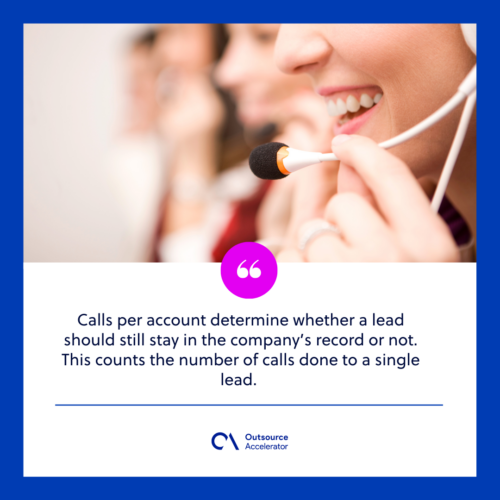
Calls per account shows if a lead should stay in the record. So it counts calls made to a single lead.
The more they drop calls or reject offers, the more likely they leave the list. In short, they show little interest in the service.
16. Cost per call
A part of cost-benefit analyses, cost per call shows the amount needed to run the team over total outbound calls. So it helps control costs in outbound centers.
17. Outbound abandon rate
Outbound abandon rate looks at leads who pick up but drop the transaction before a sales deal closes. So it measures interest and satisfaction in a deal.
18. On-call rate
The on-call rate ties in with calls per agent. So both track an agent’s average call time. It shows the average time an agent spends on calls versus the gaps between them.
In-between activities may include notes, transactions, and idle time. Like calls per agent, the on-call rate shows an agent’s efficiency, which may include hold time.
19. Call quality analysis
Call quality analysis works like inbound CSAT. So it shows the satisfaction of a customer during a call.
Does an agent sound warm or harsh? Do they share accurate details? Are the deals convincing? These are a few of its checks.
Employee satisfaction
An agent’s work often mirrors the care they get from management. In short, the better they are treated, the better they serve. So measuring employee satisfaction matters.
20. Employee engagement
Employees are the internal customers of the company. So they need care too. To serve clients well, the business and its BPO partner must look after them.
Employee engagement shows how a staff member takes part in a call or task. This covers their view of the work, the pay, and their work environment.
In the end, a happy support team gives its best. As a result, the firm keeps its customers satisfied. For a wider view, explore these key call center metrics.
Frequently asked questions about customer service KPIs
What is the most important customer service KPI?
It depends on your goals. However, CSAT and first call resolution rank high for most teams. So they show both happiness and speed.
How many customer service KPIs should a team track?
There is no fixed number. Instead, pick only the KPIs that fit your operations. As a result, you avoid data overload and stay focused.
What is the difference between inbound and outbound KPIs?
Inbound KPIs measure support calls, such as response and resolution time. Outbound KPIs measure sales work, such as conversion and first call close.
Why do KPIs matter for outsourced customer service?
They keep an outside team accountable. So you can track quality, cost, and speed. As a result, you get clear proof of value.
Key takeaways
- A customer service KPI measures the speed and quality of service.
- Inbound KPIs track support, while outbound KPIs track sales.
- CSAT, NPS, and first call resolution are core metrics to watch.
- Pick only the KPIs that fit your team and goals.
- Happy agents drive happy customers, so track engagement too.






 Independent





